
 E-Paper



It’s wrong to divide India into North and South, say Ram Darbar symposium panellists
Author Ami Ganatra said people from North-East India to Gandhara and from North to South participated in the Mahabharata war.

 Prefer HTon Google


It is wrong to divide India into North and South, said panelists comprising journalists and authors on the first day of the two-day symposium ‘Ram Darbar’ organised by Shri Guru Vashishtha Trust at a hotel in Lucknow on Saturday.
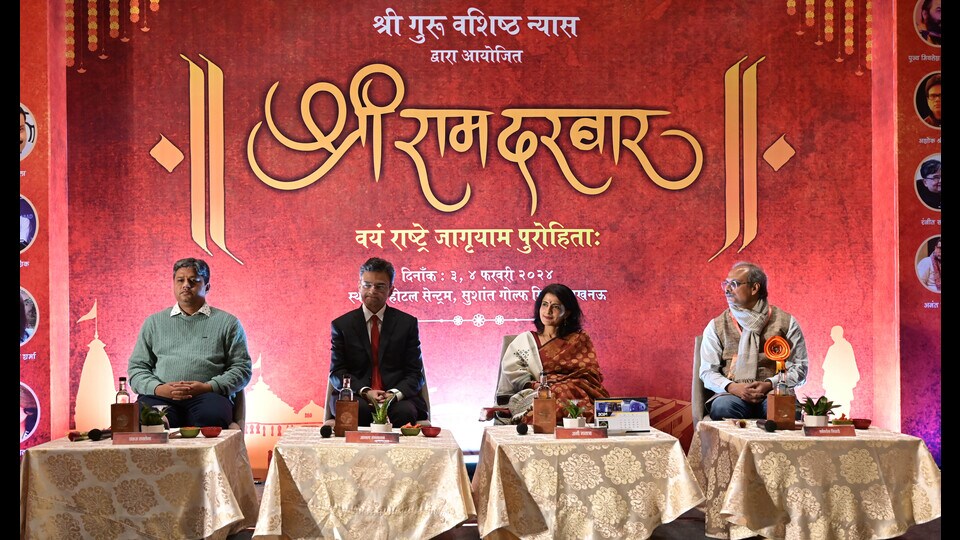
The main speakers included author Anand Ranganathan, journalists Harshvardhan Tripathi, Ashok Srivastava and TV anchor Richa Anirudh among others.
“India was not formed in 1947, but it is a cultural and geographical structure formed thousands of years ago. Those who believe that India was formed in 1947 want to break it into 600 pieces,” said Professor Anand Ranganathan of Jawaharlal Nehru University, Delhi.
Currently, Rahul Gandhi is an opposition leader and he will remain so till 2047, he said.
“Under his leadership, people will continue to do politics of division. The MPs of his own party are continuously trying to divide India into North and South. They did not even spare Ram. It is an authentic fact that there are more places named after Ram in South India than in the North. Ram is present in every corner of India,” Ranganathan said in a session titled Bharatiya Yatra Santi.
Author Ami Ganatra said people from North-East India to Gandhara and from North to South participated in the Mahabharata war.
“Arjun’s marriage took place in Manipur, Duryodhana’s marriage took place in Kalinga. People had marital and political relations from North to South. That is why it was called Mahabharata because people from all over India remained connected here. Therefore, one can say that India is not a Union of States but it is a complete nation in itself,” she added.
“There are different cultures and dialects in the country but the temples of Sanatan Dharma connect the whole of India together,” said Pankaj Saxena who has written books on Hindu temples.
In Kerala, there are temples not only of Lord Ram but also of Lakshman, Bharat and Shatrughan, Saxena added.
The first session was followed by one titled “Where women are worshipped” by Shefali Vaidya, a writer, Swati Goyal Sharma, a journalist and Vivek Kaushik. It was moderated by Richa Anirudh who hailed the importance of women in Hinduism.
There was also a session “Conspiracy to portray media as villain.”
“I don’t find the media being declared as a villain. There is a positive side to it as one will be extra careful and responsible in putting up information,” said Ashok Srivatava.
Day one concluded with the session “Savarkar Ka Bharat Bharaman” by Ranjit Savarkar and others.


