
 E-Paper



Most durable rocks will be used for Ram Lalla idol, says Trust member
All the rocks that have reached Ayodhya have religious signifiance, even those not selected will be preserved, says VHP leader


The Shri Ram Janmabhoomi Teerth Kshetra Trust has zeroed in on rocks from Nepal, Karnataka and Odisha as options for chiselling Ram Lalla’s idol for the sanctum sanctorum of the under-construction Ram temple in Ayodhya.
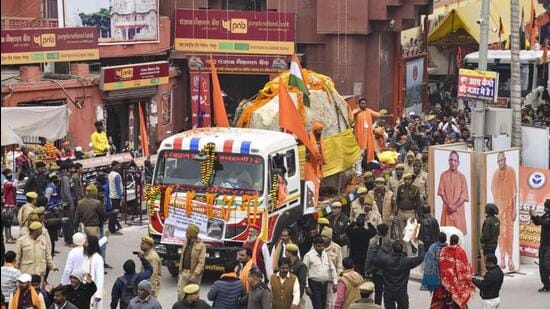
Rocks from Nepal and Mysore in Karnataka have already reached Ayodhya. The Trust has kept them safely at Ram Sewakpuram. Soon, a boulder from Odisha will also reach Ayodhya.
From these options, the Trust will use the most durable rocks for chiselling the Ram Lalla idol.
“Only the best rock will be selected for Ram Lalla’s idol for sanctum sanctorum of the Ram Mandir after testing through a scientific process,” said a member of the Trust.
The most durable rock that has a long life will be selected, he added.
“We have to make sure that Ram Lalla’s idol remains as it is for ages and that there is no impact of weather nor corrosion of the idol,” he said.
Senior Vishva Hindu Parishad (VHP) leader Rajendra Singh ‘Pankaj’ said all rocks reaching Ayodhya have religious significance for the Trust.
Even the rocks not used for Ram Lalla’s idol will be preserved, he added.
Initial suggestions by experts indicated the rock from Nepal is best suited for Ram Lalla’s idol, said a senior member of the Trust.
Earlier, people associated with the selection process in Nepal wanted the Trust to return these rocks, if not used for the idol in Ayodhya’s Ram temple.
“The Trust has the right to select the rock it wants for Ram Lalla’s idol. But if they are not using these rocks (from river Gandak), they must return it. We will put them at the place from where they were lifted,” asserted Kulraj Chalise, who has done PhD on Shaligram rocks of Shree Krishnagandaki river in Nepal. He was associated with the rock selection process and thereafter transporting the two boulders to Ayodhya.
“The Mahant of Janaki Mandir in Janakpur (Nepal) and all others associated with the selection process want the Trust to return the two rocks, if these are not used for Ram Lalla’s idol,” claimed Chalise.
For its part, the Trust has roped in renowned sculptors for selecting the rock and preparing Ram Lalla’s idol.
Sudarshan Sahu, a Padma Vibhushan awardee, Vasudev Kamath of Odisha, KV Maniya of Karnataka and Shashtrayajya Deulkar of Pune are members of the committee which, along with other experts, will finalise the rock and prepare two-three models of Ram Lalla’s idol. The Trust will then select one of the models. The Trust has also decided to install a statue depicting the childhood of the deity.
The Trust began searching for the rocks for Ram Lalla’s idol in 2020.
After much deliberation, the Trust had decided to procure rocks from Nepal’s Gandaki river in the Muktinath area of the Himalayan nation.
Former Nepal deputy prime minister Bimalendra Nidhi completed all legal formalities on behalf of the Trust. Nidhi had engaged geologists for selecting rocks.
According to the Trust, the former Nepalese deputy PM had also played a crucial role in passing the proposal for handover of the rocks to the Trust in the cabinet meeting of the then government in Nepal.
According to Champat Rai, general secretary of the Trust, the idol will be around 8.5 feet high so that the sun’s rays can fall on it.
The Trust has consulted top institutes of the country with expertise in architecture and building design to model the Ram temple sanctum sanctorum in such a way that the sun’s rays fall on the forehead of Ram Lalla every Ram Navami at 12 noon to celebrate the birth of the deity, Rai added.
A team of experts from the CSIR-CBRI of Roorkee, the Inter-University Centre for Astronomy and Astrophysics, Pune, and eminent temple architects has been constituted for the purpose.Celebrations in Ayodhya for the grand opening of the Ram temple will begin in December and end with the installation of the Ram Lalla idol at the sanctum sanctorum of the temple on Makar Sankranti on January 14 or 15, 2024.


