
 E-Paper



Candy blue Metro 3 coaches begin trial run; new govt signals intent
Fadnavis called the Metro 3 route an important lifeline for Mumbai. The service will have nine trains in its fleet eventually

 Prefer HTon Google


Mumbai The candy aqua metro zoomed towards the underground tunnel kick-starting the Metro 3 trial run on Tuesday morning. Chief minister Eknath Shinde and deputy chief minister Devendra Fadnavis were at hand to flag off the much-awaited trial of the Colaba-Bandra-Seepz Line, Mumbai first underground metro line.
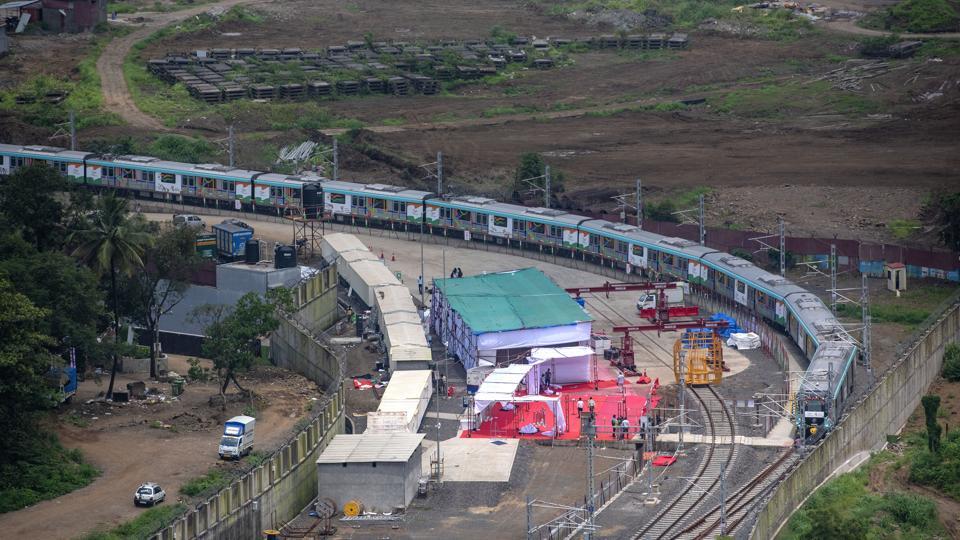
Fadnavis called the Metro 3 route an important lifeline for Mumbai. The service will have nine trains in its fleet eventually.
The Metro 3 coaches are slightly broader than the existing metro coaches, and the aqua colour scheme of the outside is reflected inside as well. A broad strip of aqua on the top corners and along the end of the coaches radiates a soothing effect. The AC vents are situated on both sides of the handle strips that reach out to passengers seated and standing as well on either side. Graphics commemorating India’s 75th year of independence are painted on the outside.
Deputy chief minister Fadnavis said the metro would greatly help decongest Mumbai’s roads given than an estimated 17 lakh people are expected to use the metro every day. This would, he said, lead to seven lakh private vehicles getting off the roads and reducing around 2.5 lakh tonnes of carbon emissions. Within 80 days of the entire track getting operational, the amount of carbon emissions that Metro 3 will save is equivalent to the carbon dioxide that the trees (that have been cut for building the car shed) would have absorbed in their entire lifetime, said Fadnavis, perhaps with an eye on the protestors outside the venue.
The coaches are 3200 mm wide and each can accommodate approximately 2400 passengers. “The aqua line of the metro portrays the marine culture and the importance the sea has for Mumbai, said Ashwini Bhide, managing director of MMRC. The small tweaks to the new coaches have been made keeping in mind that this is an undergound metro service. The trial encompasses a 10,000 km-run, and is likely to finish in two months, added Bhide.
“Irrespective of the decision to shift the car shed to Kanjurmarg, it was essential to have some kind of infrastructure available at Aarey as well. The ramp also had to be built for testing, as Kanjurmarg is a marshy land and it would have taken two more years for land stabilisation and this would have escalated the cost of the metro,” said chief minister Eknath Shinde. That escalation, Fadnavis said, would have led to cost escalation of ticket prices too.
The trial includes running the coaches up to the maximum permissible speed of the train. By the time these trials finish, the crossover facility to change the tracks between up and down lines will be ready at Sahar Road station where the final will take place. This will include a 5km long stretch of track till Sahar Road station. But before that happens, the depot facilities need to be in place.
“The delay in getting the coaches to Mumbai happened as there was no designated space to assemble the coaches and conduct these tests. We had to set up a temporary facility at Aarey and build the track to conduct these tests,” added Bhide.
Once the crossover tracks are ready, the existing prototype train will be shifted to the down line and a new set of coaches will come from Sri City in Andhra Pradesh for testing and trials. “As the entire depot is not ready, we are making do with the part of the tunnel which is ready for the trials. We will have nine more trains that will arrive over time and then the existing trains will be diverted to the other tracks,” said Bhide.
The 33.5-km-long Colaba-Bandra-Seepz Metro-3 project is the first underground corridor of the metro network coming up in the city. Of the 27 stations on this line, 26 will be underground.
This Metro line is funded by Japan International Cooperation Agency. High-voltage charging (25 KV AC daily) of the eight coaches of the prototype train began on August 15. After receiving the eight coaches from Sri City, a battery-operated rail-cum-road shunter connected the first eight-car prototype train at the train delivery and testing track area in Sariput Nagar, Aarey.
Both CM Shinde and deputy Fadnavis used the occasion to attack Uddhav Thackeray’s government for politicising a developmental project. “It is my opinion that the metro car shed issue was more political than environmental in nature. Mumbaikars are breathing polluted air (owing to the cars),” remarked Fadnavis, adding that there was no ego issue attached to the metro as far as he was concerned.
“We have given a signal that no one can stop this metro from running,” said Fadnavis. As per the original timeline, the Metro would have been operationalised on the entire stretch by March 2023, he pointed out, but the controversy and the stay on the car shed work meant that only half of the stretch will be running by December next year.
Speaking at the event, Shinde said they had taken the decision to relocate the car shed to Aarey to give an impetus to the long-pending project. “The project will help strike an ecological balance,” he added. “(The car shed site) is surrounded by roads at three sides. It is not as if we are going to the jungle and chopping down trees… the courts have accepted this considering the larger interests of the people.”
The decision to develop the car shed for the 33.5 km Metro 3 project at the Aarey milk colony, which is one of the city’s last surviving green areas, has been mired in controversy right from 2014 when it was first mooted by the then Congress-NCP government.


