
 E-Paper



First-ever record of green sea turtles nesting in Maharashtra
Green sea turtle is classified as ‘endangered’ by the International Union for the Conservation of Nature. The species is also protected under Schedule 1 of the Indian Wildlife Act (1972)


Mumbai: On Saturday, March 5, 74 green sea turtle hatchlings emerged from a nest at Devgad-Tarkarli beach in Sindhudurg district under the supervision of volunteers working with the forest department’s Mangrove Foundation. Green sea turtle is classified as ‘endangered’ by the International Union for the Conservation of Nature. The species is also protected under Schedule 1 of the Indian Wildlife Act (1972).
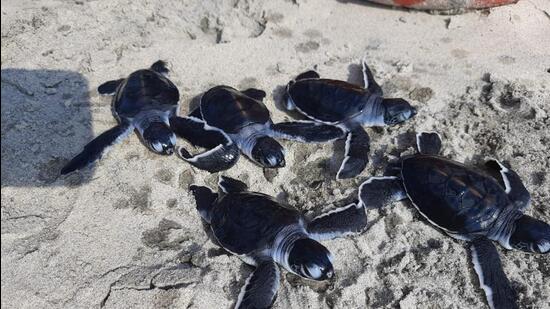
This is the first time in recorded history that a green sea turtle has nested on the Maharashtra coast, though frequent sightings have been reported by fisherfolk in the near shore waters of the state.
Volunteers discovered the nest earlier this year, on January 5, and have since been waiting keenly to watch hatchlings emerge. By 4pm, all 74 hatchlings which emerged from the nest had swum off into the sea.
“We are conserving this nest in situ, so the eggs were not transferred to a hatchery. Out of 77 eggs, only three failed to hatch,” said Harshal Karve, a marine biologist working with the Mangrove Foundation, an autonomous body founded by the state forest department.
There are four types of sea turtles seen in Maharashtra (green sea turtle, hawksbill turtle, leatherback turtle and Olive Ridley turtles), of which Olive Ridleys are the only ones which have been seen to nest in the state.
“This is an exciting find. Perhaps long-ago Maharashtra was also home to nesting populations of other species. We will continue monitoring the beaches for signs of other green sea turtle nests, and are looking forward to seeing if this phenomenon occurs again in the future. At the moment it’s too early to say anything conclusive,” said Karve.
As per data with the state forest department’s mangrove cell, sea turtles are commonly caught-and-released by fishermen, as per a state government scheme which encourages fishers to release protected marine animals that may inadvertently find themselves trapped in fishing nets. In fact, last month, a fisherman from Haji Ali’s Lotus Jetty caught and released a juvenile green sea turtle just off the Coastal Road construction site in Worli.
In just over three years since the scheme’s inception, 138 Olive Ridleys have been caught-and-released, followed by 67 green sea turtles, five hawksbill turtles and two leatherback turtles. These numbers mirror the species’ population distributions in the state.
BOX
All you need to know about green turtles
Green turtles are the largest of all the hard-shelled sea turtles, but have a comparatively smaller head. Occasionally referred to as black sea turtles, the hatchlings are just 2 inches (50 mm) in length.
Green turtles nest on large, open beaches, small coves covered with sea grasses, or in areas where seaweeds are found. The species is also known to prefer nesting on island beaches mainly, the beaches of tropical and subtropical areas near continental coasts and around islands; for instance, the Lakshadweep Islands in India.
They are primarily seen in the Atlantic Ocean, Gulf of Mexico, Argentina, in the Mediterranean Sea and Indo-Pacific. Systematic harvesting of eggs and adults on nesting beaches and juveniles and adults on feeding grounds over the years has taken a heavy toll on the species. With changing fishing patterns, incidental capture in fishing gear, especially gillnets, trawls, traps and pots, longlines and dredges, is a serious threat which prevents species’ recovery.
A large number of green turtles used to be captured in the waters of the Gulf of Mannar and off the coast of Tamil Nadu until the Wildlife Protection Act was enforced in 1972.
Until very recently, it was held that adult green turtles are unique among sea turtles as they are herbivorous, feeding primarily on sea grasses and algae. This diet was thought to have given them greenish coloured fat. Recent reports, however, suggest that during the mysterious “missing years” (from the time hatchlings leave their nesting beaches to when adults return to lay eggs), they have been seen to feed on small crustaceans and jellyfish. But as they move towards the shores there is a dramatic change in their diet and they feed only on sea grasses and algae.
Source: Sea Turtles of India
Stay updated with all the Breaking News and Latest News from Mumbai. Click here for comprehensive coverage of top Cities including Bengaluru, Delhi, Hyderabad, and more across India along with Stay informed on the latest happenings in World News.


