
 E-Paper



From flunking math to advising bizmen: Rise and fall of rape-accused ‘godman’
The Special Investigation Team (SIT) that’s probing Kharat found that he had scored 28 out of 100 in his Class 10 math paper

 Prefer HTon Google


There is a striking paradox at the heart of the Ashok Kharat story. The 67-year-old self-styled ‘astrologer-godman’ from Nashik now being probed by the Fadnavis government for rape and extortion, failed math in Class 10 board exam but earned his stripes as a numerologist who advised thousands—including Maharashtra’s top politicians-- on how to run their business, personal and political affairs.
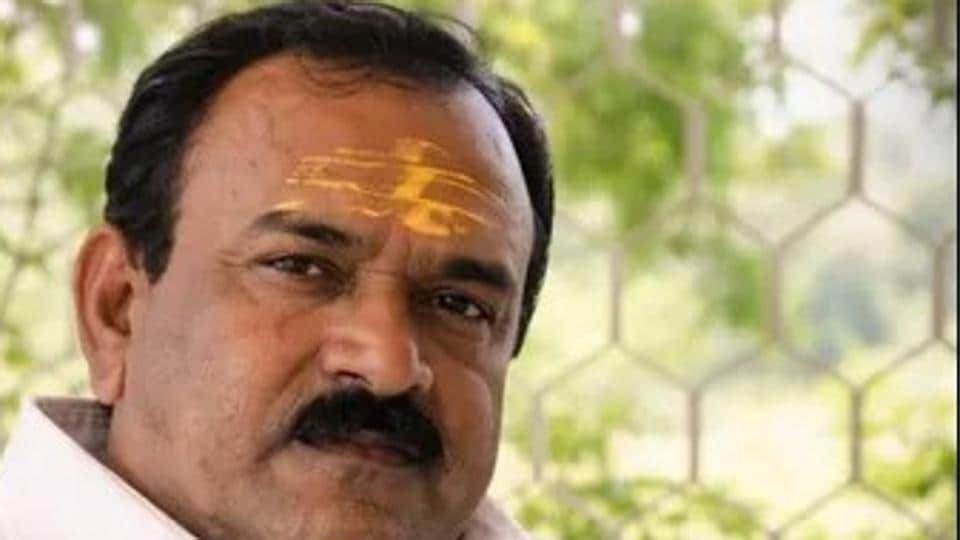
The Special Investigation Team (SIT) that’s probing Kharat—not just the cases against him but veritably his whole history—found that the numerologist had scored 28 out of 100 in his Class 10 math paper.
Kharat, against whom there have been 8 complaints of rape, sexual assault and cheating and extortion in the last 10 days, was born Laxman Kharat in Kahandelwadi village in Nashik district. His early life was marred by controversy when it was alleged that he had sexually assaulted one of his relatives, resulting in his excommunication from the village, said a senior officer with Nashik police.
Following his excommunication, Kharat went to West Bengal, and from there to Thailand. He worked as a sailor on some cargo vessels and later styled himself as ‘Captain Kharat.’ Investigators told HT they found no records showing he was a ranked officer in the merchant navy, instead, they believe he may have worked as an unlicensed crew member on ships. Yet, this stint became a key part of his narrative in later life— a way to show off his global exposure and add to his authoritativeness.
When Kharat returned to Nashik in the mid-1990s, the town itself was in the midst of a commercial and real estate boom. Kharat set himself up with a new name—Ashok Kumar--and a new profession. “He became an astrologer and numerologist who also performed small rituals. Among his key clientele were people involved in complicated real estate deals,” said a senior officer of Nashik police which first filed the rape FIR against Kharat before the probe was handed over to the SIT by IPS officer Tejaswi Satpute.
What set Kharat apart was not any proven knowledge but his modus operandi replete with theatrics. At the Mahadev temple in Mirgaon situated on his land, certain rituals would be staged in a controlled environment. Lights would be switched off and clients would be asked to close their eyes while the room would resound with the sound of hissing snakes with Kharat claiming that Mahadev himself had acknowledged the client’s prayers.
By the late noughties Kharat’s clientele expanded to include influential businessmen and politicians across the political spectrum. His services were no longer limited to simple consultations. He began prescribing elaborate rituals which required repeated consultations and significant financial expenditure. “His consultation fees could go up to ₹50 lakh,” said an officer from the SIT. “He understood psychology very well,” another senior police officer said. “He knew when to reassure, when to instil fear, and when to demand money.”
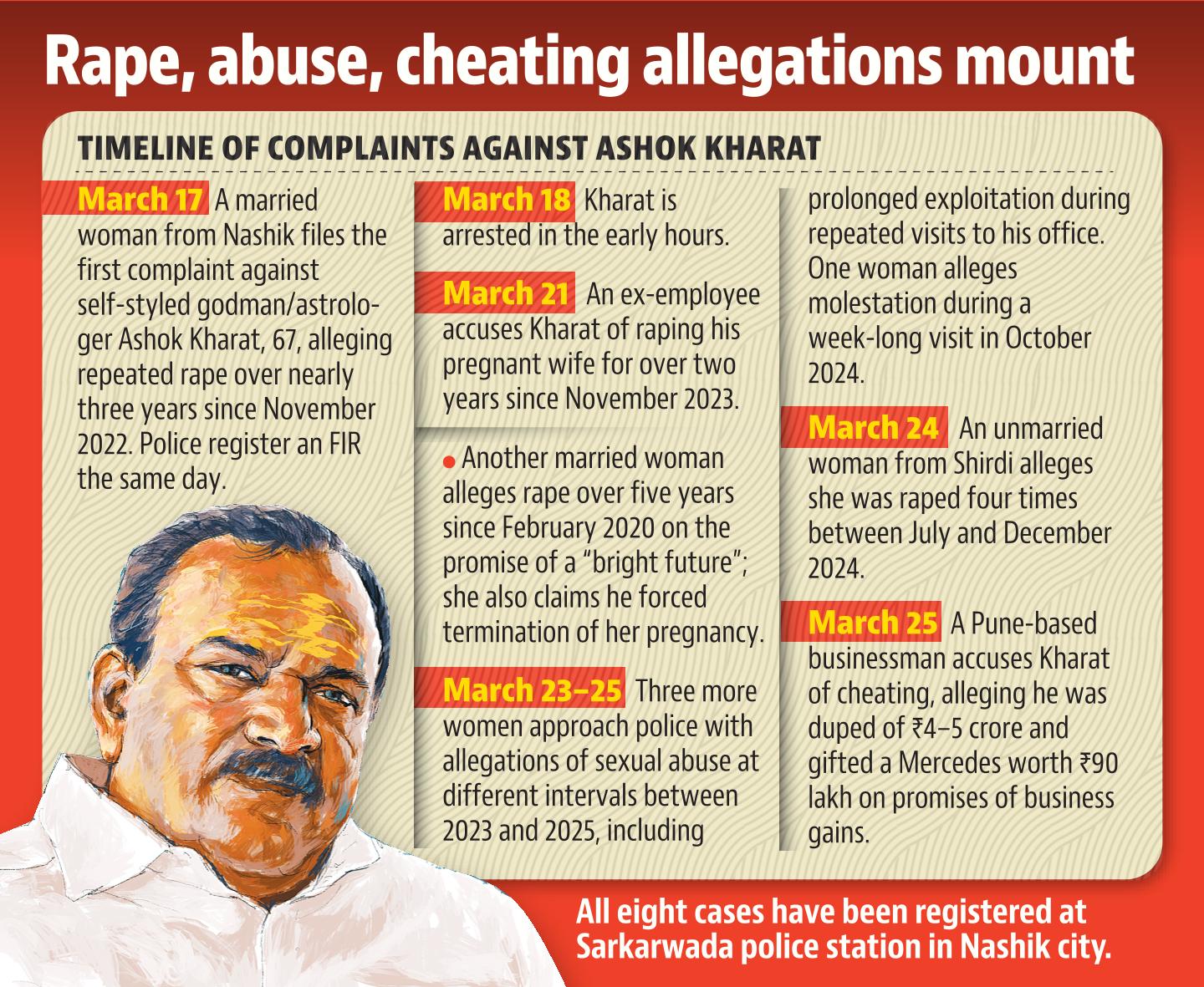
Pune realtor Rajendra Asud who filed an FIR against Kharat on Wednesday, told the SIT that a friend had introduced him to Kharat, assuring him that the godman’s rituals would help improve his business fortunes. Instead, what followed was years of financial drain. “I was in touch with him since 2018 and spent over ₹4 to 5 crore,” the businessman told investigators. “Each time I wanted to escape his hold over me, he would say that my life was in danger.”
The businessman alleged that in addition to large cash transactions, he transferred ownership of a Mercedes car worth around ₹90 lakh to Kharat. The relationship, he said, extended beyond consultations. Kharat allegedly insisted on foreign trips as part of “remedies,” and the two men travelled to ten foreign locales, including in the US.
When the promised results failed to materialise, Asud tried to distance himself. “He told me he had divine powers and could kill me if I did not listen to him,” he said in his FIR. It was only after Kharat’s arrest became public that Asud found the courage to approach the police.
Also Read: Monday Musings: Politics, faith and the comfort of godmen
If Asud’s allegations point to extortionate behaviour, the testimonies of women complainants reveal an even more troubling predatoriness.
What started as a single complaint has now expanded into a multi-layered investigation, with at least eight FIRs registered against the self-styled godman filed between March 17 and March 26. Of these, six are from women alleging rape and sexual abuse. One of these is from his former office staffer who has accused Kharat of raping his pregnant wife.
The staffer alleged that in March 2024, Kharat sexually assaulted his seven-month pregnant wife when she visited him for guidance related to childbirth. The assistant, who had waited outside during the session, later conducted a sting operation after his wife told him about the assault. The clips he recorded were handed over to the police, triggering further scrutiny.
In another case registered on March 24, a woman from Shirdi has alleged that Kharat raped her four times between July and December 2024. According to her complaint, she had first met Kharat in 2021 along with her parents, seeking advice on constructing a house. She returned in 2024 to seek guidance from him about her career prospects.
During one of these visits, she alleged, Kharat asked her parents to wait outside and then sexually assaulted her inside his chamber. She further claimed that he threatened her with dire consequences if she spoke out, saying he could harm her family or even cause her parents’ deaths using his “divine powers.”
The intimidation did not end there. The woman told the police that in December 2024, she received an obscene video clip involving Kharat and herself from an unknown number. When she confronted Kharat, he dismissed the clip as an AI-generated video, and advised her to file a complaint against the sender.
She told investigators she found the courage to complain against Kharat after his arrest in another rape case filed on March 17 in which he was accused of raping a Nashik-based married woman over three years from November 2022 to 2025. For investigators, these accounts are not just individual allegations but pieces of a larger puzzle. “The pattern is consistent — build trust, isolate the victim, use fear, and then exploit them,” said an officer associated with the probe. “In many cases, the victims were hesitant to come forward because they believed in his powers or feared repercussions.” The SIT is also investigating multiple videos of sexual assault in circulation involving Kharat and different women, and encouraging survivors to step forward to complain without fear.
The fear, police believe, was amplified by Kharat’s perceived proximity to influential individuals, including politicians across parties.
Earlier this week, NCP leader and former chairperson at State Women’s Rights Commission Rupali Chakankar was asked to resign over her proximity to Kharat and his Trust. Others known to the self-styled godman are deputy chief minister Eknath Shinde, higher education minister and BJP leader Chandrakant Patil, and Shiv Sena MLA Deepak Kesarkar.
While there is no evidence so far to suggest wrongdoing by these political figures, Kharat’s proximity to them has added another layer to the unfolding story — highlighting how deeply he had embedded himself within circles of influence.
In 2009, Kharat bought land at Mirgaon outside Nashik that became central to his operations. He built a Shiva temple there and over time acquired 30 acres around it and built a farmhouse where his influential clients could come and meet him.
“He never really interacted with villagers much,” said Sunil Hinje, a former deputy sarpanch who relinquished office in 2026. “He would come on weekends. His visitors were mostly outsiders — wealthy clients, people in expensive cars, and occasionally politicians.”
The reversal
If Ashok Kharat’s story is about how a man built an aura around himself, it is also about how that carefully constructed edifice began to crack.
A sitting MLA, speaking on condition of anonymity, admitted to having consulted Kharat in the past. “I had met him a few times and even sought advice about my political future,” said the lawmaker from Shiv Sena. “But I had no idea about these allegations. Had I known about them, I would have never gone to him.”
Manikrao Kokate, former minister and NCP lawmaker from Sinnar under which Kharat’s Mirgaon village falls, is more direct, suggesting that Kharat’s ability to operate for years points to a larger systemic failure. “He could not have continued like this without the support or protection of some officials and police personnel.”
So how did Kharat manage to sustain and expand his operations for over two decades without attracting serious scrutiny? Part of the answer lies in the complex interplay of belief, influence and institutional laxity. His temple and farmhouse at Mirgaon was where businessmen, professionals and politicians mingled — often away from public view. This created an ecosystem where his legitimacy was constantly reinforced.
The absence of early complaints — or the failure to act on them — further allowed the situation to escalate. It was only when political oneupmanship escalated in Mumbai that Kharat’s empire—estimated by Nashik police to be worth ₹1000 crore—began unravelling.
Kharat’s wife Kalpana however told HT on March 19 when the first rape case was filed, that allegations of sexual abuse against him were baseless. “The allegations made against my husband are false. He was not a professional astrologer. He merely pursued it as a hobby.”
As the SIT continues its investigation, officials are focusing on multiple fronts — verifying financial transactions, analysing digital evidence, mapping Kharat’s network of associates and identifying potential enablers. Each new complaint adds another layer, suggesting that the full extent of the case may still be unfolding.
Addressing the state Assembly on March 23, Maharashtra chief minister Devendra Fadnavis appealed to people to come forward and record complaints against Kharat. “The matter is being monitored at the highest level and I assure everyone that Kharat or anyone else involved in this case will not be spared.”
The story of a reinvention and a network built on faith, fear and abuse of power may finally be nearing the end.


Stay updated with all the Breaking News and Latest News from Mumbai. Click here for comprehensive coverage of top Cities including Bengaluru, Delhi, Hyderabad, and more across India along with Stay informed on the latest happenings in World News.


