
 E-Paper



How a play grew along with the changing face of Parel
The curator of ‘Todi Mill Fantasy’ imbibed the development of central Mumbai to keep the production in the ‘here and now’


A once-upon-a-time mill enclave, also known as Girangaon (village of mills) in central Mumbai, is now defined by shiny glass towers that house corporate offices, expensive residences and upscale commercial hubs. Around 65 textile mills thrived on the 600-acre space along with mill workers’ homes – the skyline punctuated by mill chimneys was as indelible a Mumbai image as Marine Drive. The idea of the shifting ecosystem and the demise of a way of life lent itself to ‘Todi Mill Fantasy’ (TMF), by Theatre Flamingo, four years ago as it documented the ethos that shaped Mumbai, the idea of Maharashtra and India’s labour laws.
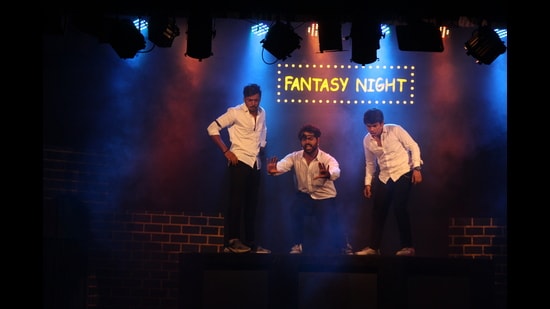
It is also a play that has evolved with the city – in four years, the curator of the play (a unique inclusion in a theatre production) kept himself abreast of the development in this area and tweaked the narrative constantly.
So TMF is no old play. Curator Ameya Mondkar spoke to HT about the contemporaneity in a subject so dynamic -- “as things change daily, even several times a day” -- on the side-lines of the theatre group’s rehearsals for its 21st show on February 5.
“Keeping Brechtian form in mind, the narrative weaves in satire and makes socio-political statements aligned with the societal status quo. The production is so nimble, every performance has the scope to modify and upgrade the text, based on current dynamics,” said Mondkar, whose job is to include every nuance in real time. “When holding a mirror to subliminal interclass conflicts in Girangaon, highlighting the sudden adrenaline rush of the youth, especially those from the lower economic strata to achieve the upward mobility, it is crucial to stay updated with even the smallest development related to mill workers directly or indirectly,” he said.
To that end, the play’s multidimensional form juggles several genres of music, soliloquies, text and lights “to ensure what is left ‘between the lines’ in the realm of the unsaid comes across effortlessly,” said Mondkar, who works closely with the director Vinayak Kolwankar to keep the play “here and now.”
The play’s dynamism is also achieved by weaving in references from rap, latest movies/ web-shows, and political discourse, doffing its hat at pop culture and on-the-spot impromptu commentary on social media, movies and politics, along with the infusion of fresh slang in the dialogues. “This ensures the play remains fresh, vibrant and up-to-date,” said Kolwankar.
Playwright Sujay Jadhav who wears several hats as a screenwriter, author (‘Jibberish Katha’), poet and rapper has written for various media including cinema (‘Chitthi’, 2018), radio, newspapers, theatre (‘Castle of Glass’, ‘Hyper-Bola’) and music. He said, the play “possessed” its cast and crew through being put together. “While we still introduce new strands for very show, for the first 13, we rewrote the whole play from scratch every single time!”
Through its four-year-run ‘TMF’ has incorporated major twists and turns in the politics and policies related to mill workers and their descendants, said Mondkar citing recommendations of the panel headed by the late architect and town planner Charles Correa (in the 1990s) which asked for equitable division of mill lands into three parcels with a portion each for commercial use, rehousing mill hands and their families, and for creating open public spaces. “But all of it was greedily used commercially. The play questions that and the politics of migration which forced workers and their descendants to Mumbai’s outskirts,” he said. “For example, in its 21st edition, the play asks whether 2024 has brought us any closer to justice for the sons of the soil. While the context keeps wearing new masks, corruption, greed and apathy ensure questions about basic rights and dignity abide.”
Though largely in Marathi, the play has a smattering of Bambaiyya Hindi and English too, “for a cosmo feel and to steer away from stereotypes thrust on regional theatre; any whiff of regional boundaries is further dispelled by the music,” said the director.
So, the story starts at a tony restobar’s opulent loo at midnight. Ganashyam Digambar Pavshe, aka Ghantya Pavshe, who has finished cleaning the loo is about to leave when he confronts Isha Singh, a privileged SoBo-ite, who enters without permission. A high-stakes encounter and drama ensues, that sees Ghantya and Isha spend the night in the toilet with some rather “dark and fantastical” ideas.
Meanwhile, Ghantya’s buddies are waiting for him on the roof of a public toilet, while making a crucial decision about their nascent slum tourism business. Ghantya’s tardiness sees his pals land in a disaster after one of them drunkenly hurls a stone at a high-rise, setting off a chain of events they seem to have no control over.
Class struggle, ambitions of the working class and a mid-moult Mumbai are delivered in street lingo. It underscores the lumpenism of regional chauvinists and shines light on “those who rode the sons-of-the-soil movement to political power selling out the mill workers, dismantling Girangaon in two generations”.
Kolwankar and Jadhav wanted an innovative and viable play. “Our departure from the conventional began when we chose to stage the production in a restroom unlike the commonplace domestic settings in Marathi theatre,” said Jadhav.
Kolwankar, who trained in theatre at Parel’s (Girangaon) Maharshi Dayanand College and Pune’s Lalit Kala Kendra, added to this thread. “My batchmates from interior Maharashtra saw Mumbai differently. This forced me to look at the city and its conflicts like them. It reflected in my adaptation of ‘TMF’ from paper to stage,” he said. Like Jadhav, he is an admirer of Girangaon writers Jayant Pawar, Bhau Padhye, Namdeo Dhasal, among others. “The universality of their storytelling aligned with the global conflicts, and made me realise how Mumbai keeps questioning her working class’ very existence relentlessly with globalisation and capitalism.” To achieve that, Jadhav spent months experimenting, redrafting and refining before eventually settling on a draft to commence production.
Underlining change, Kolwankar focussed on the new generation of workers -- food delivery partners, waiters working in restobars which stand on mill lands etc. “Forty-two years after the textile strike of 1982 when 2,50,000 workers of 65 mills struck work in Mumbai, it continues to cast its shadow on the city and its dwellers. Will mill workers’ descendants live and die as exploited, underpaid labour too? This question left me restless, eventually birthing the play,” he said. “And as we continued to develop the narrative, these elements coalesced around the central theme,” added Jadhav.
The director’s decision to make it a musical led to music directors Agasti Parab (who leads the band DesiRiff) and Kapil Redekar (also an actor in ‘TMF’) stepping in. “We created music based on discussions with the director and writer,” said Redekar. Parab’s entry inspired the team to go with live music. “Live music is both spontaneous and offers the freedom to experiment, improvise and inspire each other,” said Parab, recalling the team brainstorming at jamming sessions. “Since I’m from Girangaon, I knew what could connect musically – we cut out a few composed songs to shorten the play’s duration but finally left Alternative Rock, Opera, Reggae, Rap, Qawwali, Jazz and Indian classical pieces in the play.”
The play strikes a chord with its multiple intersectionality of class, caste, region and religion, “all interconnected in a complex web, where addressing one inevitably involves acknowledging others,” said Jadhav. As he is not from Girangaon, Jadhav explored these themes reading short stories and poems.
Achieving the perfect form and content to keep pace with the shifting energies of mid-town was no mean feat – several drafts were discarded and ideas re-calibrated in the pursuit of coherence. How challenging was that? “The immersive look on audiences’ faces makes it all worthwhile,” said Mondkar.
‘Todi Mill Fantasy’ will be performed at Mukti Cultural Hub, Andheri on February 5, at 6.30 pm

Stay updated with all the Breaking News and Latest News from Mumbai. Click here for comprehensive coverage of top Cities including Bengaluru, Delhi, Hyderabad, and more across India along with Stay informed on the latest happenings in World News.


