E-Paper



Justice Nariman invokes Vivekananda at Parliament of World Religions
Justice Rohinton Nariman mentioned Swami Vivekananda's famous speech, highlighting the impact it had in introducing Hinduism to the United States.

 Prefer HTon Google


Justice Rohinton Nariman and Jain Acharya Lokesh Muni, founder of Ahimsa Vishwa Bharati, addressed the inaugural ceremony of the Parliament of World Religions held in Chicago on August 14.
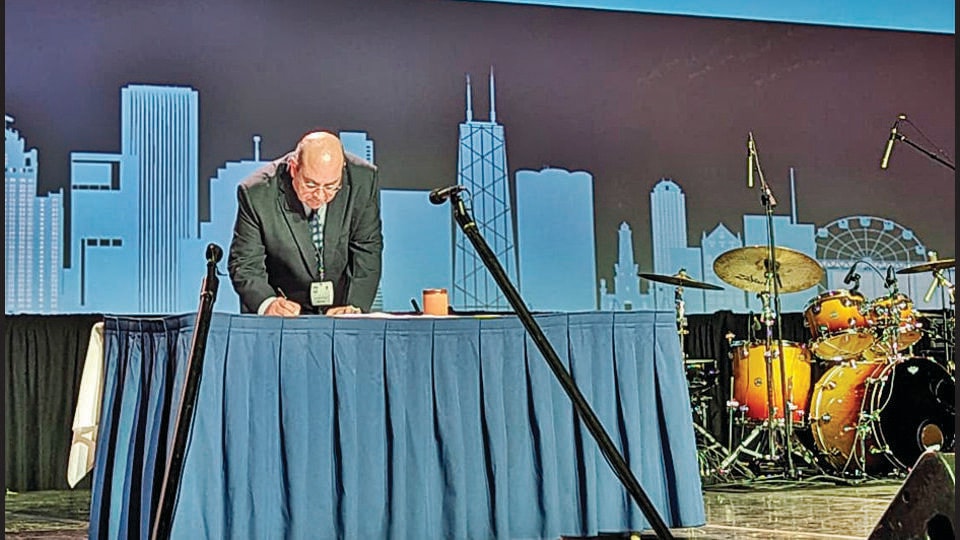
It is worth mentioning that Swami Vivekananda had in 1893 addressed the first parliament in Chicago and had attracted the world’s attention to India’s spiritual heritage, introduced Hinduism to the United States, and had called for religious tolerance with an end to fanaticism.
Justice Nariman, an ordained priest, has authored “The Inner Fire: Faith, Choice and Modern Day Living in Zoroastrianisma”. He was speaking on the Zoroastrian religion.
Justice Nariman said when Swami Vivekananda began his speech with “sisters and brothers of America”, he evoked a massive applause.
He likened the applause to what Ludwig van Beethoven got when he had conducted his ninth symphony. “If you remember, the fourth movement of the ninth symphony contains ‘Ode to Joy’ which says pretty much the same thing, ‘all men are brothers...’
“Beethoven was of course tone deaf and a young singer named Caroline Unger turned him around so that he could see the applause,” Justice Nariman said.
“The Swami then spoke about his religion being the mother of all religions and his belonging to an old, ancient order of monks. He said his religion honestly believed in tolerating other faiths but then all other faiths were equal in the eyes of his faith. Speaking about Jews, he said after the temple was destroyed in 1780 by the Roman General Titus, Jews went to the Kerala coast and they have lived there ever since in peace and harmony. As a matter of fact, I am informed that an urn containing the soil from Kerala is kept in Israel. The reason being this is the only place on earth where the Jews have been tolerated for 2,000 years,” Justice Nariman stated.
Justice Nariman explained that the concept of a Jew in the 16th century was of a Venetian Jewish moneylender Shylock in The Merchant of Venice by William Shakespeare. “Shakespeare put into Shylock’s mouth the following words where he describes the discrimination against his people and says, “Don’t the Jews have eyes and hands like any other human being? If you prick us, do we not bleed? If you tickle us, do we not laugh? If you poison us, do we not die and if you wrong us, shall we not seek revenge?” The Swami then spoke about our people, the Zoroastrians, and how they had also been given succour in this land for 1,300 years.”
Justice Nariman then referred to the Swami reciting a Sanskrit shloka which spoke about how all world religions ultimately are streams which come from different sources but go into the same “ocean”.
“Finally, the Swami wound up his speech by saying that the greatest enemy of world peace was fanaticism. And the bell that tolled that morning was the death knell for fanaticism. How wrong the Swami was. Fanaticism is at its peak in this world today,” Justice Nariman said.
Justice Nariman further said there were three great emperors - two belonged to India and the other was from Persia - who had actually lived what Swami said.
”Emperor Ashoka who lived 2,250 years ago came to the throne by killing his brothers and had waged a massive war in Kalinga where millions of lives were lost. Seeing all this bloodshed, he completely reformed himself and became a Buddhist. He left for us many edicts which survived till today and the 12th rock edict is important from the point of view of today’s discussion.Because that rock edict says when ‘any of my subjects extols another person’s faith, he is actually praising his own faith and doing a favour by doing so’. But if he does the opposite he denigrates his own faith than the other person’s.So let us live with concord which is loosely translated as fraternity,” he said.
He also mentioned king Akbar who had attracted religious faiths from across the world and lived the concept of fraternity. Justice Nariman was one of the 13 signatories to the Global Ethic Declaration.
Acharya Lokesh raised the tricolour among representatives from 80 countries at the opening ceremony. He said it was a matter of pride for him to represent Jainism and Indian culture on such a historic occasion.
The event will continue till August 18 during which Acharya Lokesh will address various sessions on subjects like “Interfaith call to action for climate change”, “Ways to establish world peace,” and “Peace and love: A war-free, violence-free, and hatred-free world.”
Prior to this, he had addressed the inauguration ceremonies of the Parliament of World Religions held in Salt Lake City, US, in 2015, and in Toronto in 2018.