
 E-Paper



MCAP: PM2.5 and PM10 levels have fallen since 2015
Another air quality report indicates average particulate matter levels increased between 2019 and 2021 in Mumbai, but fell in 2020 when Covid-related restrictions were in place


Mumbai: Between 2015 and 2021, the city recorded a declining trend in particulate matter (PM) pollution, according to Brihanmumbai Municipal Corporation’s (BMC) recently unveiled Mumbai Climate Action Plan (MCAP). This claim is based on data from nine monitoring stations operated by the System of Air Quality and Weather Forecasting and Research (SAFAR), seven stations under the BMC and nine stations under the Continuous Ambient Air Quality Monitoring Stations (CAAQMS) network of the Central Pollution Control Board (CPCB).
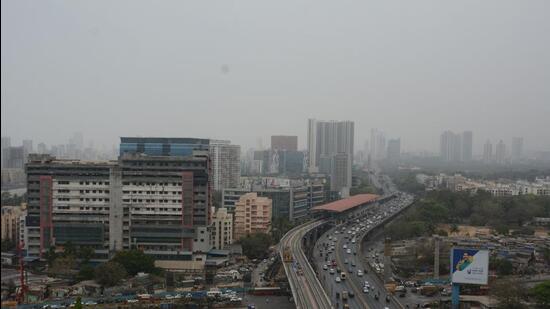
From an annual average PM10 level of 120μg/m3 in 2015-16, Mumbai recorded a dip to 91μg/m3 in 2020-21. This is still higher than the safe limit of 60μg/m3 prescribed by the Centre’s National Ambient Air Quality Standards (NAAQS). For PM2.5, the concentration fell from about 80μg/m3 to 46μg/m3 in the same time period; the safe limit prescribed by NAAQS is 40μg/m3.
“The average annual concentrations of PM2.5 and PM10 have declined over the past few years but remain above the NAAQ standards. The hazardous concentrations range from 1.5 times to twice the permissible limits between 2015 to 2019 making them critical pollutants for Mumbai city. Individual monitoring stations — Bandra Kurla Complex, followed by Mazgaon, Andheri and Malad — emerge as areas of high concentration based on SAFAR data,” the MCAP noted.
To be sure, the data showed a steep dip in particulate matter levels on account of the imposition of Covid-19 restrictions. Successive Covid lockdowns over the past two years resulted in halting many polluting activities such as construction work and vehicular movement.
What’s more, the State of World Air Quality Report 2021report released by the Swiss group IQAir, which measures air quality levels, found that the annual average of PM 2.5 levels in Mumbai has worsened between 2019 and 2021 — from 45.3 µg/m3 in 2019 and 41.3 µg/m3 in 2020 to 46.4 µg/m3 in 2021. In 2018, the average level was 58.6ug/m3.
Amrita Chakraborty, a senior programme associate at World Resources Institute (India), which conducted the air quality risk assessment on behalf of the BMC for the MCAP document said, “Though our study shows a declining city-level trend in particulate matter, the critical point for policy makers to understand is that the numbers are still in excess of India’s air quality standards. One of the actions proposed under MCAP is to set up a more rigorous monitoring network so that hyperlocal interventions can be planned at a war or zonal level. A key reason for the dip in PM levels, as we have said in MCAP are Covid-related lockdowns.”
Experts agreed that the MCAP accurately depicts declining concentrations of particulate matter, but also cautioned that the overall trend provides a very limited picture of air pollution in Mumbai, given the dearth of monitoring stations across the city, and the emergence of hotspots which are not captured under the city’s existing monitoring network.
Ronak Sutaria, founder of Respirer Living Sciences, which operates an independent network of 20 air quality monitors across the city, said, “The declining trend will be true of only those areas in which the monitors are placed. But data from 25 monitors simply isn’t enough to say that Mumbai’s air is getting cleaner. We require a denser network of monitoring devices to make conclusive statements like that. Given that the area of Greater Mumbai is about 603 km sq, we need at least 150 monitors or one per 4 km sq,” he said.
Mumbai’s current monitoring network does not capture air quality around hot-spots at a granular, ward level, and around sites which typically generate high amounts of fugitive emissions, such as real estate projects in development and the under construction Mumbai Metro network, which contributes about 2% of Mumbai’s PM10 emissions, as per a recent, state-funded source apportionment study carried out by NEERI.
“From a public health perspective, someone living around these highly polluted sites would be more at risk today than six or seven years ago, despite a declining overall trend. In order to uncover these variations and plan mitigating actions, you need to scale up the monitoring network,” said Sachin Panwar, an independent air quality scientist.
As per MCAP’s recommendation, Mumbai has the ambitious target of adopting “an air pollution hotspot-based forecasting system, preferably at ward/zonal level” in 2022.
From ranking 71st globally in terms of PM2.5 pollution in 2018, Mumbai’s ranking for the year 2021 improved to 124th globally according to IQAir.
“The PM2.5 concentration in Mumbai fell closer to the national safe level in 2020 as a result of successive lockdowns. Nonetheless, it was nearly three times higher than the current WHO criteria. According to the latest IQAir Report, air pollution worsened in 2021 and is rapidly approaching the levels recorded in 2018,” said Bhagwan Kesbhat, founder of environment NGO Waatavaran Foundation.
Keshbat added, “There is an immediate need to put in place tough steps that the Mumbai clean air action plan recommends, as well as the recently launched Mumbai Climate Action Plan, which includes air pollution as a key sector for action. There is obviously no shortage of funds from the 15th Finance Commission and the Union Environment Ministry. The state administration must increase its efforts to combat air pollution, which are currently insufficient.”
Sunil Godse, head of the BMC’s environment department, and VM Motghare, joint director (air pollution) at the Maharashtra Pollution Control Board (MPCB), did not respond to requests for comment.
Stay updated with all the Breaking News and Latest News from Mumbai. Click here for comprehensive coverage of top Cities including Bengaluru, Delhi, Hyderabad, and more across India along with Stay informed on the latest happenings in World News.


