E-Paper



MMRDA revives plan to build Metro corridor on MTHL, feasibility report awaited
The 22-km long MTHL will connect Sewri with Nhava Sheva and is expected to be ready by 2023 for which around 50 percent of work is completed.

 Prefer HTon Google


Mumbai: The Mumbai Metropolitan Region Development Authority (MMRDA) has revived its earlier plan to build a Metro line connecting Mumbai with Navi Mumbai via the under-construction Mumbai Trans Harbour Link (MTHL).
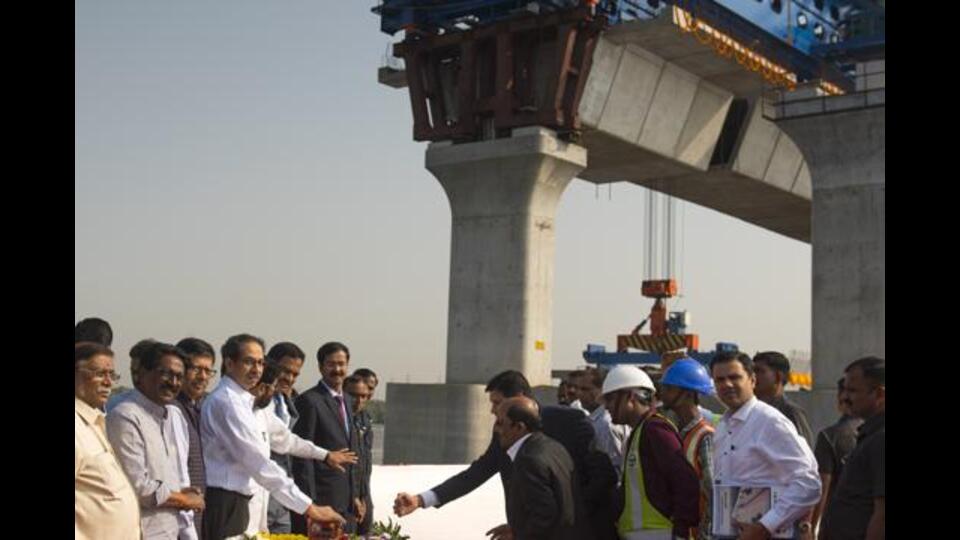
The 22-km long MTHL will connect Sewri with Nhava Sheva and is expected to be ready by 2023 for which around 50 percent of work is completed. The MMRDA has now appointed a consultant to study whether the sea bridge can take the load of a Metro corridor. The report is expected to be ready in April 2022.
MMRDA had in 2010 prepared a detailed project report (DPR) through RITES Limited named Mumbai Trans Harbour Metro Rail Link, a 49 km corridor between Prabhadevi and Dushmi which is 20 km away from Chirle, where MTHL ends in Raigad district.
The aim behind building an MTHL metro was to encourage mass transport and cater to future travel demands while facilitating decongestion of traffic on MTHL. However, later as the project was to be constructed under Public-Private Partnership (PPP) model, the interested firms were not keen on having a Metro corridor on it, citing it will be financially non-viable as citizens would prefer Metro over paying the toll and using the road bridge.
Later, in 2015 after getting no response the MMRDA decided to construct the project by self-financing it by getting a loan approved from the Japanese International Cooperation Agency (JICA).
In 2016, the MMRDA’s pre-qualification bids for the project were floated and even this did not mention plans to have metro corridors on the bridge or parallel to it. MTHL is a 22-km-long cable-stay bridge and will be the second-longest sea link in the world after the 42-km link between Qingdao and Huandao in China.
However, now the MMRDA plans to have a Metro corridor considering it will carry a much higher number of people.
SVR Srinivas, Metropolitan Commissioner of the MMRDA, said, “We are working on whether it will be possible to have a Metro corridor now on the under-construction bridge. We do not feel that finances will be a problem for this but our consultants are studying whether this will be technically feasible, and will the bridge take the load of the Metro corridor.”
Srinivas said that a call will be taken after getting a clear picture from consultants considering that building another bridge for just a Metro corridor will not be possible at this juncture.
“The report by the consultant should be out in the next 30 days or so. We are also considering a bus lane if not Metro rail,” Srinivas added.
The 6-lane Mumbai Trans Harbour Link project will provide direct access to Navi Mumbai, Navi Mumbai International Airport and a gateway to Mumbai-Pune Expressway and further towards Southern India.
According to MMRDA estimates in February 2018, around 70,000 vehicles are expected to use the overpass every day and motorists might have to pay between ₹175 and ₹790. The toll collection may have to be continued for around 23 years.
Meanwhile, experts on the other hand said that rather than going for Metro rail at this stage, the MMRDA should consider a bus lane for now.
Ashok Datar, from Mumbai Mobility Forum, said, “If given an option between Metro rail or a bus lane, I would say we should go for the bus lane because it is technically and financially viable, and it can carry 40,000 people on an hourly basis considering 100 buses per hour. I believe that wherever there is a road, there should be a bus lane. But somehow the planning of our city is such that bus lanes are missing in it.”