
 E-Paper



BMC ward officers who brave rain to keep Mumbai running
Assistant commissioners of all administrative wards in the Brihanmumbai Municipal Corporation (BMC) have been instructed to visit chronic flooding spots in Mumbai during heavy rain. The commissioners are responsible for ensuring that pumps are operational, potholes are repaired, and mosquito-breeding sites are attended to. The BMC has identified 486 such spots that get waterlogged with just 50mm of rainfall. The move comes after an 'orange' alert was issued by the India Meteorological Department for heavy rain in the city.


Linah Baliga
leena.baliga@htlive.com
Mumbai: The assistant commissioners of all 24 administrative wards of the Brihanmumbai Municipal Corporation (BMC), who had raised their bar during the pandemic by working up to 17 hours a day without a break for months, are once again back on the field.
This time, the task at hand is to visit the chronic flooding spots in the city on days the India Meteorological Department (IMD) issues ‘orange’ and ‘red’ alerts that indicate heavy to very heavy rain.
This is the instruction they have received on WhatsApp from the municipal commissioner and administrator Iqbal Singh Chahal.
Confirming this, Chahal told HT that the civic body had identified 486 spots which would get waterlogged with just 50mm of rainfall and hence, 486 junior engineers had been put in charge of those locations.
“One list of their names and contact details is with the disaster control room while another is with me. They have been advised that if there are eight inches of rainfall at a location, pumps should be made operational. They should also ensure that the pump operator is present,” he said.
The army of 24 ward officers (assistant commissioners) must ensure that the pumps never run out of diesel, potholes are repaired on time, and all mosquito-breeding sites are attended to, Chahal said. “This is the system in place to tackle waterlogging this monsoon”
An ‘orange’ alert had been sounded for the city on Friday. In the 24 hours ending at 8.30am, IMD’s Santacruz observatory received 29mm of rain while 115.2mm was recorded in the next eight hours, till 5.30pm. The coastal station in Colaba recorded 23mm and 92.2mm, correspondingly. As per BMC’s network of rain gauges across the city, central and suburban Mumbai stations saw between 70mm and 100mm of rain while most stations in south Mumbai got between 40mm and 70mm of rainfall.
The commissioner further said, “We have so far received almost 1,500mm rainfall which is 50% of our total quota. The situation on the ground is there are only a few places that see waterlogging. This speaks volumes about the level of nullah cleaning done this year.”
In the evening, Chahal visited Hindmata junction and Andheri subway to monitor the situation.
“All our officers are on the ground. We also monitor the waterlogging spots from the disaster control room through 7,000+ cameras installed across the city. Currently, there are 275 dewatering pumps in operation.
“Ahead of an ‘orange’ alert tomorrow (Saturday), I request you to not step out of your homes unless it is necessary and do not panic; we are on the ground to look after the city,” he said.
There are 425 dilapidated buildings in the city of which 125 need to be evacuated, Chahal pointed out. “Of the 125, as many as 95 are involved in various court cases.”
As IMD had issued an ‘orange’ alert for Friday, HT gives a lowdown of three assistant commissioners from island city, western and eastern suburbs to know what each of them dealt with through the day.
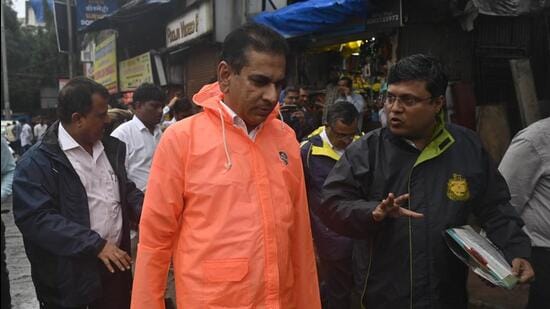
Manish Valanju, assistant commissioner of K East ward, was with Chahal at Andheri subway which had to be shut for commuters.
Valanju’s day began at 7am when he checked his emails, messages and took a live feed on the subway.
“Nowadays, the first thing I do after I get up is to check whether there is waterlogging because right now it is the most chronic flooding spot in Mumbai. We are now managing an early warning system where we have displayed digital boards, 1km away from the spot. So, if the subway gets closed, a message is flashed on the road and commuters don’t go in that direction and are faced with a four-hour extra commute due to the closure of Gokhale bridge,” he said.
The ward then informs the disaster control department who in turn alerts the traffic department. The BMC has also put cameras at Andheri subway and in K East and K West wards.
“We have marked a line on the subway. If water touches that line, we close the subway to prevent mishaps. Then we also have a dashboard where we come to know the number of potholes right now and complaints received. We attend to them as early as possible, and we even check complaints of serious nature like missing drain covers which can cause casualty. We have a team who moves around to check if dhapas and manhole covers are missing. I take a review in the morning before moving out of my home,” he said.
Valanju takes a round of three areas - Andheri on the first day, Jogeshwari on the second day and Vile Parle East on the third day. “When on the field, I come to know if the garbage is cleared or not, if potholes are attended to or not. I then come to my office and hold meetings in the afternoons.”
Valanju said waterlogging was reported on Friday at the junction of JVLR and the Western Express Highway where work of Metro line 6 was going on. “During a dry spell a solution will be worked out. We are also facing the issue of water contamination. So, we took a meeting of community health volunteers to increase awareness of malaria and dengue and activated fogging teams.”
At 5.30pm on Friday, Valanju had to conduct a site visit at Andheri subway with Chahal and other senior officials to explain the issues. “I finish my day by 8.30pm but we cannot switch off our phones because there are also building collapse calls that we cannot afford to miss,” he added.
Dhanaji Herlekar, assistant commissioner of L ward, was at LBS Marg, Kurla.
Herlekar too began his day at 7am and was on his way to Surve junction and also to check on the Mithi river level.
“There is a heavy downpour, but the situation is under control now. The Mithi river level has not reached the danger mark. My first job is to visit flooding spots and ensure that diesel stock is available for operation of dewatering pumps,” he said.
Fifty dewatering pumps in L ward are used at chronic flooding spots at LBS Marg, Kamani junction, Surve junction, Sheetal cinema, and Nehru Nagar bus depot. The stormwater drain team along with labourers looks after the flooding locations. There is a disaster control room at the ward from where officials monitor the situation through cameras and deploy labourers to remove choked garbage from culverts.
Herlekar’s job is also to keep an eye on places where there are potholes. “Every road engineer and beat officer will have to be on site. Once a bad road is identified, a programme is chalked out by appointing a contractor to fill the potholes within 24 hours,” he said, adding, “We have around five teams consisting of five road engineers each in every ward.”
L ward is always faced with the task of vacating ground-floor residents at LBS Marg whenever the river overflows. “This year, the Mithi river is desilted, but we will have to wait till Vihar lake overflows and that would lead to additional discharge with tidal effect, and it would cause flooding on LBS Marg,” Herlekar said.
Besides, Herlekar chairs a meeting with medical health officers to take stock of gastro, malaria and dengue cases in the ward and initiate anti-larvae activities. “I also instruct health officers to act against unauthorised hawkers selling food as it leads to an increase in gastro cases.”
Uddhav Chandanshive, assistant commissioner of C ward, was at Gol Deval, Bhuleshwar
Chandanshive said his day begins even before 6am where he checks the different WhatsApp groups, takes updates from ward control room, and pass the information to the duty officers concerned.
Then he makes trips to MK Road, JSS Road market area, Gol Deval, CP Tank, Police Gymkhana, Catholic Gymkhana, H Cross Road during heavy rain to ensure there is no waterlogging in those areas.
“We have already installed dewatering pumps at all flooding spots, and they are continuously monitored from the control room,” Chandanshive said.
On the health front, he said before the onset of monsoon he had undertaken a rat eradication drive other than identifying mosquito-breeding spots.
“We prepared small teams to identify and prepare an eradication plan. We are continuously monitoring mosquito-breeding sites, which helps tackle monsoon-related diseases,” he added.

Stay updated with all the Breaking News and Latest News from Mumbai. Click here for comprehensive coverage of top Cities including Bengaluru, Delhi, Hyderabad, and more across India along with Stay informed on the latest happenings in World News.


