
 E-Paper



PM level six times the safe limit; AQI drops to ‘poor’ day after Diwali in Mumbai
On November 5, a day after Diwali, the city’s air quality index (AQI) slipped into the ‘poor’ category after two years in Mumbai


On November 5, a day after Diwali, the city’s air quality index (AQI) slipped into the ‘poor’ category after two years. Mumbai’s AQI stood at 215 based on 10 monitoring stations under the Union ministry of earth sciences’ system of air quality and weather forecasting and research (SAFAR) as compared to 107 (moderate) in 2020 and 75 (moderate) in 2019.
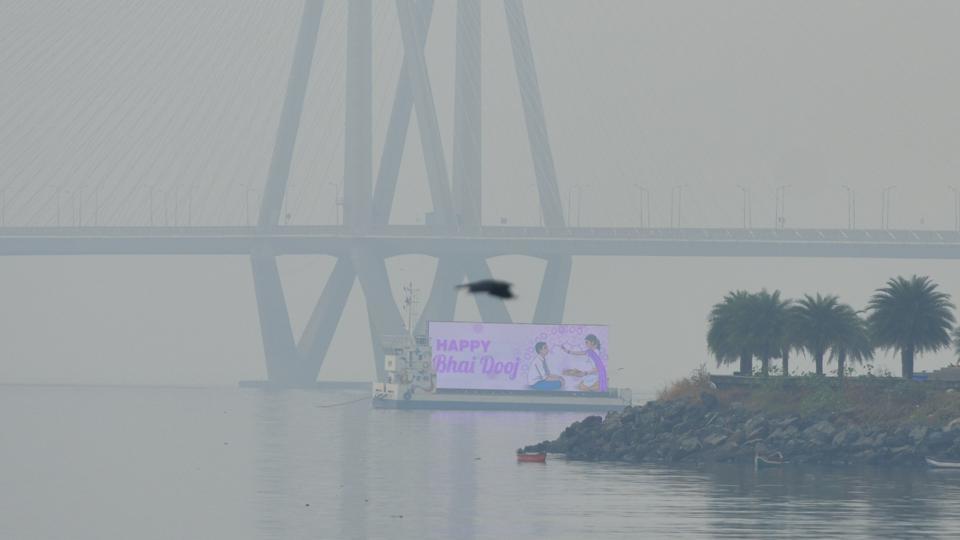
The drop in air quality on Friday was an outcome of emissions from firecrackers and prevailing weather conditions the previous day, according to scientists monitoring the city’s pollution levels. After logging in ‘satisfactory’ air quality on Diwali day for two years, the city’s AQI fell into the ‘moderate’ category at 180 on November 4 – it was 90 last year and 75 in 2019.
Hourly data from 21 continuous ambient air quality monitoring stations (CAAQMS) across the city operated by the Maharashtra Pollution Control Board (MPCB) and SAFAR showed that the immediate, localised impact of bursting firecrackers between 8pm and 10pm was much more significant on November 4 with spikes in the concentration of particulate matter.
“AQI is calculated as a 24-hour average. Given the significant variations in concentration of pollutants that can happen within a single day, this average tends to mask the very high spikes that are seen within the permissible window of time for bursting crackers,” said Gufran Beig, project director and meteorologist at SAFAR. “These pollutants then linger on due to lower temperatures at night and slower wind speeds.”
Navy Nagar in Colaba was the most polluted locality recording particulate matter (PM) concentrations well over 300ug/m3 (micrograms per metre of cubic air) from 8pm Thursday to 11am on Friday. An air quality monitor in the area recorded a maximum of 425ug/m3 of PM2.5 at 6am Friday, which is more than seven times the daily safe limit of 60ug/m3, as per the Central Pollution Control Board’s National Ambient Air Quality Standards (NAAQS). Maximum PM10 concentration was 235ug/m3.
The SAFAR monitor in Mazagaon recorded PM2.5 levels at 395ug/m3 on Friday evening, and PM10 at 373ug/m3. High levels of PM were present till around 10am on Friday, and by evening the concentration of suspended particulate matter had dropped to between 70-80ug/m3, the data shows. Other monitors in the city also recorded intense spikes in pollution, as opposed to seeing satisfactory levels of PM just a few hours ago. In Worli, for example, MPCB monitor that recorded PM2.5 at 123ug/m3, at 6pm on Thursday, saw a threefold increase in pollutants with PM2.5 levels touching 438ug/m3 by 10pm.
Experts and officials said this was a clear indicator of widespread use of firecrackers. “The data clearly shows that around Thursday evening there was a dip in air quality as people started bursting crackers, and then there is an improvement the next morning as the sun comes up and winds become stronger,” said Sachin Pawar, an independent air-quality scientist certified by the Quality Council of India under the union environment ministry.
These granular spikes in pollution, which can adversely impact a person’s health on exposure, are not reflected in the average AQI value calculated by CPCB in its daily all-India bulletin, or by SAFAR, which maintains its own network of monitors in the city.
However, past AQI data suggests that pollution levels this year were considerably higher. In 2019, Mumbai had recorded its cleanest Diwali and post-Diwali air in five years owing to high wind speed under the influence of Cyclone Kyarr in the Arabian Sea. The year 2020 was the second cleanest post-Diwali air since 2015.
Quietest Diwali in three years
While MPCB officials did not share official data from their annual noise monitoring exercise, spot checks by city-based NGO Awaaz Foundation observed that Diwali this year was the quietest in three years.
The maximum noise levels were recorded at 100.4 decibels (dB) at Shivaji Park at around 9pm. In 2020, the maximum noise level was 105.5dB at Shivaji Park. In 2019, pre-Covid, maximum noise level was 112.3dB at Marine Drive. “Maximum recorded noise levels measured at Bandra, Mahim, Worli, Dadar, Shivaji Park, Babulnath and Marine Drive were much lower than previous years,” Awaaz Foundation said in a report on Saturday.
Marine Drive, which was the centre of firecracker use before 2020, was completely silent in 2021 even before 10pm due to heavy police presence, the report observed.
Stay updated with all the Breaking News and Latest News from Mumbai. Click here for comprehensive coverage of top Cities including Bengaluru, Delhi, Hyderabad, and more across India along with Stay informed on the latest happenings in World News.


