
 E-Paper



Road dust main contributor to PM10 pollution in state
In the year 2021, various polluting activities in the state generated a whopping 1,723 giga-grams of PM10, of which road dust contributed the largest share at 29.8%. One giga-gram comprises 10 lakh kgs


Mumbai: A state-wide emissions inventory for PM10- suspended particulate matter less than 10 microns (µm) in diameter - has identified suspended road dust as the primary contributor to air pollution across rural and urban areas of Maharashtra.
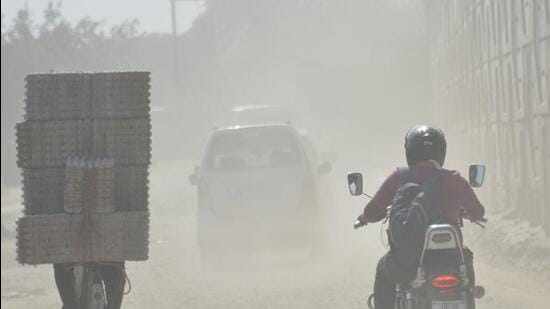
In the year 2021, various polluting activities in the state generated a whopping 1,723 giga-grams of PM10, of which road dust contributed the largest share at 29.8%. One giga-gram comprises 10 lakh kgs.
Road dust largely refers to solid particles generated during the handling and processing of road-building materials, such as gravel and concrete. Turbulence generated by passing traffic, particularly in areas with high traffic volume or where road surface erosion and tyre wear are high, also generates and resuspends fugitive particles which become airborne. These particles are small enough to pass through the throat and nose and enter the lungs, causing serious health implications.
Researchers from the National Institute of Advanced Studies, Bengaluru, and Utkal University, Bhubaneshwar also found that the domestic sector generates the next largest share of PM10 in Maharashtra, at 22.4%. “These emissions come mainly from various activities in households and slums, from crop residue and cow dung combustion, diesel generators and street vendors,” said Gufran Beig, professor, NIAS and the founding director of the System of Air Quality and Weather Forecasting and Research (SAFAR) under the union ministry of earth sciences.
Emissions from the industrial sector generated 14.1% of the state’s total PM10 load in 2021, followed by thermal power plants at 9.8%, and transportation at 10.2%. Municipal waste burning, construction work and crematoria contributed the remaining 13.7% of Maharashtra’s PM10 emissions.
“Similar source apportionment studies have been conducted at a city level, but this is the first such study that looks at the entire state, both urban and rural. If we had to consider only urban areas, the share of road dust would be much higher. For now, we have only considered PM10 pollutants and not PM2.5, which are much finer and more lethal. We are in the process of assessing the PM2.5 emissions load for Maharashtra as well and will share the results soon,” Beig added.
These findings, which were shared by Beig and his colleague Saroj Kumar Sahu at an air quality seminar in Nagpur on Tuesday, are in line with recent, similar studies. In March 2021, the Maharashtra Pollution Control Board (MPCB) released the findings of a study by NEERI which found that resuspended road dust makes up 71% of all PM10 pollution in Mumbai. Of this, 45% came from unpaved roads (which are more prone to erosion by wind) followed by paved surfaces, which contribute to 26% of Mumbai’s dust load. Another 8% came from construction activities, and 3% from vehicles. The rest came from industries, the domestic sector, aircraft, marine vessels, open eateries, bakeries, and crematoria.
PM (categorised as PM10, PM2.5 and PM1 depending on their size) is known to be the most prevalent air pollutant by volume compared to other gaseous pollutants like carbon monoxide, nitrogen and sulphur oxides, and ozone, among others. Experts who spoke to the Hindustan Times said that dust management does not require large budgets but a few simple interventions.
Rakesh Kumar, former director at NEERI who oversaw the study commissioned by MPCB, said the key intervention was simply to build better roads. And a stronger watch on project management consultants and contractors is vital. “Take the Bandra-Worli Sea Link for example. It hardly sustains any damage or has to be revamped. Other roads are not as well built, and when they suffer wear and tear a lot of that material ends up as dust. Mumbai’s poor roads are leading to poor air quality as well.”
Stay updated with all the Breaking News and Latest News from Mumbai. Click here for comprehensive coverage of top Cities including Bengaluru, Delhi, Hyderabad, and more across India along with Stay informed on the latest happenings in World News.


