
 E-Paper



Sweepers excluded from chawl redevelopment fight back
The families, along with two others, did all the dirty work of the huge chawl: they swept the corridors, cleaned toilets and emptied the garbage from the drains with their bare hands. M J Deshmukh, a resident who grew up in the chawl, remembers buying them cleaning supplies


MUMBAI: On December 1, the former residents of Byculla’s Botawala Chawl gathered for the lottery draw of flats in the two new towers built in its place. Living in transit camps for over a decade, they were inching closer to homes of their own. Two residents, however, were missing, and not by choice.
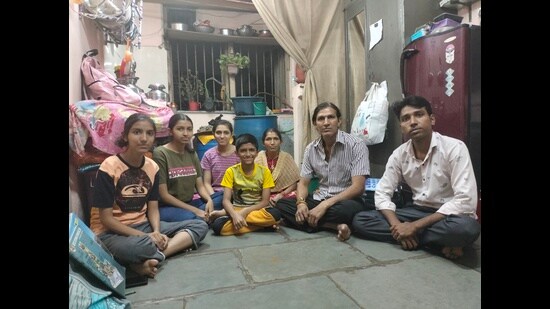
Cousins Mukesh Makwana, 37, and Girish Makwana, 44, were children when they came with their parents to live in the outhouses on the chawl premises. They had an arrangement with the charitable trust that owned the land: they would clean the chawl in exchange for accommodation.
The families, along with two others, did all the dirty work of the huge chawl: they swept the corridors, cleaned toilets and emptied the garbage from the drains with their bare hands. M J Deshmukh, a resident who grew up in the chawl, remembers buying them cleaning supplies.
Decades later, with Mukesh’s father and both of Girish’s parents deceased, their families have been excluded from the chawl’s redevelopment. This is despite a Government Resolution (GR), dated 2010, about the eligibility of residents in the redevelopment of cessed buildings.
Point 23 of the GR states, “The washermen and small stall holders who carry out business from unauthorised constructions outside the building, as well as sweepers and others residing that are there in the voter list dated 1.1.1995, if they submit evidence accordingly, should be rehabilitated like other tenants.”
Mukesh goes into the long history. In 2006, when the trust signed an MOU with M/s Sarah Housing Development Pvt Ltd, the families in the four outhouses were included in the tenant list. In 2014 and ’15, they were asked to sign consent forms for the redevelopment and submit their documents proving residence prior to 1996. Their homes were inspected by MHADA, all on the promise that they too would get 400-square-feet houses.
“It was in 2015, when the final list of residents was published that we received the first blow: there was no mention of us,” said Girish.
Neither Mukesh nor Girish took this lying down. Since then, they have been filing RTIs, running from authority to authority, appealing to political parties, and in 2017, even registered two cases in the city civil court. They received help from Deshmukh in this. “I have seen them grow up,” he said. “Getting a house is their legal right, which is why I am helping them.”
As the case proceeded in the city civil court, the chawl buildings were demolished and a tower began coming up. Mukesh and Girish stood their ground, refusing to vacate their outhouse. Then in 2019, they were furnished a notice under Section 55 of the MRTP Act, which said that their structures were temporary and unauthorised, and they had to leave within 15 days. Following through on the order, the BMC demolished their homes in June. This was in the monsoon, reminded Girish. His youngest child was eight then.
When questioned, a representative of Sarah Housing Development Pvt Ltd claimed that the Makwana family was living in a hutment in the compound outside the chawl. “The truth is that the family has failed to establish the legality of its premises to the BMC and also eligibility under Regulation 33(9) to MHADA,” he said. “They cannot blame the developers for lack of essential documents at their end.”
The cousins’ lawyer, Sapna Khobragade, countered this. “Their eligibility was never done,” she said. “Whenever they go to BMC, they are told to go to MHADA and vice-versa. The authorities are tossing their case around like a football in the air. But both their names are on the voting list and they have ration cards prior to 1995. They are authorised and eligible residents.”
An RTI reply dated 2023 clearly states that MHADA’s Mumbai Building Repair and Reconstruction Board is responsible for the eligibility. The chief officer, Milind Shambharkar, did not respond to repeated requests for a comment.
Exhausted with the failed attempts at acquiring justice in the civil court, Mukesh spent ₹50,000 to approach the high court this month. Girish has no plans to follow suit on account of health and financial difficulties. To date, said Mukesh, both have spent around ₹4 lakh on lawyers.
The cousins continue their parents’ occupation of sanitation work, doing odd jobs when they’re lucky to get them. They live in tiny one-room-kitchen flats, paying ₹10,000 by way of rent and utilities. “My wife now works as a domestic help to help run the house and feed our children,” said Girish. With four children, three of whom are studying, and his health issues, it is a hand-to-mouth existence.
Mukesh lives with his aging mother and other family members “We feel dejected, as despite having so much proof, our simple right to a house is being denied,” he said. “But we will keep at it.”

Stay updated with all the Breaking News and Latest News from Mumbai. Click here for comprehensive coverage of top Cities including Bengaluru, Delhi, Hyderabad, and more across India along with Stay informed on the latest happenings in World News.


