
 E-Paper



‘There’s no point trying to uncomplex human beings’
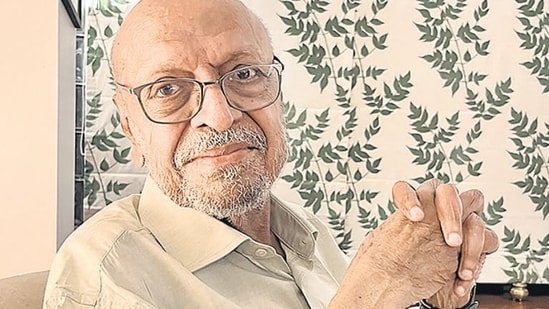
Mumbai lost Shyam Benegal last month. HT leafed through the pages of time and pulled out an interview of Benegal by filmmaker and author Nasreen Munni Kabir


Biopics are a trend these days, but very few were made in the 1970s Indian cinema, how did you decide to make ‘Bhumika’?
The autobiography of the Marathi actress Hansa Wadkar was read out to me by my partner who was much senior to me, Mr Ghanekar, who started the company, Sahyadri Films. He had worked with Prabhat, as their Executive Producer (EP) and was also the EP on many Hansa Wadkar films that became popular.
Hansa Wadkar was a feminist before the term was even thought of. She was rebellious and independent-minded despite the fact that she came from an extremely traditional background. Her mother and other family members were great gharana singers of Maharashtra. They devoted their life to music, and to the God of the temple, Mangeshi.
So Hansa Wadkar belonged to such a family, but was a very outspoken woman. She was very unusual, very different from women with her background. They would never have worked in films, because films were considered sort of taboo at that time. But she became a very well-known film star in Marathi and Hindi cinema from the late 1930s and then decided to write her autobiography in Marathi called ‘Sangtye Aika’, which was very unusual.
The title translates as “I speak, you listen.” Did Mr Ghanekar translate it for you or did he read it to you in Marathi?
No, he read it in Marathi. I can understand Marathi. It’s close to Konkani. The language I can speak.
Marathi magazines were very popular, even now, for their serials. You had a new chapter of a story appearing in consecutive issues. This was the standard practice in the old days. It’s like television serials or Web series now. So, Hansa Wadkar wrote her life story, which initially appeared in ‘Manoos’, the Marathi magazine, in the form of interviews [by journalist Arun Sadhu. Later published as a book in 1970].
Her writing became a sensation because it was very rare that anybody coming from a middle-class background would be so outspoken about herself, about her parents, and particularly about her sexual relationships. Her writing became both notorious and famous, all at the same time. I knew this is a film I must make. Hansa Wadkar was alive at that time, but she died soon after. I met her daughter who said I could go ahead. And I then got the rights of the book to make the film. There was no problem or interference.
My next film was going to be ‘Manthan’ [released in 1976], which was set in Gujarat. Throughout the making of ‘Manthan’, I was working on the biopic. Mr Ghanekar kept translating the book verbally, and I would make notes. Smita was already playing the second lead in ‘Nishant’, and then she played the main lead in ‘Manthan’. So, there was no question in my mind as to who would play the role of Hansa who was called Usha in the film.
40 years later, ‘Bhumika’ feels years ahead of its time. What I loved was how you maintained the characteristics of the young girl who plays Usha in the adult Usha. That continuation in characterisation was fabulous, it made the character so real.
That came directly from Hansa Wadkar’s writing about her childhood. She had this little chicken, it was her pet. When her mother’s singing Ustad came for dinner, she cooked that chicken. So, you know, this little girl got so upset. She was also a very wilful person. And it may have harmed her, in terms of her own career, and eventually her life.
The girl who plays the young Smita/Usha was wonderful. Who is she?
She was a little girl from the slums around Mohammad Ali Road. Her name was Rukhsana. She was from a very poor Muslim family. Because this film happened, the family suddenly felt they could live off her. Obviously, it wasn’t possible because that girl was not a natural actress. She was just a natural person. She wasn’t self-conscious which made her performance fine. She was capable of following instructions, but she wasn’t an actress. She did try to become one, but it didn’t work. I remember when we were doing ‘Kalyug’, with Shashi Kapoor, she came to see me hoping to find a role. I gave her a very small walk-on part, because I could not send her away with nothing. After that I never saw her again.
How did you decide to call the film ‘Bhumika’?
I couldn’t call it ‘Sangtye Aika’. It wouldn’t mean anything. I thought about many titles and finally decided on ‘Bhumika’; it somewhat alludes to the many roles Hansa played in her own life.
Most human beings are complex. No point in trying to uncomplex them, because those complexities are built into the way the personality is. Everybody wants a neat kind of character that you can put in a box, but Hansa was not that kind of person. You couldn’t put her in a box.
How did the film do when it was released?
When the film was released, it did very badly. Yes, it just collapsed. It opened in the Metro cinema. It ran for one weekend and that was the end of that. Then the film was released in Ahmedabad, and for some reason, it started to do extremely well there. Women were seeing it, not the male audience. And suddenly its reputation grew and so the film was brought back to Bombay because it had developed a reputation of appealing to women.
In the beginning, unfortunately, the general impression of the film was, here is the story of a woman with no morals. That she had a loose character. So, men went to see the film and were disappointed. There was nothing for them to see which would excite them in any way. In Ahmedabad, it went for a Jubilee, while in Bombay it finally ran for about 12 weeks or so. But it did very badly in the beginning. Eventually it was considered a successful film and then the critics started paying attention.
And what kind of reviews did you get?
Very mixed reviews. When Smita won the National Award for Best Actress, it was chosen to be in competition at Cannes. Suddenly the whole thing changed and it was shown in many International Film Festivals. Not that it got any great awards.
You started by writing your notes based on her autobiography, so at what stage did you bring in Satyadev Dubey and Girish Karnad?
Satyadev Dubey was writing it, then I got Girish in, because it involved his sensibility and his knowledge.
How would you write? Would you sit and write scenes together or talk about scenes?
It was like this. Discuss it, write it, go over it, scene by scene. And sometimes, I would change everything and get Girish to write it all over again. Dubey was writing the dialogue, and he would get very upset with me because I would ask him to change the dialogue. This is not working, change it. That kind of thing. But each one of us was fully into it. The main writing work was done by Girish.
You have spoken about using different film stock to give a sense of period to ‘Bhumika’.
Those were very eventful times because we had a foreign exchange problem then. We couldn’t get film stock. I wanted to shoot the film in colour. Kodak dried up because they wouldn’t send anything to us against rupee payment. At first we got some Gevacolor stock, then some ORWO colour, and some black and white Kodak, some black and white Plus X film and later ORWO black and white.
So, I was working with four different kinds of film stock and I couldn’t shoot the whole film in a single stock. I decided that I would film period wise. The period in the story is represented on the soundtrack by various things and some costume changes, and the raw stock also indicates the time frame of the story.
Where did you shoot most of the film?
In Jyoti Studio and then later in Mehboob Studio. Jyoti Studio is no longer a film studio. It’s in Nana Chowk. I used to have my office there. I loved that office. I lived with the ghosts of Indian cinema, going back to the silent era. Because the very first sound film, ‘Alam Ara’ was shot there. We even used the studio equipment and lights in ‘Bhumika’ that were used for films like ‘Alam Ara’. Shapoor Irani was running Jyoti Studio. His father Ardeshir Irani made ‘Alam Ara’.
You are known to work with more or less the same actors.
Yes, most of the actors were common to many films, and some of them have acted in maybe five films or more each. Amrish Puri would be most offended if I did not take him although he was such a popular star of his time, and the most famous villain of his time, opposite Amitabh Bachchan and Rajesh Khanna. He would always say: “Kuch nahin hai mere liye is film mein? Thumb impression bhi nahin hai?” I would say – yes, I have a thumb impression part for you!
I loved the song you used in ‘Bhumika’, “Meri zindagi ki kashti.”
I wanted a K L Saigal voice but he had died in 1947. C H Atma could sing in Saigal’s voice but he passed away in 1975. Chandru Atma was his brother, and was also a singer. He had a very good voice so he sang “Meri zindagi ki kashti.” Raja Mehdi Ali Khan wrote the lyrics. Majrooh Sultanpuri was the one who did most of the other songs in ‘Bhumika’. I would tell him this is the situation, etc, etc, and it would take him about 20 minutes to come up with a song. Majrooh was a wonderful person He was such a famous lyricist and poet, but was not given enough recognition in his lifetime.
You must not forget I had such hugely talented people around me. Girish Karnad, Satyadev Dubey, such wonderful actors, composers. I mean, when I think of it now, that must have been some magic moment when everybody came together in that manner.
Did you have to find different ways of instruction in relation to which actor you were dealing with?
100 percent. I can give you examples. For instance, Shabana needs reason. Logic behind the action or speech and requires that kind of rational discussion. But Smita was not like that. Totally spontaneous. I think she did think about it in a different way but she didn’t require only normal logic. Somewhere she sensed what was needed. But, she could go wrong as well, which was never the case with Shabana. It would never go wrong. Smita could do something special on a whim.
You were not working with Video Assist in those days. And using Video Assist might have ended the direct connection with the actor.
Yes, that is a distinct problem. That is where you get a television performance, not a cinema performance.
How would you define the difference?
Actors are looking at the level of competence when acting for TV, rather than the quality of performance. You are talking of the competence level, is he competent enough?
For example, in the theatre, it’s the actors that carry the theatre, not the director. But with films it is the director who carries the thing. In the cinema the control is entirely in the hands of the director. In the theatre, the control has been relinquished to the actors.
What was your wife Nira Benegal’s reaction to ‘Bhumika’?
You’ll have to ask Nira that question! She was working on the film too.
(Nasreen Munni Kabir has made over 120 TV programmes for Channel 4 TV, UK, on Hindi cinema, and is author of 23 books on the subject, the last being ‘The Legacy of Guru Dutt, 2025 diary’.)

Stay updated with all the Breaking News and Latest News from Mumbai. Click here for comprehensive coverage of top Cities including Bengaluru, Delhi, Hyderabad, and more across India along with Stay informed on the latest happenings in World News.


