
 E-Paper



Treks, infections and stalled projects: Many faces of Shahapur’s water crisis
Women from these villages spend hours to fetch the water from rivers, tanks and wells, often walking 2-3 km under the hot sun with infants and children in tow


Thane: Shahapur taluka in Thane district is well-known for dams like Bhatsa, Modak Sagar, Tansa and Madhya Vaitarna, which supply water to homes and industries across the Mumbai Metropolitan Region (MMR). The taluka receives abundant rainfall during the monsoon – last year, it measured around 3,500-4,000 ml, among the highest in the state – and several big rivers such as Bhatsa and Kalu flow through it.
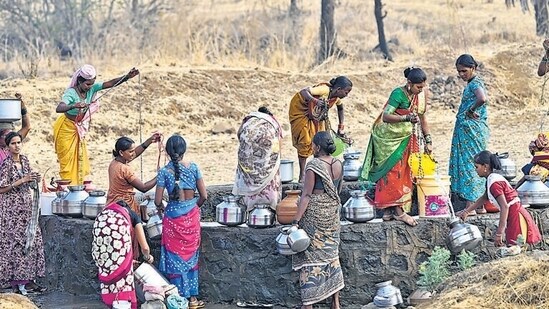
Yet, like every other year, 126 out of 148 villages in the taluka have been facing acute water shortage this summer. Women from these villages spend hours to fetch the water from rivers, tanks and wells, often walking 2-3 km under the hot sun with infants and children in tow. Residential projects in the area have also not received occupancy certificates for years owing to lack of water supply.
Administrative officials said apart from dedicated schemes for water supply, affected villages were being provided drinking water via tankers regularly. But residents complained of the water being turbid and unfit for consumption, and doctors in the area said stomach ailments were common. Civil society group Shramjeevi Sangathana alleged schemes to provide tapped water to residents of the taluka were riddled with corruption and mismanagement, and their pleas to improve the situation had fallen on deaf years.
Arduous journey to fetch water
Adivasis or tribals predominate among the population in Shahapur taluka, and most villages such as Kasara, Khardi, Shirol, Ajanup and adivasi Padas Dand, Umbavane, Vashala, ruichi, Bibalwadi, Khadyacha Pad, Kalshet Parand, Naralwadi are located in and around hills. At present, the Zilla Parishad supplies drinking water to 96 villages in the taluka via tankers, but these are mostly emptied into wells near the foothills, which are located far away from many neighbourhoods located high up in the hills.
Consequently, women from several villages told HT that since February-March this year, they had been spending all their mornings to fetch water – first, for purposes of drinking and cooking, and later, for washing utensils, clothes and other household activities.
“Our struggle starts and ends with water,” said Poonam Shivram Khule from Khandshet. “From the morning till the day ends, all we think is that we need to bring water, and we need to use it wisely, so it lasts till we are able to wake up and get it again.”
Though Kalshet Parand is among the 96 villagers that are supplied drinking water via tankers, Khule said the tankers were emptied into wells located at the foothills, which was around 3 km away from their neighbourhood. “We have to climb up all the way with 3-4 pots on our head and in our hands. If the burden of fetching water was even half of what it is, we could spend the time to earn more money or look after our small children,” said Khule.
Women in the area said there was no respite from fetching water even if they (or another family member) fell sick or had babies or toddlers to take care of.
“I carry my 17-month-old child with me when I go to fetch water as there is no one to look after the baby,” said Shivali Baghat. Although there are four members in her family, her husband and brother-in-law leave home for work early in the morning, while her mother-in-law is bedridden.
“I carry my baby on my lap, holding her with one hand, with one pot in the other hand and three pots balanced on my head,” she said, accusing the administration and politicians of not bothering about their plight. “They just think that once tankers are allocated, their responsibility is over. But how many are trying to solve the problem thoroughly?”
Turbid water, stomach ailments
The tankers that supply drinking water to villages in Shahapur taluka get their fill from the Bhatsa river. But the river is used by many villagers to wash their clothes and bathe their cattle, making it unfit for consumption.
“Washing clothes, animals and cars is common. But what is worrisome is that several villages empty their sewage into the same river from which the tankers are filled,” said Prakash Khodka, a social worker. Since Shahapur does not have any water purification plant, the water is supplied to villages without any treatment, he said. “Water is distributed from our area to Mumbai and other nearby cities after adequate purification. But unfortunately, we do not have any rights on that water, neither do we get purified water.”
Gajendra Pawar, a doctor at the Shahapur taluka hospital, said stomach ailments were common the area, especially during the summer, owing to the unavailability of purified water. Of late, nearly 300-500 patients had been turning up at the out-patient department everyday with complaints of stomach-ache or infection, he noted, adding, “Women and children who walk long distances to fetch water also get bitten bu snakes or scorpions often. Such cases are common at the hospital,” said Pawar.
Stalled residential projects
Though private residential projects have mushroomed in Shahapur in recent years, many projects have been awaiting clearances and occupancy certificates as they have no assured water supply.
Bhushan Deshmukh, supervisor at an under-construction residential project near Khardi in Shahapur said four major residential complexes in the area ran into major trouble and had to refund money to customers owing to the water crisis. “These complexes were built around six years ago. Initially, we got tremendous response from customers. But later, when they got to know of the water shortage in the area, we faced severe crisis and had to refund their money,” said Deshmukh. The complexes were assured water supply via a dedicated line that was to be set up under one of the government schemes but it didn’t take off, leading to the trouble, he noted.
Mismanagement of schemes
A total of 189 schemes under the Jal Jeevan Mission, which are related to water supply, are functional in Shahapur taluka. But all these schemes are riddled with corruption and mismanagement, alleged Vivek Pandit from Shramjeevi Sangathana.
“The contractors for 88 out of the 189 schemes are not working, say officials, while 12 contractors are reportedly not interested in the work,” said Pandit. He demanded that such contractors be blacklisted and barred from taking on any government contracts.
Among the 189 schemes, 103 schemes envisage getting water from the Bhavli pumped storage hydropower project located in the neighbouring Nashik district, whose cost is estimated at ₹5,723 crore. The engineer for the Bhavali project said 60% of the work complete, but one approval was pending from the forest department. Though this has led to inordinate delays in implementing schemes for water supply to Shahapur, the project “will supply water to Shahapur residents for years”, said the engineer.
But Pandit alleged the schemes were delayed because the Nashik Zilla Parishad was demanding crores of rupees. “If schemes are stalled only because of non-payment of additional money, the district collector should intervene and solve the problem,” he said.
Meanwhile, block officials who spoke to HT on condition of anonymity said that they were facing problems in continuing with the supply of tanker water to villages, mainly on account of cash crunch.
“We have already spent ₹1.59 crore on providing tanker water since February this year but have written to higher authorities requesting for another ₹5 crore,” said an official, saying cost on fuel the tankers comprised a major expense. The letter mentioned that if the money was not made available, supply of water via tankers would have to be stalled, leading to outrage among villagers.
However, Thane collector Ashok Shingare said shortage of funds was not an issue. “Some coordination was required with the zilla parishad, which has been done and enough funds have been allocated through the government,” he said.
The collector concurred with Pandit about the mismanagement of schemes, saying lack of permissions were causing delays. He also claimed all efforts were being made to mitigate the crisis, saying, “Our team is on the ground, looking into every possible option to meet the demands for water.”

Stay updated with all the Breaking News and Latest News from Mumbai. Click here for comprehensive coverage of top Cities including Bengaluru, Delhi, Hyderabad, and more across India along with Stay informed on the latest happenings in World News.


