
 E-Paper



What does it take to stop an accident?
A stretch that has seen 5 accidents or 10 fatalities in 3 years in a row, is a blackspot. Maha has over 1,300, but the plan to rectify them has some gaps


Mumbai: In the intervening night of February 28 and March 1, at around 3 am, a tempo carrying wedding paraphernalia came hurtling down Bhor Ghat pass, towards the Mumbai-Pune expressway. Within minutes, it crashed into the side barrier and turned turtle. Of the 22 labourers in the truck, one lost his life, and the remaining injured. The driver, whohad fallen asleep at the wheel, was arrested for speeding and death due to negligence. This particular stretch of the Western ghat, between Khopoli and Khandala, is steep and prone to accidents, Sunita Salunke Thakare, superintendent of highway traffic police (HQ), said.
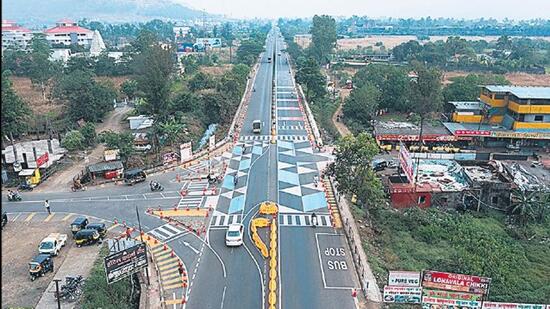
“We often make announcements with megaphones before that blackspot, asking drivers to be cautious. We also deploy officers to make sure drivers do not speed,” she said. Yet, the steepness of the slope means that accidents inevitably happen with over-tired drivers, especially in the wee hours of the morning when patrolling is less frequent.
According to the highway traffic police, if a stretch of road has witnessed five accidents or 10 fatalities in three consecutive years, it is marked out as a blackspot. And according to data collected by them in 2019, there are 1,377 blackspots in the roads of Maharashtra.
However, a deeper analysis reveals that there are discrepancies in the data collected on blackspots by the state and the highway traffic police (which falls within the purview of the state) — in 2019, the state identified 1,324 blackspots which includes numbers from the Public Works department (PWD; 381) and urban local bodies (ULB; 315).
In 2014, a road safety committee formed by the Supreme Court found that the Maharashtra government (among others) was not doing enough to tackle blackspots. At the time, the government assured the apex court that it would identify and rectify all blackspots by 2020.
A district-level road safety committee was formed by the Maharashtra government to analyse and eradicate blackspots in 2018. However, rectification work was discontinued in 2020 and 2021 on account of the Covid-19 pandemic and the mass exodus of migrant workers.
In January, a host of government bodies including the road-safety committees, PWD, ULBs, Maharashtra State Road Development Corporation Limited (MSRDCL), and other officials of the state transport department held the State Road Safety Council’s 11th meeting in the Sahyadari guest house. The state said that of the 1,324 blackspots it has identified, remedial measures have been carried out on 931 blackspots, and temporary measures have been applied at 359 places.
A permanent remedy would involve fixing an engineering defect — such as say, a curve or a slope that has resulted in making that location a blackspot — whereas a temporary measure would include putting up signage or a crash barrier to avoid fatalities.
The state highway police, which was not part of the January meeting, does not have a record of the rectifications carried out by the state. This could be well be one of the reasons for the discrepancy in numbers.
“We are yet to clarify the discrepancy of the figure on blackspots with all the agencies including the Highway Traffic Police,” said a senior official from the state transport department requesting anonymity.
The importance of finishing this work of rectification cannot be underlined enough.
In all, the state witnessed 24,971 accidents that claimed the lives of 11,569 persons and injured another 13,971 in 2021, according to data maintained by the highway traffic police.
A number game
While addressing the meeting in January, transport minister Anil Parab told government officials that “saving lives should be the main concern while planning new road safety measures for this year”.
“All the black spots will now be reviewed to ensure that mishaps don’t happen on those stretches,” said joint transport commissioner (road safety) J B Patil, who was present at that meeting.
The state highway police analyses accidents on national highways, state highways, expressways like the one between Mumbai and Pune, as well as major arterial roads connecting districts. The state highway police shares its data with the state transport department as well as the authority in-charge of maintaining that specific road. They also analyse First Information Reports (FIRs) of each accident and the cause of the crash. The data also includes blackspots within cities.
“As experts, the concerned authorities then study the spot and find out the reasons for the accidents following which steps are taken to rectify the blackspot,” Additional director general highway police (Maharashtra) Kulwantkumar Sarangal said.
According to the state highway police, the number of blackspots across the state dropped between 2015 and 2018. In 2015, it stood at 774, and reduced to 139 in 2016, 109 in 2017 and 55 in 2018. However, in 2019, the number rose to 300, taking the total number of blackspots since 2016 to 1,377.Of this, 160 blackspots were identified on national highways, 77 on state highways, four on major district roads and 59 on other roads.
Cumulatively, since 2016 and till 2019, Nashik rural has the most blackspots (83), followed by Aurangabad city (83), and Nagpur city (72). Mumbai has 64 blackspots.
Rectification woes
“The rectification of a blackspot depends on the kind of problem the engineers and police find as the cause of crashes. It is even possible that a blackspot has been rectified at one place but a new one develops near the previous one,” said the senior transport department official quoted above.
Piyush Tewari, Founder and CEO of SaveLIFE Foundation, a non-governmental organisation that works with the MSRDC to improve road safety and access to emergency medical care on the Mumbai-Pune expressway and the old Mumbai-Pune highway, said that they have a different definition of blackspot.
“We do not go by the government’s approach on blackspot as it is flawed. We analyse each crash and reasons behind the fatalities on a stretch of 5 to 15 kilometres. We analyse the stretch as a high fatality zone and do a crash vulnerability audit regularly,” said Tewari.
SaveLIFE Foundation’s audit of Mumbai-Pune Expressway conducted between 2016 and 2017 had found 3,200 engineering issues of which 3,000 were rectified by SaveLIFE and MSRDC engineers, which brought down fatalities by 52%, the NGO claimed. Similarly, it found 2,300 engineering issues on NH-48 (the old Mumbai-Pune highway) and rectified 1,700 defects by December 31, 2020. The NGO claims that this brought down fatalities on the highway by 54%.
MSRDC spokesperson said that they maintain the Mumbai-Pune Expressway and NH 48 (Mumbai-Pune) highway and their engineers along with the police analyse the accident-prone spots or the high fatality zones of the stretch and with the help of SaveLIFE Foundation, they have managed to bring down accidents to a great extent.
According to MSRDC officials, engineering defects like exposed concrete structures or bridge pillars or even wrongly placed flower pots and exposed debris were rectified by placing crash barriers. Shoulder lane barricades were also covered with crash barriers and tactical rumblers to protect drivers falling sleep on the wheel. The MSRDC official said that 120 gaps were identified in the road divider (median) on the Expressway, where drivers would take sudden U-turns leading to crashes. Of these, at least 100 gaps have been closed.
However, experts said, more needs to be done.
Traffic experts claim that as per the government, rectifying a blackspot means erecting signboards to alert drivers to drive cautiously. This may not always work if accidents are caused by engineering defects of the road.
“We do not get a straight answer from government officials when we ask about what has been done to rectify a blackspot. At times when we visit such a spot, we find that a signboard has been erected which warns a motorist about the blackspot. There is an urgent need to form an SOP which the government can follow while analyzing or rectifying a black spot,” said Sandeep Gaikwad from Parisar, a civil society organisation (CSO) working on lobbying and advocacy for sustainable development including urban transport and road safety in Pune.
“The agencies responsible for the Maharashtra highways are not coordinated within themselves which is the need of the hour,” said Gaikwad.
Stay updated with all the Breaking News and Latest News from Mumbai. Click here for comprehensive coverage of top Cities including Bengaluru, Delhi, Hyderabad, and more across India along with Stay informed on the latest happenings in World News.


