
 E-Paper



Why commuters are choosing to travel ticketless on locals
The Western Railway caught 5,274 people travelling without valid tickets in just three days of fortress checking, earning revenue of ₹13.93 lakh in fines. The railway plans to conduct surveys and speak to passenger associations to address the issue. Some reasons for ticketless travel include a lack of sufficient ticket collectors and the habit of travelling without tickets developed during the pandemic. The railway is also exploring digital payment options for fines and improving monitoring of people's movement at stations.


The Western Railway (WR) has caught 5,274 people travelling without valid tickets or ticketless in just three different days of its fortress checking – where ticket collectors (TCs) would block all entry and exit points to the station and move inside the trains. This drive earned WR a revenue of ₹13.93 lakh which was collected as fines.
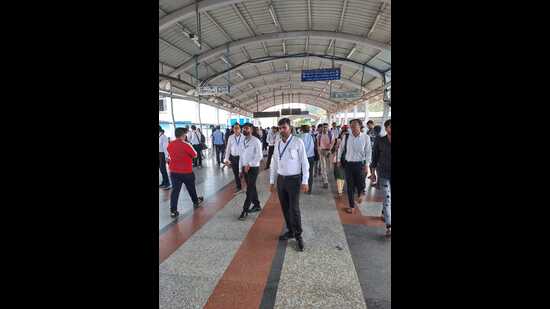
On September 30, a group of TCs found 1,647 errant commuters at Dadar station. The number jumped to 2,693 when the drive was conducted at Andheri station on October 3. Two days later, on October 5, AC locals on the Bandra-Mumbai Central route were checked between 7am and 2pm. As many as 934 people were found without tickets and were fined ₹2.57 lakh. The exercise involved 186 TCs who guarded each door of the train. On Friday, checks were carried out at Virar station from 2pm to 10pm.
People not wanting to buy train tickets that hardly cost anything is certainly a problem, said A V Shenoy, a transport expert and member of Mumbai Mobility Forum.
“This is more of a social issue. The railway should conduct a survey to find the reason. They should also speak to passenger associations,” he said.
A senior railway official, who did not wish to be named, said some of those who were caught without tickets said since they did not find adequate TCs posted on trains and platforms, they took the chance. “Even some reasoned that paying fines once in 15-30 days is better than buying tickets after standing in a long queue.”
Another reason, a WR official said, was that after Covid-19, it had become a habit to travel without tickets. During the pandemic there were cases when people, who were barred from travelling in public transport, used to take the local trains, he said.
“This habit seems to be continuing. They are okay to pay fines rather than standing in long queues. Even though there are options to buy tickets on UTS mobile app, the growth seems slow, yet it is steady,” the official added.
Besides, some of the ticketless commuters were insisting on paying fines digitally as they were hardly carrying cash after Covid-19 and the government was also pushing for this mode of payment, officials said. However, on-ground staff were facing difficulties on account of this, they added.
“The railway should ensure that people can pay through digital forms. At least some QR code-based device should be provided to TCs,” Kailash Verma, president of Mumbai Rail Users Cell, said.
Nandkumar Deshmukh, president of Federation of Suburban Railway Passengers Association, said the heavy crowd at ticket windows discourages many from buying tickets. “The multiple entry and exit points at railway stations is also an issue and so is controlling and monitoring people’s movement.”
Every station is mapped with drawings. But despite having designated entry and exit points, illegal ones crop up, which is a cause for concern. For instance, at stations like Dadar, Andheri and Borivali there are 13, 13 and 22 entry and exit points respectively. During the eight-hour fortress checking, all points were manned and TCs stood as human chains on foot overbridges.
In the last 10-12 days, around 200 TCs inspected railway stations daily on alternate days. On the remaining days, a group of 25 TCs spread out in eight different stations in hunt for ticketless commuters. These TCs are apart from the regular ticket-checking staff who are present at the stations.
Sources said the number of ticket-checking staff in Mumbai division of WR had dropped from 1,100 to 700-750. In the past there used to be 250-300 TCs dedicated to Mumbai’s suburban stations and local trains, which has dipped to 150. These TCs now manage both long-distance and local trains.
Stay updated with all the Breaking News and Latest News from Mumbai. Click here for comprehensive coverage of top Cities including Bengaluru, Delhi, Hyderabad, and more across India along with Stay informed on the latest happenings in World News.


