
 E-Paper



Why Mumbai cops doff their caps to Sir Patrick Kelly
Mumbai: September 2 is a noteworthy date in Mumbai police’s calendar

 Prefer HTon Google


Mumbai: September 2 is a noteworthy date in Mumbai police’s calendar. This was when, at the height of the freedom movement, residents of the city installed the statue of a retired European police officer by voluntarily raising money -- a testament to Sir Patrick Kelly’s image in the public consciousness.
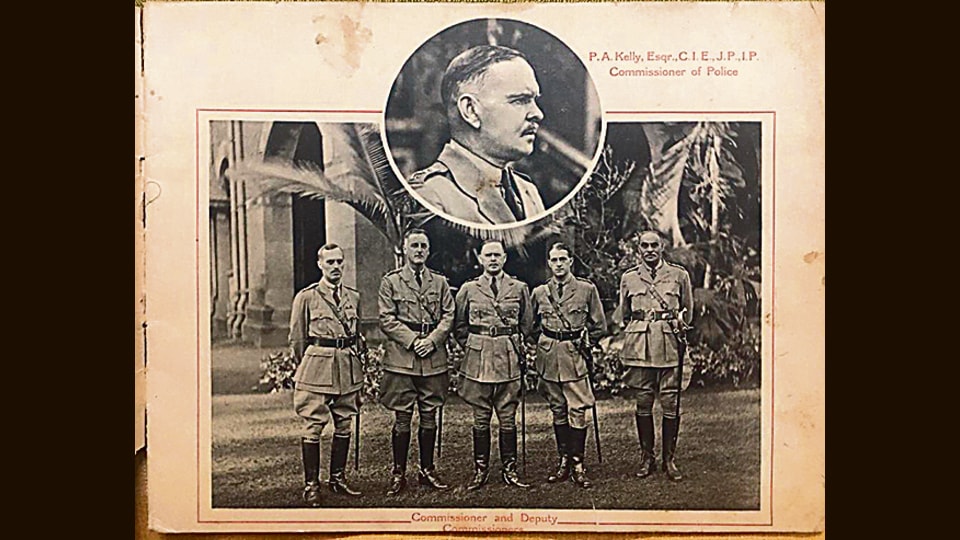
The city faced sudden communal riots on February 5, 1929, fuelled by rumours of child-lifting. In an incident unprecedented in the history of the city’s police force, a group of Pathans attacked the commissioner’s office. During this melee, a constable was thrown on the ground and assaulted, reportedly, as he had defaulted on loans taken from the Pathans.
Such borrowings were common among constables, in the absence of a strong formal banking and credit system. So, when the cop was beaten up, many of his colleagues held back, perhaps not wanting to get into the bad books of the Pathans.
Hearing the commotion in his office and after being informed about this by his orderly, Patrick Kelly, the commissioner of police, rushed down from his first-floor office. He shielded him with his own body, his uniform being splattered with the victim’s blood in the process. Spurred on by their chief’s heroism, others joined in and drove away the assailants.
Acts like these earned Kelly, who retired on September 1, 1933, the respect of his men and a place of pride in the annals of Mumbai police. Mumbai’s citizenry contributed to build his marble statue. It was unveiled by then mayor Barrister Jamnadas Madhavji Mehta outside the commissioner’s office in Crawford Market on September 2, 1936.
Kelly, an Irishman, joined the Imperial Police Service as a 22-year-old in November 1902. Through his postings at Nashik, Khandesh, Kathiawad, Thane, Solapur and Mumbai, he earned the reputation of an efficient and upright officer. He was appointed the Commissioner of Police in Mumbai on June 1, 1922, marking the beginning of a landmark stint. “A memorable period in the history of the Mumbai city police had begun,” wrote Arvind Patwardhan, retired deputy commissioner of police (DCP) and former chief editor of ‘Dakshata,’ in his ‘Mee Mumbaicha Police.’
He cracked down on the Pathan money-lenders and other anti-socials. Many were employed as rent collectors and watchmen by the affluent, to prevent robberies or burglaries by fellow Pathans. They were also used to break strikes by the predominantly Maharashtrian textile mill workers, who were the vanguard of the labour movement.
Kelly, who was fluent in Marathi and Pashto, started the ‘Pathan branch’ and used a police inspector specially deputed from the North West Frontier Province (NWFP) to weed out trouble-makers. Many of them fled the city after this crackdown.
In this backdrop, another sinister theory was floated at the time about the attack on the commissionerate --- the intended target may have been Kelly himself!
“The Pathans held a great grudge against Kelly for taking strong action against them. So, they had come to attack him,” said Deepak Rao, Mumbai police historian. “Kelly stood up to them. Awed by his personality, they fled.”
“The modernisation of the Mumbai police took place during Kelly’s tenure. He started the traffic control branch (1924) and got rid of the mounted police (1932) and set up the motor transport section,” said Rao. Communal violence and labour unrest were rife in the years since 1920 and Kelly laid down a “riot scheme” for police stations to handle these troubles, he added. He was also instrumental in founding the police club.
The upright officer captured national attention with the Abdul Kader Bawla case. On January 12, 1925, 25-year-old Bawla, a corporator and grandson of the philanthropist Haji Saboo Siddik, was waylaid and mortally wounded on Malabar Hill while on a drive with his companion Mumtaz Begum.
One of the armed assailants, who was later found to be a Risaldar in the Indore state mounted police, was nabbed by four British army officers who fortuitously arrived at the scene and prevented Mumtaz Begum’s abduction heroically. Under Kelly’s supervision, the case was investigated by a Bombay police team under E.L. Cauty, the deputy commissioner in-charge of the crime branch; it led to three getting life sentences and four life imprisonment. It was a significant milestone in the erstwhile Bombay police’s history.
More crucially, it led to the abdication of Maharaja Tukojirao Holkar III of Indore, and cleaved contemporary society based on issues like relationship between the colonial rulers and princely states, and caste, while involving men like M A Jinnah and ‘Prabodhankar’ Keshav Sitaram Thackeray. Mumtaz, who later left India to try her luck in Hollywood, was in the Maharaja’s harem before she had joined Bawla in Mumbai.
“The colonial government wanted the police to go soft on Holkar. But Kelly threatened to resign rather than compromise. His reputation had spread to the larger Bombay Presidency, and hence the government had to back down,” noted Rohidas Dusar, retired deputy commissioner of police (DCP), and a chronicler of the history of the Mumbai and Maharashtra Police.
Kelly began the system of night patrolling in 1926 in the jurisdiction of all police stations to nab thieves, said Patwardhan. It’s a practice that continues till date.
He was knighted on January 1, 1930. Kelly had the second-longest tenure (11 years) as the city’s police chief after the first commissioner of police Sir Frank Souter (24 years from 1864-1888). He was given the police medal twice (1921 and 1931) for exemplary service.
In October 1933, when Sir Kelly set sail for England from Apollo Bunder, lakhs bade him a tearful farewell, wrote Dausar. In his tenure the number of registered crimes fell from 11,348 in 1922 to 7,493 when he left the office.
Mumbaikars decided to erect Kelly’s statue as a memorial in his lifetime. Then mayor Moreshwar Javale took the initiative and collected around ₹13,500. The statue was unveiled on September 2, 1936, in the Crawford market square by Mehta.
The statue is now in the police museum. Kelly, who passed away in 1966, continued his association with the Mumbai police. He would send a New Year greeting card to his successors every year.


