
 E-Paper



Why Mumbai looks hazy even when air quality is ‘moderate’
Over the past 30 days, the city’s overall AQI has oscillated between “satisfactory” and “moderate”, ranging from a low of 70 on January 28 to a high of 140 on January 4

 Prefer HTon Google


Mumbai: The city recorded an average Air Quality Index (AQI) of 127 on Friday—firmly in the “moderate” category—but remained shrouded in haze throughout the day, with poor visibility prompting residents to complain that they couldn’t see the skyline.
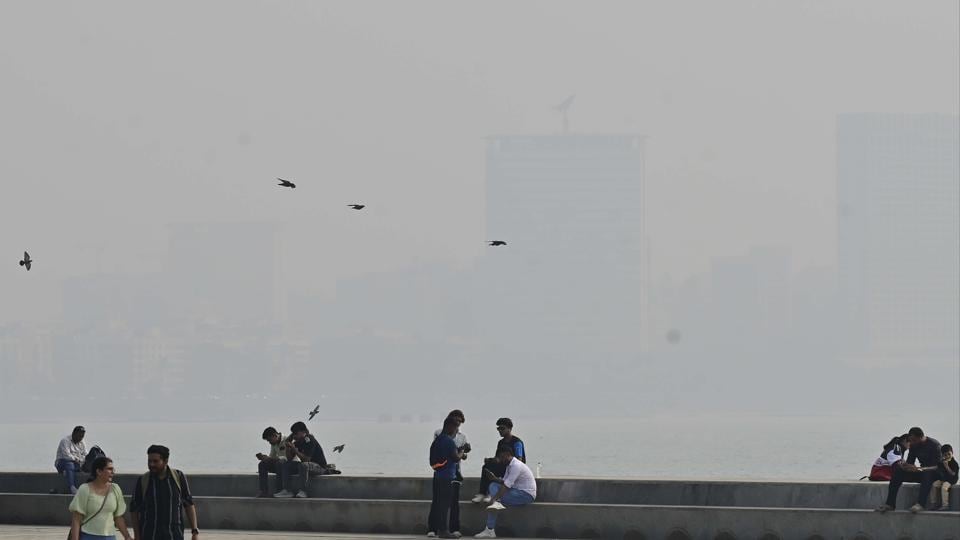
These conditions, which have persisted for much of the month, have raised questions over why Mumbai appears so hazy even when official AQI readings do not indicate severe pollution. Over the past 30 days, the city’s overall AQI has oscillated between “satisfactory” and “moderate”, ranging from a low of 70 on January 28 to a high of 140 on January 4.
On 20 of these days, PM10 (particulate matter with a diameter of 10 micrometres or less, or roughly 1/5th to 1/7th the width of a human hair) was the primary pollutant. According to the Central Pollution Control Board, AQI levels between 50 and 100 are considered satisfactory, while levels between 101 and 200 are moderate.
Why does Mumbai have hazy skies?
Environmental scientist and former CSIR-NEERI director Rakesh Kumar said the haze being witnessed in Mumbai is a combination of fine particles generated by the reaction of nitrogen oxides and hydrocarbons in the presence of sunlight. “These are secondary particles, which are very fine and behave like gases. Meteorology also plays a crucial role, which can be seen from calmer wind conditions,” he said.
In a coastal city like Mumbai, meteorological factors also play a vital role in the dispersal of pollutants, said environmentalists. The higher the wind speed, the faster the pollutants clear the skies. During winter months—November, December and January—wind speeds are low, while temperatures drop, creating conditions that trap pollution at the ground level.
“Slow wind speed and lower temperatures [in the winter months] lead to stagnation of pollutants, resulting in higher concentrations, which is the reason for hazy skies in Mumbai,” said Sunil Dahiya, founder and lead analyst at Envirocatalysts, a think tank.
According to the European Environment Agency, during winter months, solar radiation reaches the ground, warming it up. “At night, the lack of cloud cover means the ground loses heat rapidly, and the air in contact with the ground becomes colder. The warmer air rises and acts as a lid trapping the colder air close to the ground,” it states.
With pollution, including that from road traffic and construction dust, also trapped, the layer of air closest to the ground becomes even more polluted. This phenomenon extends till the prevailing meteorological conditions change.
Flawed urban planning is another reason for the stagnation of pollutants. “High-rise buildings, especially near the coastline, block natural wind that could otherwise disperse pollutants. When airflow is obstructed, dust and vehicular emissions get trapped within the city,” said Dahiya.
Haze-laden pollution
Doctors warn that the toxic cocktail of fine particles, including dust, and gases such as sulphur dioxide, nitrogen dioxide and volatile organic compounds, can lead to respiratory and cardiovascular diseases. Air pollution can also cause neurological diseases.
“Complaints of allergic rhinitis, headaches, tiredness, loss of hair, pigmentation, and acne flare up are all very common. Young children are suffering from many autoimmune conditions,” said Dr Tushar Jagtap, a city-based physician. “Toxic air also leads to premature greying, hair loss, premature ageing, skin damage, pigmentation, dark spots, and acne.”
Paediatrician Dr Suhas Prabhu said that long-term exposure to high levels of particulate matter permanently damages the lungs. In urban autopsies, lungs are often blackened. “I see children with chronic coughs that don’t heal. If this continues, we are heading toward a generation with severely compromised lungs.”

Stay updated with all the Breaking News and Latest News from Mumbai. Click here for comprehensive coverage of top Cities including Bengaluru, Delhi, Hyderabad, and more across India along with Stay informed on the latest happenings in World News.


