
 E-Paper



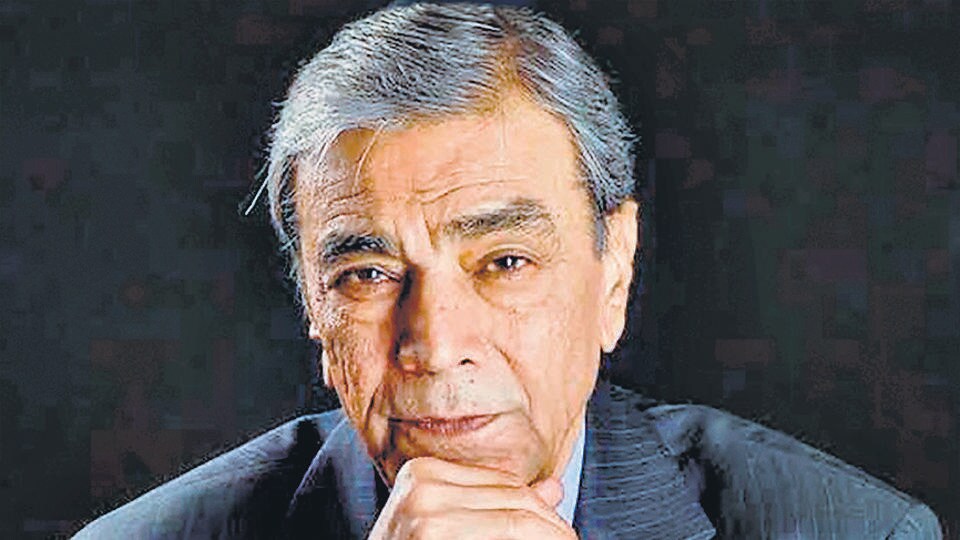
Zia Mohyedddin (1931 - 2023): A teller of stories like none other
Zia Mohyeddin was a fastidious man, a fastidious artist, a fastidious teacher and a rasik in the truest sense of the term


Zia Mohyeddin was a fastidious man, a fastidious artist, a fastidious teacher and a rasik in the truest sense of the term. He so dominated the field, which he himself created, of performative Urdu prose and verse recitation that none has been able to emulate him. But he was much more than that. Like Saeed Jaffrey and Naseeruddin Shah, he justifiably took pride in his Shakespeare performances and in his command over the bard’s oeuvre. Like them he had a considerable experience of theatre, especially in the UK of the 1960s and 70s, but unlike them his command over Urdu language and literature, and its history, was exceptional. He could correct the best. On the only occasion that I met him at his home at Karachi he corrected my pronunciation of the word Shabash by insisting that this was an instance of ghalatul awam, a popular mistake hence deemed to be correct, whereas the correct pronunciation was shibash, and proceeded to prove that by quoting several classical verses.
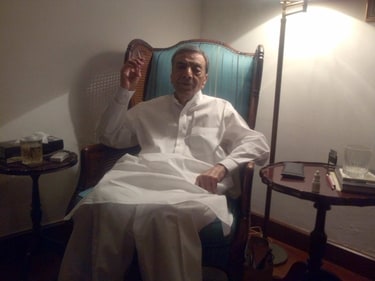
I say fastidious but in fact he is better described by the Urdu word nafasat, which means polished, but also carries connotations of sophistication, purity and connoisseurship. A few years ago, when we performed at the Karachi Literature Festival he invited us home. As expected, his house in the posh Defence area of Karachi was exquisitely done up, dotted with several works by the great Sadequain. He greeted us in a plain white salwar kamiz, which was starched, much like the man himself. I have rarely seen a more sprightly, advanced octogenarian. He insisted on serving us our drinks. In his study there was a special arm chair with angular lighting, which is where he sat and enjoyed his cigarettes. He listened to some excerpts from us, and then did me the honor of asking me to listen to and direct a few students of his who were interested in emulating us in performing Dastangoi and had been practicing for some time. I say honor because who was I to impart anything to the students of the great Zia Mohyeddin. I suspect his gesture was more a deference to the great Shamsur Rahman Faruqi, my uncle and mentor and the then greatest living Urdu writer and critic, than to my skills. It was a memorable evening, complete with some ribaldry.
On a previous trip we had performed at the National Academy of Performing Arts, which he had set up at Karachi, and which bore his imprint, much like Ebrahim Alkazi moulded the National School of Drama. He made sure to include lessons in Kathak and music for his students. He was away at the time but we had the pleasure of a long mehfil in his office with Muhammed Ahmad Shah the President of the Karachi Arts Council, one of Karachi’s most famous sitarists Ustad Nafees Ahmed of the erstwhile Delhi gharana, and one of my great idols, one of the greatest actors produced by South Asia, Rahat Kazmi of Dhoop Kinare fame. As we got higher and higher--on Zia saheb’s scotch of course--conversation invariably turned political and our argument kept receding to periods further and further back in our history until I found myself on the floor!
Zia saheb was born in Lyalpur, now Faisalabad, in Pakistan where his family had migrated from Rohtak, India, and where his mathematician, musicologist, playwright, and lyricist father made his home. His cousin Daud Rahbar, the translator of Ghalib’s Persian letters, and an outstanding writer on Indian classical music describes how they immersed themselves in the local music scene. Around the same time as Alkazi, Zia saheb attended the Royal Academy of Dramatic Arts and then made a career in London where he spent nearly half a century as an actor in theatre, films and television, including Bombay Talkies and Immaculate Conception. He returned to Pakistan in the late sixties to host the popular Zia Mohyeddin show, and in one of its episodes, available on YouTube, he can be seen introducing a debutante called Moin Akhtar who went on to become a legendary actor and mimic. After Zia ul Haq came to power in Pakistan Zia Saheb returned to England where one of his last appearances was in a marvelous sitcom called Tandoori Nights, alongside Zohra Sehgal. He was invited by General Parvez Musharraf to launch the National Academy of Performing Arts, which he headed until his demise on Monday. His scintillating memoir A Carrot is a Carrot vividly brings out his rich and multifaceted life and his encyclopedic command of the literatures and performance traditions of the East and of the West.
Zia Mohyeddin was not a poet, nor a writer, but he popularized more of Urdu literature than anyone else. When I was growing up I spent hundreds of hours listening to his recitations. Like millions around the world I was introduced to Faiz by Zia Mohyeddin through audio cassettes which our cousins dutifully sent from Karachi whenever anyone visited. But he also recited Noon Meem Rashid, known as the poet of poets, and several other classical writers. His prose recitations of works such as Fasana-e Azad and Mushtaq Ahmed Yusufi form a staple of Dastangoi workshops. He not only dug out gems from the classical era but also taught us how to intone and enunciate phrases which have been lost to us. More than anybody else he taught us to read Urdu literature, of which he was a master. He created a veritable genre of performance for himself and was invited all over the world for evenings of recitations, which so far as I know, has few peers around the world. He was a connoisseur of all things literary and performative, an unforgettable teacher, and a giant unto himself. There is an Egyptian saying that when a storyteller dies an entire library dies with him, and this fits Zia Mohyeddin perfectly. There will be poets and writers galore but there will not be anyone who can so brilliantly present them to the world.
(Mahmood Farooqui is a writer, performer and an exponent of dastangoi)
Stay updated with all the Breaking News and Latest News from Mumbai. Click here for comprehensive coverage of top Cities including Bengaluru, Delhi, Hyderabad, and more across India along with Stay informed on the latest happenings in World News.


