
 E-Paper



Envisaged as means to check traffic snarls, Noida’s U-turns add to woes
These U-turns have been a cause for concern in the past years and more recently led to at least two fatal crashes in a month at a single point


What the Noida Police thought was its solution to solve traffic snarls, has turned into a problem. The flailing concrete arms of frequently encountered U-turns dotting all arterial roads in Noida were designed to ease traffic congestion or add to the convenience of residents. Instead, they have become killers.
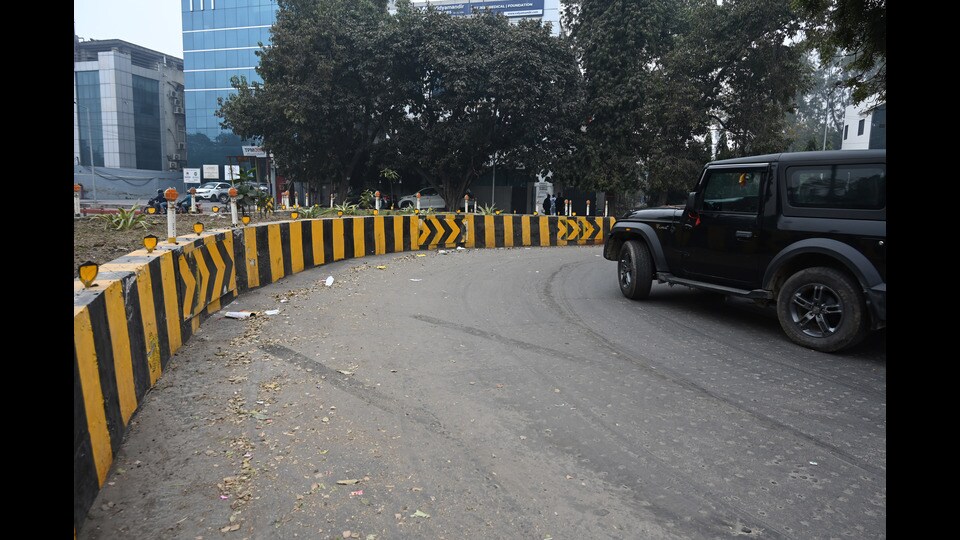
The concrete arms blocking a portion of the carriageway marking a U-turn is a Noida-specific design not seen in any other city of the National Capital Region (NCR). These U-turns have been a cause for concern in the past years and more recently led to at least two fatal crashes in a month at a single point.
There are at least over 40 such U-turns on all arterial roads of Noida that stick out from the high concrete central verge.
Early in the morning on January 22, a 30-year-old man was charred to death after his speeding car rammed into a U-turn and caught fire near Sector 59 Metro station. Around a month ago, a bus also rammed into the divider of the same U-turn. But there were no fatalities.
The authorities are also aware of the problem caused due to these U-turns. They have recognized that these misconceived U-turns are faulty, need design changes and have become accident-prone spots in their current form.
“There have been complaints in the past too and surveys were done. We plan to get the U-turn design checked again from next month onwards and will take opinion from experts as well,” said deputy general manager (traffic cell), Noida Authority, SP Singh.
In 2022, the Noida Police had said that it would prepare a list of all such accident hot spots, including these U-turns that jut out abruptly encroaching into the middle of the road unannounced in the absence of signage or warning signs.
The list had to be prepared using data from the integrated road accident database (iRAD), a Central government approved system used to create a database of all crashes across the country.
According to deputy commissioner of police (traffic) Anil Yadav, they have discussed the U-turn designs in the past as well and have informed the Noida Authority about how these (designs) have been causing crashes.
“We had, in particular, mentioned the U-turn in front of Hyde Park society in Sector 78. We are hoping that some action will be taken soon,” he said.
These 50-odd U-turns, the concrete arms of which jut out into the middle of the traffic, have turned things the wrong way both for the traffic police and commuters.
Commuters have long been complaining that these U-turns are dangerous and can cause fatal accidents, especially at night, more so during winters when there are visibility issues owing to fog.
One case that stands out as the most baffling is the U-turn near Gate 2 of Sector 15A. This U-turn, which is in the middle of fast-running traffic on the Noida Expressway, connects two fast-paced traffic lanes on either side, something that is not advisable.
Another classic case is the road from Hoshiarpur to Noida City Centre. The road from Hoshiarpur in Sector 51 to the Logix Mall has brought to light another menace caused by these U-turns.
Vehicles, especially two-wheelers, blatantly approach these U-turns from the wrong side for a short cut. This has further added to the litany of dangerous road traffic issues caused by these U-turns.
The U-turns on the Parthala Chowk to Sector 71 road is yet another menace. Firstly, the lumen of the U-turn is narrow. Secondly, the intervention is used by commuters to move to a service lane that feeds into residential societies.
Commuters have long rued that they have to negotiate high-speed traffic coming from Sectors 120, 119 etc. to proceed towards the service lane.
In another example, the entire road from 7X sectors to Sector 62 that merges with the Meerut Expressway is dotted with such U-turns -- the main cause of painful traffic congestion during peak hours and sluggish movement even otherwise.
“We have made innumerable complaints about these U-turns. At some places these are narrow, at other places they appear suddenly on a congested road, forcing commuters to change lanes in a rush. These are badly made and have been leading to crashes,” said Brajesh Sharma, a resident of Sector 76.
Residents added that the U-turn design is also confusing and unscientific as the concrete partition appears suddenly on the right side that is supposed to be the fast-moving overtake lane.
According to Vishnu Saini, a transport consultant and resident of Sector 137, people drive fast on the right side, as it is supposed to be the overtake lane. For U-turn, there is a proper signage and deacceleration lane. It is not provided here so that people can reduce speed.
“There is also no margin lane for vehicles that are merging with fast-moving traffic. Also, most of these U-turns are at crowded places that add to the confusion amid heavy traffic,” he added.
Experts suggest using Transverse Bar Markings (TBMs) and signage as cost-effective solutions to reduce speeds before reaching the point.
According to urban planning experts, controlling speed is the only way to reduce crashes at these points.
“Instead of the concrete crash barriers wire ropes should be used and clear signages have to be put up at least 100 metres before, leading up to the U-turn,” said S Velmurugan, chief scientist and head of traffic engineering and safety division of Central Road Research Institute (CRRI).
The expert said the idea is to reduce speed before the vehicles reach the U-turn and not at the location of the U-turn.
He added that the signages along with the TBMs are among the most cost-effective solutions, compared to changing the design. The use of thermoplastic paint is suggested for these markings.
“TBMs are markings on the road that alert commuters in advance that there is U-turn or a crash prone zone ahead. Drivers will slow down seeing these markings and this will ensure that even if there is a crash, its impact will be less and there will not be a fatality,” said Velmurugan.

Stay updated with all the Breaking News and Latest News from Mumbai. Click here for comprehensive coverage of top Cities including Bengaluru, Delhi, Hyderabad, and more across India along with Stay informed on the latest happenings in World News.


