
 E-Paper



Experts work overtime to fix explosives ahead of demolition deadline of Noida twin towers
Officials said that as the fixing of explosives is being completed, the elevator access will also be removed for additional security. Presently, the elevator access is available only in Apex tower while the team uses intermediary walkways built between the two towers to cross over to Ceyanne. The lift has already been removed from the top floors and is only up to the 23rd floor now


On the second day of charging of the Supertech twin towers at Sector 93A in Noida on Sunday, demolition experts said that they have completed fixing explosives on three floors each of both the Apex and Ceyanne towers.
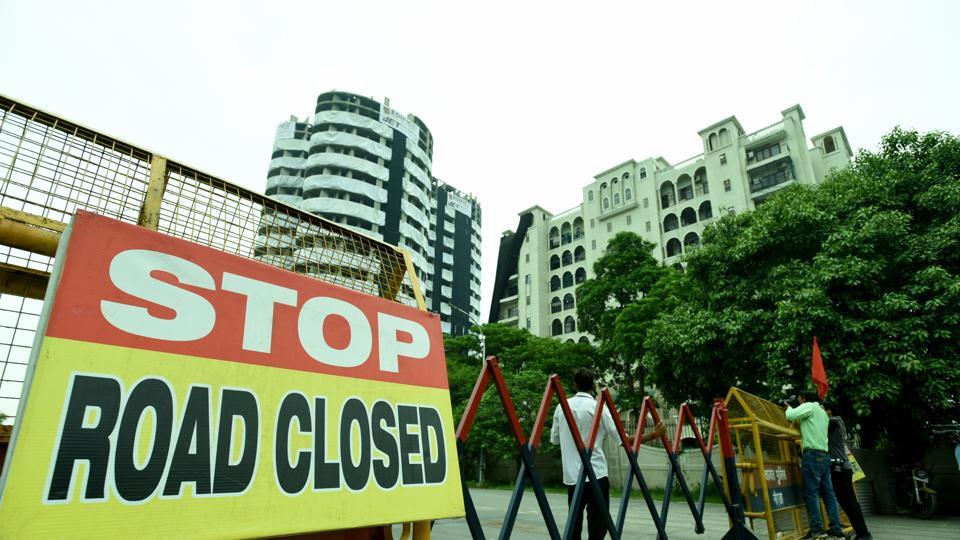
Officials from Edifice Engineering and Jet Demolition are fixing explosives on the 32-storey twin towers ahead of the demolition on August 28. Officials said that work has started from the top floors of both the towers simultaneously and will gradually go downwards. Nearly every alternate floor is planned as a blast floor where explosives have to be fixed. So far, explosives have been fixed on floors 30, 28 and 26 in Apex and 28, 26 and 24 in Ceyanne, officials added.
“Since we don’t have much time, work has been expedited and we are making the most of the daylight hours. The team has already covered three days’ work in two days,” said Mayur Mehta, project manager, Edifice Engineering.
Officials said that as the fixing of explosives is being completed, the elevator access will also be removed for additional security. Presently, the elevator access is available only in Apex tower while the team uses intermediary walkways built between the two towers to cross over to Ceyanne. The lift has already been removed from the top floors and is only up to the 23rd floor now.
“Once the explosives are connected, we will have to make multiple trips up to the 32nd floor using the staircases,” added Mehta.
There are 16 teams of three members each working on charging and connecting the explosives. These include 10 teams headed by Indian certified blasters and two assistants who are charging the columns or putting explosives in varying quantities in accordance with the blast design.
Another six teams are headed by foreign blasters along with two assistants, who are making the initial inter-connections between the columns.
Mehta explained that there are five main steps in the entire charging process. The first step is the fixing of various kinds of explosives and shock tubes inside the holes that have been drilled earlier in each column. The second process is stemming. Once the explosives are fixed, stemming foam and plugs are used to fill up these holes so that there is no leakage of the explosives and it also reduces the amount of flying debris during the blast.
The third step is interconnecting all the shock tubes in all the columns. The fourth step is trunking wherein all the explosives or shock tubes from every floor are connected with the floor below it.
“The final step is connecting all the explosives with a simple wire to an ignition point. This point has an exploder which has a dynamo inside. It also has a handle to charge the dynamo. The basic purpose of this device is to provide a tiny charge or power that will send a small shockwave and ignite all the shock tubes towards the blast,” explained Mehta.
Once charging is done, the interconnections will also be checked at least twice and once more on the day of the blast. The rechecking on the day of the blast will take at least four hours, said officials. The entire implosion from the first blast to the last part of the building hitting the ground will take around 12-15 seconds, officials added.
Stay updated with all the Breaking News and Latest News from Mumbai. Click here for comprehensive coverage of top Cities including Bengaluru, Delhi, Hyderabad, and more across India along with Stay informed on the latest happenings in World News.


