
 E-Paper



Ghaziabad: Infrastructure works, sludge obstructed free flow of river Hindon, say environmentalists
In 2010, the construction of a major overbridge began near Karhera. City-based environmentalist Vikrant Sharma approached the National Green Tribunal (NGT), raising concerns that mud and debris were being dumped on both sides of the bridge, narrowing the river’s natural flow and space

 Prefer HTon Google


In the aftermath of river Hindon’s flooding, which submerged large areas near the floodplains and various localities like Karhera, a team of workers and machinery was seen on Wednesday, actively clearing debris, sludge, and overgrown vegetation from the riverbed near the Hindon barrage in Ghaziabad.
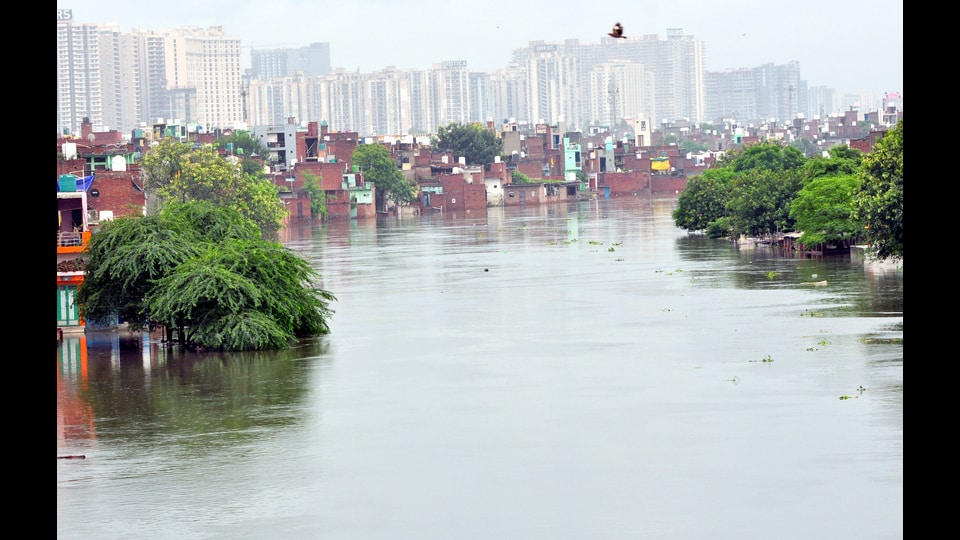
Environmentalists argue that the river’s restricted flow, resulting from various factors, has contributed to the flooding of areas like Karhera.
On one side of the river Hindon lies an embankment near Raj Nagar Extension, and another near the Haj House, while the upstream on the Karhera side lacks any such embankment.
In 2010, the construction of a major overbridge began near Karhera. City-based environmentalist Vikrant Sharma approached the National Green Tribunal (NGT), raising concerns that mud and debris were being dumped on both sides of the bridge, narrowing the river’s natural flow and space. The tribunal, in its final order on May 15, 2013, directed the construction of additional pillars.
The tribunal’s order stated, “Obviously, the result of this answer is that it is bound to obstruct the natural flow of the river in question to which the solution is very simple that additional pillars on either side of the bridge can be constructed, as presently the bridge is under construction has not been completed...”
While ordering the construction of these pillars, the tribunal said, “Consideration should ensure that the approach road does not fall within the flood plain of the river in question.”
Sharma said that the approach on the Raj Nagar Extension side of the bridge obstructed the river’s flow, reducing its flowing area. “The free flow of the river got obstructed due to this as the river flow has a turn near the bridge. This obstruction causes the water to move towards Karhera and thereby leads to flooding. The approach on both sides of the bridge was filled with earth and it obstructed the free flow of the river,” Sharma said.
After the tribunal’s directive, Sharma filed an RTI in 2013 with the Ghaziabad Development Authority (GDA) to inquire about the status of the directed pillars. The GDA’s response on July 31, 2013, stated that a study was assigned to a specialized agency in Roorkee, and action would be taken based on their recommendations.
When HT reached out to GDA’s officiating chief engineer Manvendra Singh he said that he was out of station for official meetings in Lucknow and cannot comment about the status of work on an immediate basis.
Sharma further added that two additional infrastructure projects were constructed near the GT Road and the Hindon barrage, utilizing the riverbed. “A significant amount of debris and sludge remains, necessitating a study to identify the issues impacting the river’s free flow. These obstructions not only disrupt the river flow but also reduce its water holding capacity,” he said.
According to environmental lawyer and Ghaziabad resident Dipesh Chaudhary, other issues that require attention include the construction of houses and structures on floodplains and irregular cleaning of the river. “The Regional Rapid Transit System (RRTS) project also utilized the river for constructing pillars, increasing the chances of settling materials on the riverbed. Additionally, an electricity sub-station (220kv Morti) was constructed on the floodplain near Karhera, which could contribute to further inundation of nearby areas,” he said.
HT raised a query regarding the Karhera bridge with Sandeep Kumar, chief engineer of the UP Irrigation Department (UPID), on Tuesday. While he promised a response, it was awaited till the filing of the report on Wednesday evening.
Meanwhile, UPID officials in Ghaziabad said that they are actively working to clean the river and remove debris. They initiated a cleaning exercise on Wednesday, focusing on downstream areas near the Hindon barrage, where obstruction and boulders were evident. The RRTS project agency also deployed machines to assist with the clearing process.
“Since the upstream areas were flooded, we got cleaning exercise done on Wednesday as there was obstruction and boulders were also seen there. This area is downstream near the Hindon barrage and also the nearby area where pillars of RRTS have been constructed. There was obstruction to the flow and we are getting it removed. Machines were also deployed by the RRTS project agency for our help,” said Sanjay Singh, executive-engineer from UPID.
Officials from the NCR Transport Corporation (NCRTC), responsible for the RRTS project, said that the entire river area they used was cleared in December 2021 after the completion of the project. “As informed recently, silt and vegetation developed in the river causing slow flow of water. To remove it, men and machines are deployed in coordination with the irrigation department to ensure smooth flow of the river,” said Puneet Vats, chief PRO of NCRTC.


