
 E-Paper



Noida most polluted in India post-Diwali, Ghaziabad, G Noida not far behind
According to the Central Pollution Control Board (CPCB), Noida was the most polluted city across the country on Friday with an AQI reading of 475 (severe). The air in Ghaziabad and Greater Noida was no better, as the AQI reached the “severe” category with readings of 470 and 464, respectively.

 Prefer HTon Google


Residents in Ghaziabad, Noida and Greater Noida breathed this season’s worst air on Friday as, for the first time since the Graded Response Action Plan came into effect on October 15, the Air Quality Index (AQI) readings of the three cities breached the “very poor” category and spiked to “severe” a day after Diwali.
According to the Central Pollution Control Board (CPCB), Noida was the most polluted city across the country on Friday with an AQI reading of 475 (severe). The air in Ghaziabad and Greater Noida was no better, as the AQI reached the “severe” category with readings of 470 and 464, respectively.
An AQI reading between 0 and 50 is considered “good”, 51 and 100 “satisfactory”, 101 and 200 “moderate”, 201 and 300 “poor”, 301 and 400 “very poor”, and 401 and 500 “severe”.
Officials of the Uttar Pradesh Pollution Control Board (UPPCB) attributed the sudden spike in pollution levels to the bursting of firecrackers on Diwali (Thursday) and stubble burning in neighbouring states.
“The air quality of the region was impacted as firecrackers were burnt on Thursday evening and the air quality continued to deteriorate till 3am on Friday. Thereafter, we witnessed a downward trend. The pollution levels have also increased because of stubble burning in the neighbouring states. It is likely, as per the pollution pattern, that the air quality will improve from November 7,” said Utsav Sharma, regional officer of UPPCB, (Ghaziabad), who is also officiating for Noida.
The System of Air Quality and Weather Forecasting and Research (Safar) in a forecast said that firework emissions on the night of Diwali degraded air quality from “very poor” to “severe” category, as predicted.
“The share of stubble emissions has peaked today (Friday) at 36%. In the last 24 hours, PM2.5 level is higher as compared to 2020, but much less than that in 2018. However, it may be noted that local winds have picked up since morning and now fast dispersion is expected. Without any more firecracker emissions, AQI is likely to improve to ‘very poor’ category by tonight (Friday night) although stubble contribution is expected to remain almost the same as today,” said the Safar forecast on Friday.
It added relief from “severe” pollution is expected only from the evening of November 7, but the air quality might remain in the “very poor” range.
According to CPCB, on Thursday, the AQI of Ghaziabad and Noida was recorded in the “severe” category with readings of 419 and 404, respectively. Greater Noida had “very poor” air with a recording of 322.
Last year on Diwali (November 14), the AQI of Ghaziabad and Noida was recorded in the “severe” category, with readings of 456 and 425 respectively, while Greater Noida’s air quality was in the “very poor” category with a recording of 394.
Despite no licences, residents buy firecrackers
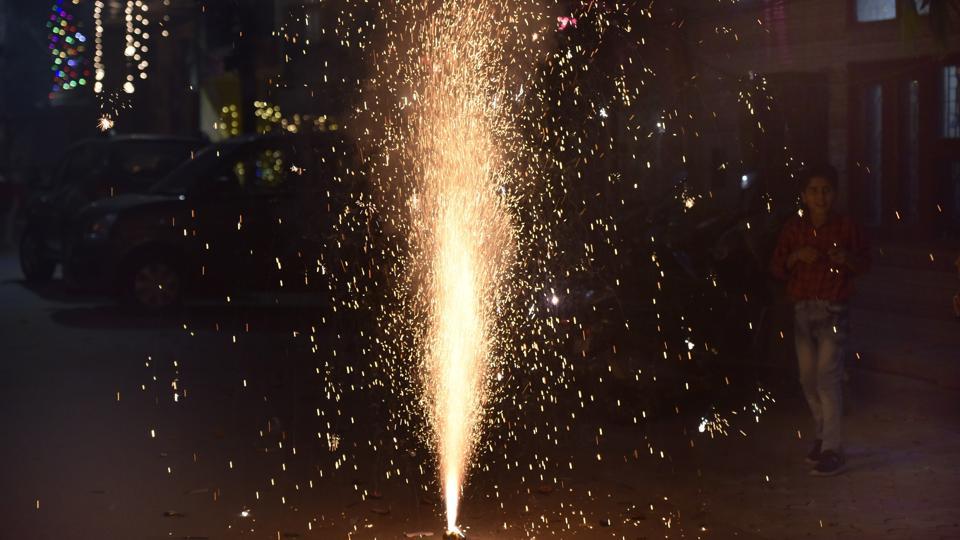
In both Gautam Budh Nagar and Ghaziabad, authorities did not issue any licence for the sale of firecrackers. However, residents managed to buy crackers and burst them till late Thursday night in both districts.
Brajesh Sharma, a resident of Antriksh Golf View 2 in Noida’s Sector 78, said a number of people burst firecrackers on Thursday night.
“The police and administration had informed people that firecrackers were not allowed. However, people managed to get firecrackers and burst them from 8pm till midnight. This led to a rise in pollution levels and poor visibility in Noida,” said Sharma.
He said on Friday morning, he drove to his office in Delhi amid such low visibility that he was hardly able to see anything even 50 metres ahead. “I was not able to clearly see the Yamuna river while driving on the DND flyover,” said Sharma.
“Residents burst a lot of crackers despite the fact that no licence was issued this year or last year. There was no enforcement and the bursting of firecrackers went on until very late at night,” said Alok Kumar, a resident of Arihant Harmony in Indirapuram.
According to official statistics from the Consortium for Research on Agroecosystem Monitoring and Modelling from Space (CREAMS) Laboratory of the Indian Agricultural Research Institute, there were 3,032 fire counts reported from Punjab, 228 from Haryana, 123 from Uttar Pradesh, 19 from Rajasthan and 123 from Madhya Pradesh on November 4.
Authorities in both districts admitted people burst firecrackers on the night of Diwali but emphasised that they did enforce rules.
“We will recover environment compensation cost from erring persons, who are being identified with the help of video records. There was some bursting of crackers but residents in most localities celebrated the festival peacefully. The spike in pollution is also because of the high volume of traffic on roads during the festival,” said Rakesh Kumar Singh, district magistrate of Ghaziabad.
Love Kumar, joint commissioner of police, Gautam Budh Nagar, said that the commissionerate had not issued licence to any vendor to sell firecrackers this year.
“The police deployed enforcement teams and registered cases against five vendors for unauthorised sale of crackers. In some cases, police also stopped people from bursting firecrackers. It seems somehow people managed to get firecrackers and burst them on Diwali,” he said.
Health experts said with the spike in pollution levels, health ailments are expected and may include burning of eyes, watering and redness of eyes, nasal congestion, runny nose, frequent sneezing, headache, breathlessness, cough and chest heaviness among others.
“The effect that air pollution has on lungs depends on the type and mix of pollutants in the air, the concentration of pollutants and how much of the pollutant gets into the lungs... the deteriorating AQI makes even non-smokers highly susceptible to the risk of developing chronic obstructive pulmonary disease (COPD) and other life-threatening lung diseases,” said Dr Sharad Joshi, principal consultant (pulmonology), Max Hospital, Vaishali.


