
 E-Paper



RRTS project: Trial run on ‘priority’ stretch in Ghaziabad to commence in December
According to NCRTC sources, the completion period for the ‘priority’ section is four years, while the entire 82-km RRTS corridor from Delhi to Meerut will be completed in six years from the date of commencement of work. Construction work for the RRTS project started on June 3, 2019


The much-awaited trial run for the Regional Rapid Transit System (RRTS) trains is likely to start in December. The National Capital Region Transport Corporation (NCRTC), which has undertaken the RRTS project, will be initiating the process with at least three trains on the 17-kilometre-long ‘priority’ section in Ghaziabad, sources said on Thursday. NCRTC officials said that a third train-set has already reached the Duhai depot for the purpose.
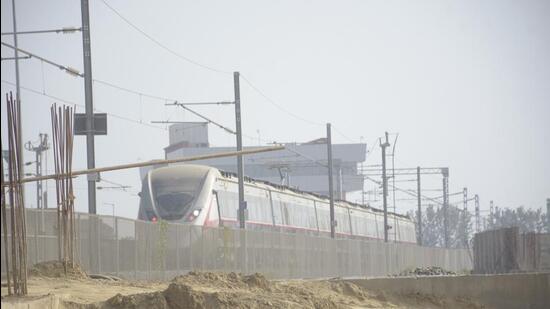
The 17-km ‘priority’ section that will connect Sahibabad to Duhai is slotted for commencement of passenger operation in March 2023, and the trial run of the RRTS trains will go on for four months, sources added.
“We will procure 30 RRTS trains for the 82-km corridor while the trial run for the ‘priority’ section will initially start with three trains. The third train-set arrived at Duhai on Thursday. We are targeting commencement of passenger operations in the ‘priority’ section in the month of March next year, which is ahead of the prescribed deadline,” said Puneet Vats, NCRTC chief public relations officer.
According to NCRTC sources, the completion period for the ‘priority’ section is four years, while the entire 82-km RRTS corridor from Delhi to Meerut will be completed in six years from the date of commencement of work. Construction work for the RRTS project started on June 3, 2019.
The first full train-set comprising six coaches arrived in Duhai from the manufacturing facility at Savli in Gujarat on June 12. The NCRTC will rope in 30 such high-speed trains for the entire 82-km corridor, while 10 other trains will also run as a local transit module in Meerut.
“Static and dynamic testing of RRTS train-sets at the Duhai depot is in progress. After successful completion of the tests, integrated testing of the trains will be carried out, in which rolling stock, signalling and power supply will be tested. After successful testing, a pre-operational trial will be carried out. After the successful completion of the trials, the trains will be made operational for passengers,” said an NCRTC official.
The NCRTC has planned a host of measures to save energy and generate about 10 million units of power annually by the year 2025, when the RRTS project gets fully commissioned.
Officials said that one of the important features that will save energy in the RRTS trains is the selective opening of doors.
“The doors of coaches will automatically open only when passengers are waiting to deboard. The doors will not open when there is no passenger to deboard. In such cases, other passengers waiting in the platforms can use a button to open the doors from outside. This will help save energy and all the trains will be equipped with this feature. During the trial run, the train operations will be controlled from the control centre at the Duhai depot in Ghaziabad,” Vats added.
During the trial run, the RRTS trains will attain a running speed of 160 kilometres per hour (kmph).
Official sources also said that once the entire 82-km section is ready, the command centre at Jangpura in Delhi will act as the main control centre, while the Duhai depot will be a backup control centre. They added that a third control centre is also being planned at Modipuram in Meerut.
The RRTS project is getting developed at a cost of about ₹30,274 crore and is estimated to take about 100,000 vehicles off roads, while attracting a daily ridership of about 800,000 passengers, sources added.

Stay updated with all the Breaking News and Latest News from Mumbai. Click here for comprehensive coverage of top Cities including Bengaluru, Delhi, Hyderabad, and more across India along with Stay informed on the latest happenings in World News.


