
 E-Paper



Supreme Court accepts traffic plan drawn up for Kaushambi, closes PIL by resident
The order came on a petition filed by VK Mittal, a resident of Kaushambi, who apprised the court of the hardships faced by the constant movement of interstate buses that clog the roads outside the Inter-State Bus Terminus in Anand Vihar in the vicinity


The Supreme Court on Tuesday closed proceedings in a public interest litigation (PIL) filed by a resident of Ghaziabad’s Kaushambi, seeking an effective traffic management plan for the area, almost 20 months after such a plan was jointly prepared by authorities of Delhi and Uttar Pradesh following a court order in March last year.
After going through the submitted plan, a bench of justices Aniruddha Bose and Bela M Trivedi said, “We do not think any further purpose will be served by keeping this petition pending as it is stated that the respondents (Uttar Pradesh government and Ghaziabad Nagar Nigam) are in the process of implementing the traffic management plan.”
The committee, comprising members of both states, which prepared the traffic plan, was also dissolved by the same order.
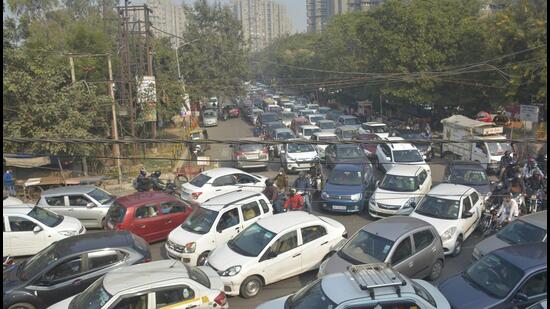
The order came on a petition filed by VK Mittal, a resident of Kaushambi, who apprised the court of the hardships faced by the constant movement of interstate buses that clog the roads outside the Inter-State Bus Terminus in Anand Vihar in the vicinity. Due to the heavy volume of traffic, especially of diesel-run buses, residents said they suffered breathing disorders. They also complained of haphazard parking, encroachment of public roads and green spaces and a total absence of law enforcement.
The petitioner, represented by advocate Gaurav Goel, requested the court to either dispose of the petition with some timebound directions or to keep the committee functioning so that it could ensure implementation of the plan.
The committee comprised divisional commissioner, Meerut; chairperson, Ghaziabad Development Authority; municipal commissioner, Ghaziabad Nagar Nigam; district magistrate, Ghaziabad; UP State Road Transport Corporation (UPSRTC) chairperson, senior superintendent of police, Ghaziabad; municipal commissioner, East Delhi Municipal Corporation; a nominee of Delhi Police commissioner; and transport secretary of the Delhi government.
The committee was formed by the court on March 24 last year and it submitted an action plan to the court in April 2021. Since then, no effective hearing took place in the matter. On Friday, the UPSRTC, Ghaziabad Nagar Nigam and UP government told the court that the plan was in the process of being implemented.
Advocate Goel told the court that the plan failed to consider two other aspects -- dealing with phasing out diesel-run buses of UPSRTC and the encroachment of green belt.
State additional advocate general (AAG) Garima Parshad said the state was in the process of phasing out short route UPSRTC diesel buses to CNG. As regards long route buses, she stated that these will be upgraded from BS-IV to BS-VI. “It may take some time but work has already commenced,” she said.
As regards encroachment, the bench said, “The authorities shall ensure that any encroachment in green zones/belt are cleared in due course.”
As regards further directions on environmental degradation due to pollution or encroachment, the court permitted the petitioner to approach the high court concerned or the National Green Tribunal (NGT).
The proceedings before the court on Tuesday were in stark contrast to the March 24 order passed by a three-judge bench headed by justice Dhananjaya Y Chandrachud (the present CJI).
In that order calling for the traffic management plan to be prepared by the nine-member committee, the court said, “The problems which have confronted Kaushambi and Ghaziabad, in general, cannot be treated in a manner isolated from the wider context of the National Capital Region. This is not merely a matter which pertains to the Ghaziabad Development Authority or, for that matter, other authorities within the state of Uttar Pradesh alone.”
Placing the matter on a wide canvas, the court called for a “coordinated effort” on part of the authorities within Delhi as well as the statutory authorities of Uttar Pradesh.
The matter was first taken by the petitioner to NGT which dealt with the issue in the year 2020 and passed a slew of directions that remained unimplemented. One instance noted by the top court in its March 2021 order, after perusing photographs, was the flagrant violation of the “no parking” boards and signboards put up in the area.
The latest order of the court recorded this fact. “This problem has to be addressed by proper management of traffic and creating adequate space for parking. Merely treating it as a matter of law enforcement will not provide a longlasting solution. Ad hoc reactions to a deeper malaise will bring no relief to residents, users of public transport and those providing public transport.”
Stay updated with all the Breaking News and Latest News from Mumbai. Click here for comprehensive coverage of top Cities including Bengaluru, Delhi, Hyderabad, and more across India along with Stay informed on the latest happenings in World News.


