
 E-Paper



Shrinking lanes choke Delhi-Noida route
The problem is most acute for vehicles travelling from Noida towards Delhi, with the tailback routinely extending from the Film City Flyover towards Amity University in Sector 126

 Prefer HTon Google


For thousands of commuters travelling between Delhi and Noida every day, the most frustrating part of the journey is not the distance between the two cities but a two-kilometre stretch where six lanes suddenly become three, often leading to serpentine jams that stretch several kilometres on the Noida-Greater Noida Expressway.
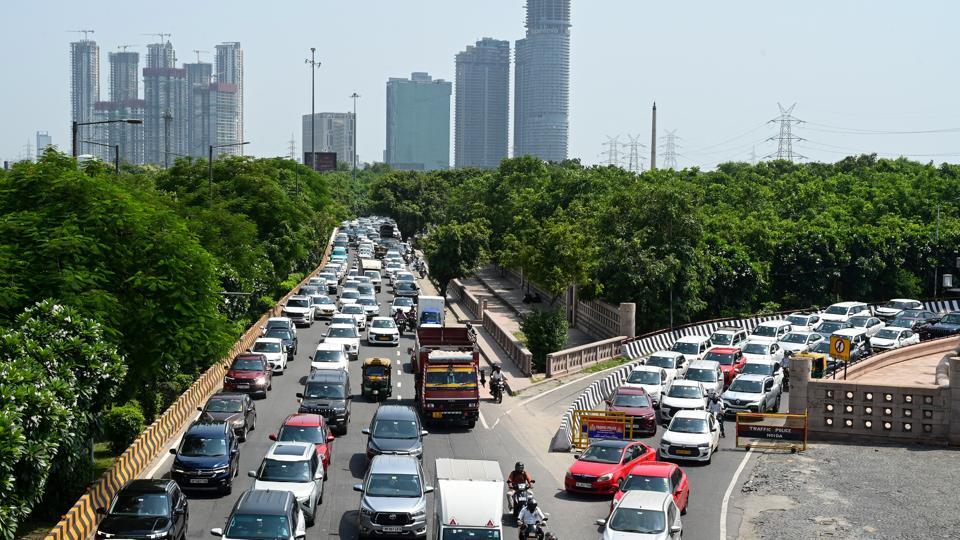
The bottleneck on the expressway, on the 2km stretch between the Mahamaya Flyover and the exit towards the Delhi-Noida-Direct (DND) Flyway, has increasingly turned into a daily nightmare, with queues stretching several kilometres during the morning and evening rush hours.
The problem is most acute for vehicles travelling from Noida towards Delhi, with the tailback routinely extending about 4km, from the Film City Flyover towards Amity University in Sector 126.
For commuters, the lane-reduction arithmetic is particularly unforgiving: a road built to carry substantially less traffic is now expected to handle more than twice that volume, while the available lanes narrow precisely where several major traffic streams converge.
“Around 450,000 vehicles are crossing that stretch every day,” said Abhay Kumar, deputy commissioner of police (Noida Traffic).
Traffic police estimates suggest around 350,000 vehicles cross Chilla Border every day, where the expressway eventually meets Delhi near Mayur Vihar, while another 400,000 use the DND border. The expressway itself was designed to handle only around 150,000 vehicles, officials said.
The pressure has grown with the expansion of residential and commercial sectors along the expressway, including Sectors 150, 128, 132, 110, 108, 105, 135 and 134.
For much of its length, traffic on the Noida-Greater Noida Expressway moves relatively smoothly. The predominantly four-lane road (and a breakdown lane) and two-lane service roads on either side, expands to six lanes after traffic from Sector 37 and Kalindi Kunj merges with it.
Then comes the abrupt squeeze.
Near Gate 2 of the Rashtriya Dalit Prerna Sthal, the six lanes reduce to four and, a short distance later, to three near the Film City Flyover. At almost the same point, another three-lane stream of traffic from the Sector 62-18 elevated road merges into the corridor.
The result is absolute pandemonium: thousands of vehicles competing for fewer lanes, with traffic police forced to regulate the flow through stop-and-go movement.
“Due to this bottleneck, the expressway traffic slows down and creates long queues of vehicles during peak traffic hours,” Kumar said. “The vehicle pressure on that stretch is more than the capacity of the road. We deploy additional traffic police personnel during peak hours.”
Barricading that blocks two lanes of the Film City Flyover further compounds the problem. Before the DND exit, illegally parked vehicles near the ticket counter of the Dalit Prerna Sthal, including those of visitors and hawkers, adding even more to the congestion.
There is also a human factor. Police said poor lane discipline among drivers adds to the chaos, with motorists heading towards Sector 18 or DND often moving into the extreme right lane before abruptly diving to the left.
Traffic police began issuing challans for lane violations in the area in February 2025.
But lane discipline can only go so far when the infrastructure itself is the bottleneck. Traffic from the expressway, Sector 37, Kalindi Kunj, the Sector 62-18 elevated road, Sector 18 and the Film City Flyover all converge around the same point.
Authorities insist that they have tried to find temporary solutions. In June 2025, the Noida Authority planned a 600-metre-long, 5.5-metre-wide road between Sector 95 and the DND Flyway alongside the Rashtriya Dalit Prerna Sthal. The proposal was abandoned after the authority failed to obtain a forest department NOC for cutting trees.
The memorial’s sandstone divider and a Film City Flyover pillar also restrict the available space.
“We have surveyed but except for the Chilla Elevated Road, there is no other alternative to decongest that stretch,” said SP Singh, deputy general manager, Noida Authority.
That leaves commuters with an uncomfortable answer: wait.
Dr S Velmurugan, head of the traffic engineering and safety division at the Central Road Research Institute, said the road carried around 150,000 vehicles a day in 2013-14 but is now expected to handle more than double that volume.
“As traffic pressure increased over time, the road, which was carrying nearly 150,000 vehicles every day in 2013-2014, is now expected to handle more than double that volume,” he said. “The road is not designed to bear such massive vehicular traffic pressure,” he said, adding that the only option left was to wait for the Chilla Elevated Road.
For commuters, however, the consequences are measured not in traffic volumes but in lost time.
“The problem is that the road narrows suddenly, and thousands of vehicles are forced to squeeze into fewer lanes. Even if you start early, you cannot predict how much time you will lose at this bottleneck,” said Brajesh Sharma, a Sector 78 resident who drives to Siri Fort in Delhi. “Because of this stretch, my travel time has increased by 30 minutes.”
Vikram Gupta, a Sector 168 resident, said the congestion had become a daily struggle, especially since he has no option but to cross the stretch daily. “We understand that traffic volume has increased but commuters cannot wait for years for a permanent solution. We have no option but to remain stuck in the queue because all routes towards Delhi face similar congestion. The authorities should take immediate steps to ease the bottleneck,” he said.
To be sure, the expressway also connects Noida and the wider NCR with western Uttar Pradesh, bringing substantial outstation traffic. The opening of the Noida International Airport in Jewar is expected to add further pressure.
The six-lane Chilla Elevated Corridor, being built at a cost of ₹893 crore, is expected to provide relief by allowing Delhi-Noida traffic to bypass the bottleneck. But the project, conceived a decade ago, has itself been delayed.
Construction began in 2019 after the project gained momentum in 2018, but financial and logistical problems, including gas pipeline realignment and the Covid-19 pandemic, halted work in 2020 when only 13% had been completed. Work resumed in early 2025 and the project is currently 47% complete.
The latest target is July 2027 – still around 10 months away.
Until then, commuters are effectively being asked to endure the consequences of an infrastructure mismatch that has been visible for years: more vehicles, more merging traffic and fewer lanes at precisely the wrong place.
“If the authorities are aware that the Chilla Elevated Road is the only option that can bring relief, they should expedite the project,” Sharma said. “Someone should take responsibility and ownership to ensure that the project is completed on time, especially when it is needed the most.”


Stay updated with all the Breaking News and Latest News from Mumbai. Click here for comprehensive coverage of top Cities including Bengaluru, Delhi, Hyderabad, and more across India along with Stay informed on the latest happenings in World News.


