
 E-Paper



Noida sees cleanest Earth Day since active pollution monitoring began in 2018
According to the data assessed, the average PM2.5 for Noida for Earth Day 2020 was 54.9 microgrammes per cubic metres (Ug/m3), against 78.97 Ug/m3 on Earth Day 2019, and 98.46 Ug/m3 in 2018.

 Prefer HTon Google


With Wednesday marking the 50th anniversary of ‘Earth Day’ – a day that aims at enhancing environmental education and awareness -- Noida saw the cleanest Earth Day in the past three years with particle and gaseous pollutants well within prescribed limits.
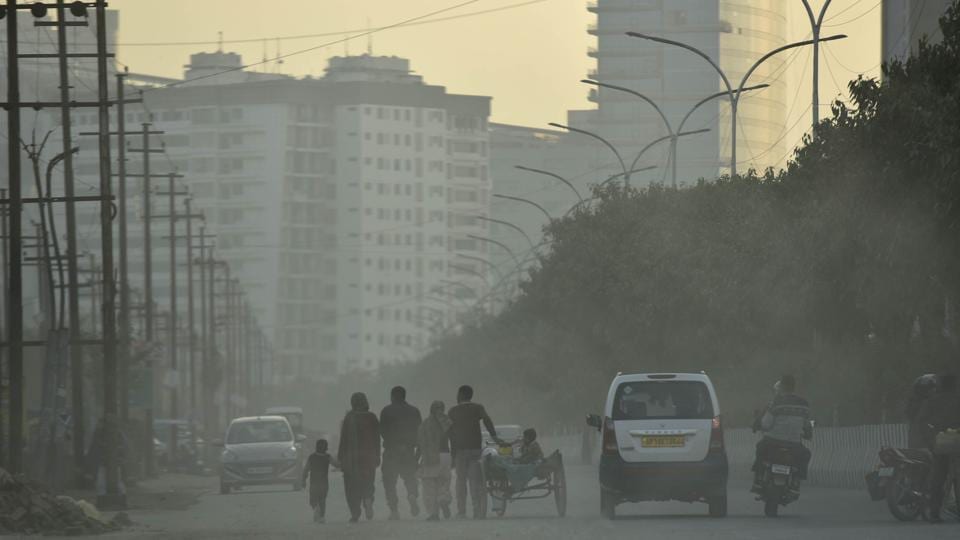
According to data assessed through the Central Pollution Control Board (CPCB), the air quality index (AQI) of Noida, on a scale of 0 to 500, was 88 or ‘satisfactory’ on Wednesday, against 168 or ‘moderate’ the same day last year, and 262 or ‘poor’ in 2018.
Interestingly, while the theme for 2020 is climate action, it’s not the mitigation measures taken by the authorities but rather the nationwide lockdown that has given the city the cleanest Earth Day since active monitoring of the pollution levels began in 2018.
According to the data assessed, the average PM2.5 for Noida for Earth Day 2020 was 54.9 microgrammes per cubic metres (Ug/m3), against 78.97 Ug/m3 on Earth Day 2019, and 98.46 Ug/m3 in 2018. The PM2.5, or particles with diameter less than 2.5 microns, are coarse particle pollutants produced from industrial and vehicular emissions. The safe limit for PM2.5 is 60 Ug/m3, going by national standards.
The average PM10 also dropped, though not under the prescribed limit just yet, with Wednesday seeing an average of 111.84 Ug/m3, while last year the same was 203.24 Ug/m3, and in 2018 it was 280.21 Ug/m3. The PM10 safe limit is 100 Ug/m3, going by national standards.
The gaseous pollutant, nitrogen dioxide (NO2), which comes from industrial and vehicular fuel combustion, however, fluctuated. Wednesday saw an average of 21.61 Ug/m3 of NO2, while the day in 2019 saw 18.19 Ug/m3 and 2018 saw 29.45Ug/m3 in NO2 values. The safe limit for NO2 is 40 Ug/m3 for industrial areas and 30 Ug/m3 for eco-sensitive zones, going by national standards.
Though the lockdown has reduced pollution levels due to lesser vehicular movement and industrial activities, experts believe they will spike sharply when the lockdown is over.
“One of the major reasons the air is cleaner is the reduction in the vehicular movement. However, there are chances that the pollution levels will spike sharply after the lockdown is over, people might prefer personal vehicles and avoid public transport in fear of the pandemic. The government has to ensure trust among people to ensure that public transport areas are safe. Also, local authorities must work on parking policies to discourage private vehicle movement,” said Shambhavi Shukla, senior project associate, air quality, Centre for Science and Environment (CSE), said.
According to Noida-based environmentalist Vikrant Tongad, strict measures would be required to minimise the likely risk of sharp spike in pollution.
“The air quality will obviously deteriorate after the lockdown is over. In such a case, the best that could be done is to minimise the impact of pollution on the local environment. The authorities will have to implement proper waste management rules, for both industrial and local waste, and ensure that industrial effluents are not discharged into rivers. Also there has to be accountability, so in case pollution levels spike, there could be liable agencies that could be held accountable,” said Tongad.
According to officials, while taking cars off the road has had a major impact on pollution levels, the post lockdown scenario will depend on the meteorological conditions.
“It’s obvious that the pollution levels will as the lockdown is in place, as the major reason (for emissions) is vehicles. You take the vehicles off the road and pollution drops. However, it also depends on the meteorological conditions. There would be a spike in pollution levels once the lockdown is over, but meteorological conditions will play a major role in controlling them,” said Utsav Sharma, environment engineer, Uttar Pradesh Pollution Control Board.
“Though Covid-19 is the major crisis that we are handling currently, the authority is already doing a lot of sprinkling for sanitisation, which also acts as a pollution cutting measures. There are a number of measures to be taken post lockdown, which are currently on hold due to the ongoing pandemic, such as water sprinkling, grassing and massive plantation. Controlling pollution will be our priority,” said Rajeev Tyagi, general manager, Noida Authority.


