
 E-Paper



Old Tehsil building — a link to the colonial era — to turn into Mewati Museum
Located along the erstwhile Delhi-Alwar Road, the colonial-era Old Tehsil building in Nuh is expected to get a fresh lease of life with deputy chief minister Dushyant Chautala announcing plans to turn the heritage structure into a ‘Mewati Museum’. Chautala had shared plans for the building last Sunday, while addressing a farmers’ gathering in Nuh.


Located along the erstwhile Delhi-Alwar Road, the colonial-era Old Tehsil building in Nuh is expected to get a fresh lease of life with deputy chief minister Dushyant Chautala announcing plans to turn the heritage structure into a ‘Mewati Museum’. Chautala had shared plans for the building last Sunday, while addressing a farmers’ gathering in Nuh.
The building was constructed by the British in 1872 and is currently being used as an administrative space by patwaris (rural registrars). In 2018, the state department of museums and archaeology had also initiated the process of taking the structure under protection, but the process is yet to be completed. While the preliminary notification was issued two years ago, the final notification is yet to be issued. Once converted, this will be the first government museum in both Nuh and Gurugram.
Banani Bhattacharyya, deputy director, Department of Archaeology and Museums, said that the Old Tehsil building is a heritage structure dating to 19th century and demonstrated colonial-era architecture. “The building was constructed in 1872 during the colonial period, as per the details mentioned in records. The construction unit comprises stones and lakhori bricks, whereas lime-surkhi has been used as mortar and plaster. Lakhori bricks have been used in the construction of the building in the central portion and along the arches towards the entrance, whereas stones are used in the bottom,” said Bhattacharyya.
The building served as the administrative centre for five tehsils — Gurgaon, Firozpur Jhirka, Nuh, Palwal and Rewari — since its construction. The then-Gurgaon district was rearranged into the five tehsils in 1861, as per the district gazetteer.
Locals say that an inscription bearing the year of construction of the structure, placed at the entrance gate, has now disappeared. Over the years, the premises of the tehsil have been whitewashed and a number of modifications made. Two years ago, efforts of demolishing the structure were stopped after a civil suit seeking a permanent injunction on construction and demolition activities was filed.
Matloob Khan, 65, the petitioner, said that plans were afoot to demolish the building and make way for newer constructions. “Through newspaper reports, I learned that the government wanted to come up with flats on the premises of the tehsil. As a responsible citizen, I decided to approach the courts so that the destruction of this historical place could be averted. Eventually, the department intervened and the district administration was asked to ensure that the place is left as it is,” said Khan, a professor who lives in the vicinity of the tehsil.
The building has fallen into disrepair over the years, due to poor upkeep. Many markers of the building’s heritage ]have been damaged by humans and nature alike. A huge wooden gateway that served as the entrance to the premises was removed in the early 1990s. “There used to be a massive wooden gate at the entrance. I remember seeing it. At some point in time, it was removed. The overall security apparatus existed for a long time. Santris (guards) used to sound a bell/alarm every half hour until a few decades ago,” recalls Khan.
The building is spread over 12 kanals and 8 marlas (roughly 2 acres), as per local records. It comprises 30-40 rooms spread across the perimeter of the building. Arches are a recurring element across the rooms and the buildings. The central portion of the building used to serve as the treasury during the British rule and remains locked at present. This portion also houses a jail.
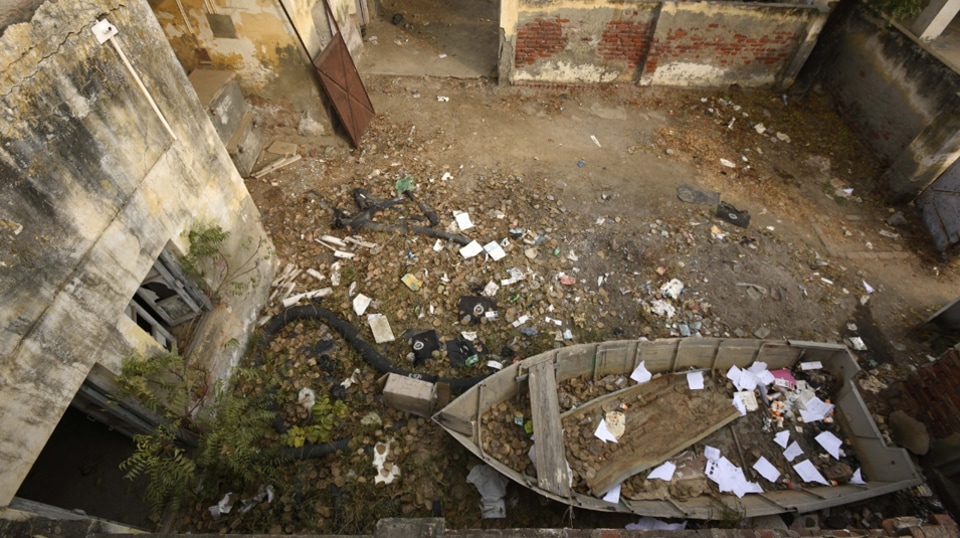
In one of the rooms, an abandoned old boat sits like a souvenir from the past. Locals claimed that the boat was used for rescue efforts during floods in 1976. The original court structure where magistrates used to carry out proceedings is also intact. While the interiors of the building are replete with such objects, the outer portion gives a clearer picture of the original architecture, with trees growing through its walls.
Most locals in the area said that steps need to be taken for the upkeep of the building. Umar Mohammad, 60, a resident, said that the government could preserve the memorabilia associated with the building. “There used to be a huge wooden gate at the entrance, some 15 feet tall. A massive hand-held curtain used to be present at the court earlier. The government can showcase such remnants to make people understand the history of the region,” said Mohammad.
Khan said that the building was a witness to the colonial past and needed to be preserved for the future generations. “It should become a heritage building or a museum with antiquities from the region. Mewat doesn’t have a museum. Turning the building into one can start a conversation around the history of the region.”
Bhattacharyya said that the department had been apprised about the proposal of converting the building to a museum. Welcoming the move, she said that the building was an important component of Mewat’s history and needed to be preserved. “The tehsil building is a part of history. It holds an important place in the history of Mewat. Besides, the history and culture of the region can be demonstrated if a museum is made,” said Bhattacharyya.
Bhattacharyya said that the department had earlier proposed that conservation plans for the tehsil building could focus on children, particularly girls. “There is a paucity of good schools and libraries in Nuh. We had earlier suggested that whenever the tehsil building is refurbished, we could keep the focus on children. If a museum is made, it can be imagined as a museum for children with libraries and other aspects. This would also encourage awareness and curiosity among children towards their area history,” said Bhattacharyya.

Stay updated with all the Breaking News and Latest News from Mumbai. Click here for comprehensive coverage of top Cities including Bengaluru, Delhi, Hyderabad, and more across India along with Stay informed on the latest happenings in World News.


