
 E-Paper



AMU workshop: World realised the importance of anaesthesiologists during Covid, say medical experts
The event, which commenced on Saturday, was held by the department of Anaesthesiology, Jawaharlal Nehru Medical College (JNMC), Aligarh Muslim University (AMU).


AGRA Anaesthesiologists and doctors batted for developing a range of airway skills for providing optimised health care during the two-day ‘CME cum Workshop on Mechanical Ventilation, ABG and Difficult Airway Management’. The event, which commenced on Saturday, was held by the department of Anaesthesiology, Jawaharlal Nehru Medical College (JNMC), Aligarh Muslim University (AMU).
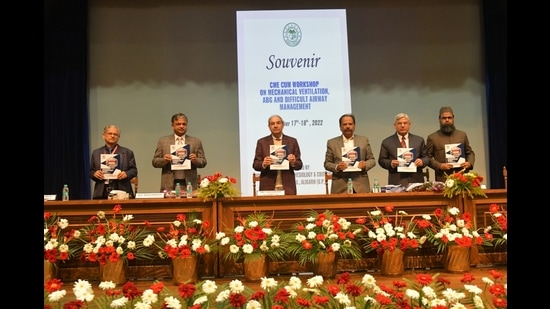
Speaking at the inaugural function at the JNMC Auditorium, Professor Tariq Mansoor, AMU Vice Chancellor and the chief patron of the programme, said, “The pandemic over-flooded the emergency rooms, in-patient floors, and ICUs with Covid-positive patients. The situation overwhelmed healthcare resources and even as we return to normal, it is imperative not to forget that the world looked at anaesthesiologists desperately as airway experts, respiratory physicians, and intensivists, and even asked them to assume leadership roles during the uncertain times of the pandemic.”
He added, “To make sure that a further outbreak of the virus does not pose varying degrees of challenges, it is necessary to provide our anaesthesiologists with a vast skill set which can be extremely valuable in the Covid-like crisis situation.”
In a similar vein, programme patron Professor Mohammad Gulrez, AMU pro-Vice Chancellor, pointed out, “The world felt a dearth of anaesthesiologists during the pandemic and now even freshly passed anaesthesia residents are coveted, which only accentuates the importance of the specialty.” He also stressed the need for training doctors from all branches in difficult airway management.
In his welcome address, Professor Qazi Ehsan Ali, the organising chairman of the programme and the chairman of the department of anaesthesiology, said, “During the two-day CME and workshop, seven anaesthesiologists will deliver lectures on advances in airway management and seven experts will provide hands-on-training to participants.”
Meanwhile, Professor MU Rabbani, dean, faculty of medicine, said, “The challenges thrown by the pandemic were bravely received by anaesthesiologists; their hunger and interest for learning more skills to manage the pandemic situation was evident. I am sure this workshop and CME will be hugely beneficial to our doctors to update difficult airway management skills.”
Speaking at the event, Professor Rakesh Bhargava, principal, JNMC, said, “Skills like airway management and resuscitation that form a basic part of anaesthesiology training are life-saving procedures and are indispensable in any surgical procedure. In no other branch of medicine can one have better understanding and training of vital organ management as in anaesthesiology.”
On the occasion, Dr Abu Nadeem, organising secretary, extended the vote of thanks while Dr Shahna Ali and Dr Farah Nasreen conducted the inaugural function.


