
 E-Paper



Black spots on key stretches ring alarm bells in Gurugram sectors
The police have claimed that they are actively working on identifying and mitigating these black spots. Their efforts have already led to a decline in road fatalities. However, these dangerous areas continue to pose a threat to commuters’ safety in the city


Gurugram: With new road constructions in Gurugram’s developing sectors, the number of black spots—areas prone to accidents—has been increasing, raising safety concerns among residents of these areas. Despite ongoing efforts by the police to address these hazardous locations, the surge in construction activity has made the situation more challenging.
The police have claimed that they are actively working on identifying and mitigating these black spots. Their efforts have already led to a decline in road fatalities. However, these dangerous areas continue to pose a threat to commuters’ safety, needing more robust measures to ensure the safety of commuters.
The district administration has prepared a plan to reduce black spots and accidents in the city. This includes installing speed limit signboards, adding more streetlights to ensure roads are well-lit at night, and implementing rumble strips to reduce vehicular speed. According to the traffic police, any location that records 10 accidents or five deaths in accidents within a year is identified as a black spot. The city, currently, has a total of 37 black spots, 19 of which are on National Highways Authority of India (NHAI) roads.
Annually, Gurugram witnesses nearly 400 fatalities due to road accidents, with the national highways accounting for nearly 66% of these deaths, according to official data.
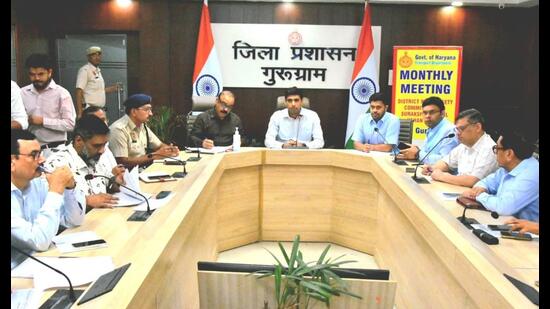
Deputy Commissioner Nishant Yadav held a meeting of the district road safety committee last week, directing NHAI, the traffic police, GMDA, PWD and HSIIDC officials to take strict action against speeding and illegal parking on roads.
“These factors have been identified as primary causes of accidents in the city. Officials were also instructed to undertake steps to remove black spots from NH-8, Sohna Road, Pataudi Road and Farrukhnagar Road, which experience heavy traffic and numerous accidents. “Departments involved in road construction should work on improving roads, installing indicators, and fixing sharp turns. Strict action should be taken against those who violate traffic rules,” he said.
The Gurugram Crash Report (GCR) for 2023 highlights a concerning rise in road accidents and fatalities. The city witnessed 1,190 crashes resulting in 439 deaths and 1,020 injuries. Specific categories show pedestrian crashes numbered 334, causing 149 deaths and 138 serious injuries. Two-wheeler crashes totalled 556, leading to 191 deaths and 288 serious injuries, while car users were involved in 178 crashes, resulting in 37 deaths and 76 serious injuries.
The city has identified 10 new black spots, such as Sector 42-27 Chowk, Bakhtawar Chowk, CD Chowk, 32 Milestone Entry, Krishna Chowk, Palam Vihar, Mahavir Chowk, Sidheshwar Chowk, Jharsa Underpass, Sector 4-7 Chowk, and Gamroz Toll Plaza.
Traffic police officials said the reasons for these new black spots include over-speeding, poor road design, and forced wrong-side driving due to a lack of provisions for suitable U-turns.
Sarika Panda Bhatt, a road safety expert, director, Nagarro and Co- Founder, Raahgiri Foundation, said every life lost or injured on the roads is an irreplaceable tragedy for the entire family. “Gurugram deserves better. It is imperative that we prioritise road safety and take decisive action to reduce fatalities and injuries. All the agencies need to prioritise safe infrastructure as bad road engineering is responsible for more than 50% of the crashes, they also need to enforce traffic rules and promote responsible driving. We need to build a Gurugram where families can live without fear of losing their dear ones, and where every journey ends safely. There is a need to target reducing 20% road deaths and injuries every year,” she said.
Comparative data indicates pedestrian fatalities are 120% higher than those of car users, while two-wheeler deaths are 135% higher. The highest number of crashes occurs on Wednesdays, with the most vulnerable age group being those under 18, accounting for 38% of deaths. Notably, 58% of crashes and 62% of total deaths occurred during night between 6pm and 6am.
High-risk areas identified include the area of Bilaspur Police Station, with 104 crashes resulting in 60 fatalities, and other significant crash sites such as Farukhnagar, Khedki Dhaula, Gurugram Sadar, and Badshahpur police stations.
Top black spots like Rajiv Chowk, Iffco Chowk, and Hero Honda Chowk are critical areas of concern, police officials pointed out. However, progress has been made under the District Road Safety Committee (DRSC) with interventions at IMT Chowk, IFFCO Chowk, Vatika Chowk, Panchgaon Chowk, and Khushboo Chowk, showing significant reductions in fatalities and serious injuries.


