E-Paper



Gujarat caste violence back on spotlight after Dalit man’s thumb chopped
The victim’s brother alleged that one of the accused individuals became enraged after the boy picked up the cricket ball while watching a match in a school ground


A group of men allegedly chopped off the thumb of a Dalit man after an altercation over his son picking up a cricket ball during a match at a school playground in a village in Gujarat’s Patan district on Sunday, police said.
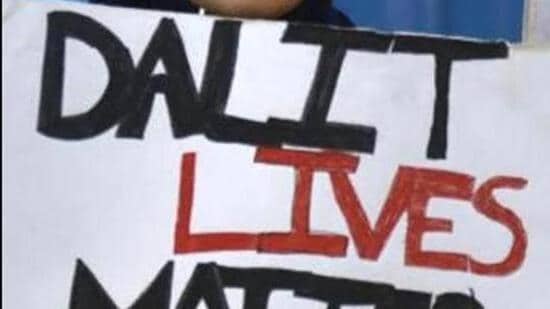
The incident happened in Kakoshi village and the victim has been identified by police as Kirti Parmar. His brother Dhiraj Kumar Parmar, who was also assaulted, filed a complaint with the police and a first information report (FIR) has been registered.
K K Pandya, DySP Siddhpur, said that police have booked seven individuals, with four already arrested.
Dhiraj Kumar Parmar, who works as a labourer, said that the family had gathered near the school ground to celebrate his eight-year-old nephew’s birthday. One of the accused individuals, identified as Kuldipsinh Rajput, became enraged and issued threats to the boy after he picked up the ball while watching the match.
The FIR, seen by HT, said that the attackers resorted to hurling casteist slurs during the assault.
Dhiraj said that the situation seemed to calm down after his interference. However, later in the evening, a group of men attacked them at separate places, he alleged.
The named accused individuals are Kuldipsinh Rajput, Siddhrajsinh, Raju alias Rajdip Darbar, Jashvantsinh Rajput, Chakuba Lakshmanji, and Mahendrasinh. They face charges of rioting, voluntarily causing hurt with dangerous weapons, and sections of the atrocity act.
Meanwhile, Siddhrajsinh, one of the accused, has filed a cross-complaint against Kirti Parmar and others. He alleged that Kirti Parmar had attempted to strike Kuldipsinh with a sword, and Siddhrajsinh, in an attempt to stop him, sustained an elbow injury from the weapon.
A police official at Kakoshi police station said the matter is under investigation.
Meanwhile, Dalit rights activists in the state expressed outrage over the incident.
“From not allowing a Dalit groom to sit on a horse to beating up Dalit youths for sporting a moustache or not allowing them to enter public places, the cases of atrocities against the Scheduled Caste people are rising at an alarming rate. There is also a lot of under-reporting of such cases. Incidents like not giving a house on rent to a scheduled caste teacher in villages are happening on a daily basis,” said Kantilal Parmar, a Dalit rights activist in Gujarat.
On May 30, a Dalit man was allegedly beaten by a group of individuals belonging to an upper caste community in Mota village, Palanpur taluka of Banaskantha district. According to police, the accused individuals expressed their displeasure over the victim’s choice of clothing, including his well-dressed appearance and sunglasses.
In 2016, the brutal flogging of four Dalit men by self-proclaimed cow vigilantes in Una garnered national attention.
In 2018, a Dalit groom was prevented from riding a horse during his wedding procession in Aravalli district.
According to government data on offences registered under the Atrocity Act on Scheduled Castes in Gujarat, at least 1,425 offences were reported in 2022, with the highest number recorded in Ahmedabad city at 189 cases. This was followed by Kutch-Gandhidham with 78 cases and Banaskantha with 72 cases.
The figures for previous years also reveal a distressing pattern. In 2021, the state witnessed 1,298 cases of atrocities against Scheduled Castes, while in 2020, the number stood at 1,370. The year 2019 saw 1,495 registered offences under the Act in Gujarat.
“These statistics paint a troubling picture of ongoing discrimination and violence faced by Dalits in the state,” said Kantilal Parmar.
He said that the State Vigilance and Monitoring Committee for strict implementation of the provisions of the Scheduled Castes and Tribes (Prevention of Atrocities) Act, has not met for the last three years.
“A 20-member committee headed by the chief minister including the DGP and other members are to compulsorily meet once every six months for review and implementation of the Act. In Gujarat this committee hasn’t met for about three years now. I have time and again written to the chief minister and other senior government officials regarding this and hope they will soon take corrective action,” said Parmar.
In June last year, Dalit activists in Gujarat carried out a Ashwamegh Yatra to protest atrocities against Dalits and attacks on Dalit marriage processions for grooms riding horses.