
 E-Paper



Delhi: Facades lining Chandni Chowk set for extensive revamp
The stretch is dotted with buildings demonstrating architectural influences from different time periods, some of which go back several centuries

 Prefer HTon Google


New Delhi: The Shahjahanabad Redevelopment Corporation (SRDC) is expected to soon start work on restoring the façade of buildings lining the 1.3km Chandni Chowk stretch between Red Fort and Fatehpuri Masjid that has been revamped and made a no-go zone for motorised vehicles.
Starting from the ES Pearey Lal Building to the State Bank of India building, and the iconic Chunnamal Haveli near Town Hall, besides Sis Ganj Gurdwara and Shahi Sunehri Masjid, the stretch is dotted with buildings demonstrating architectural influences from different time periods, underlining the fact that the Mughal-era market embodies both built heritage and a vibrant culture. Some of the building go back several centuries.
Many of these buildings are dilapidated, and in dire need of repairs.
Nitin Panigrahi, deputy general manager, Shahjahanabad Redevelopment Corporation (SRDC), the nodal agency for Chandni Chowk redevelopment, said the appointment of a consultant for façade restoration was underway. However, heritage experts and local residents have cautioned against a cosmetic approach to the process.
A shopkeeper at Pearey Lal building, who asked not to be named, said cosmetic beautification alone will be like covering up the mess in the market. Established in the early 20th century, the building is currently occupied by hundreds of shops and has not been repaired in years.
“Beautification alone is not development. The government is trying to replicate what was done in Connaught Place. However, CP consists of a uniform pattern building with shops of similar sizes. You can’t implement a “uniform approach” in Chandni Chowk where every building and shop is different from each other,” said the shopkeeper.
“Since the past many years, we have heard how all signage will be similar or how shops will have similar signboards. Different signboards add to the character of a market and here they want to kill all innovation,” he said.
Heritage body INTACH offered help with facade improvement in 2019, and said that it was crucial to preserve individual characters of buildings. A uniform one-size-fits-all approach was unlikely to work for Chandni Chowk, experts said.
Annabel Lopez, a consultant with INTACH, said the any attempt at restoration will need to preserve the ethos of the market. “Why should an old building change its unique front that they have been using for the last hundred years? There is no reason why all the boards or hoardings should be at a specific location and of same height. In popular memory, people associate and identify places due to their unique characteristics. These elements should be preserved,” said Lopez.
Citing the facelift of the walled city in Amritsar, she said such an approach will not work in Chandni Chowk. Lopez said as part of the façade treatment in Amritsar, the whole street was given a standard treatment due to which the individual character of buildings was lost. “In Shahjahanabad, every building is unique. One building might be a late Mughal period structure, the next might be an early colonial one, and another building might have a mix of both styles. So, there is a unique character to each of the facade in Shahjahanabad and that should be retained,” she said.
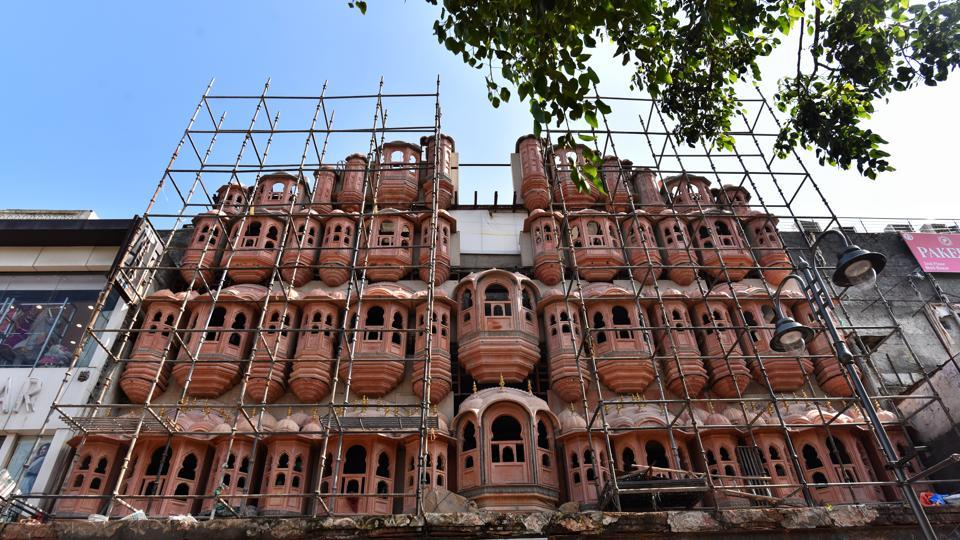
Local residents welcomed facade improvement but insisted on the need to curb unauthorised construction and encroachments in the area. Pointing to a recent development in which a building was given a massive façade on the lines of Jaipur’s Hawa Mahal, residents said it was important to keep a check on construction that was undertaken without necessary permissions, and does not align with the proposed restoration plans.
“Local residents have to go from pillar to post for basic repairs. No construction can be undertaken here without permission, on paper, but we see examples where people are making massive buildings. It’s crucial to ensure that unauthorised construction is stopped, if the agencies are sincere about façade restoration,” said a resident, asking to remain anonymous.
Conservationist and executive director of World Monuments Fund, India, Amita Baig said it was crucial for design guidelines to be framed for a façade improvement exercise. “Someone made a façade that looks like Hawa Mahal recently. How do you stop instances like these in the absence of design guidelines? And if you have design guidelines, who will be paying for them? These questions need answers,” said Baig.
Both traders and residents also stressed the need for agencies to incorporate suggestions from stakeholders before finalising plans. Anil Pershad (77), one of the owners of Chandni Chowk’s iconic Chunnamal Haveli, said that he was not aware if the haveli would be taken up for façade restoration. “We don’t have any idea if our building will be included among those that will be taken up for façade restoration. I presume that they will undertake a drive similar to the one that was taken up at CP. Chandni Chowk, however, is a different place. Every building has its own unique façade and we are not sure if the agencies will be roping in conservation experts before undertaking such a drive,” said Pershad.
Structures such as the haveli and many other buildings that have become weak over the years can only be restored with intervention from conservation experts. “The balcony of our haveli is made of wood. Any work would depend on the availability of raw materials and craftsmen who can deal with the process. Only conservationists can take such calls as per the needs,” said Pershad.
Ashok Mathur, 52, another resident, said redevelopment in a true sense will require that issues faced by residents are addressed first. Mathur said while the façade restoration was being discussed, there was no clarity on how it will be undertaken and what buildings will be shortlisted. “The SRDC might selectively take up some buildings which are owned by banks and other institutions. There is congestion in arterial lanes and other local issues. Since such crucial aspects are not being addressed, I am not hopeful about the façade restoration plans either,” said Mathur.
A senior PWD official, however, said that all buildings along the corridor will be given a facelift so that a uniform look is achieved. “The appointment of a consultant will be done this month. Once a uniform facade is achieved, MCD or SRDC might impose conditions on owners to ensure that the facade is maintained,” said the official, adding that any future facade work by individuals may require permission.
Manoj Aggarwal, who runs a saree shop near Sarafa Bazaar, said while façade improvement sounds promising, it was crucial that feedback was sought from people in the area. Aggarwal recalled that some years ago, shop keepers in the area were asked to remove hoardings so that newer ones could replace them, but the exercise ended abruptly. “They removed our boards and said that we will get new ones. While some got new ones, others didn’t and the entire exercise just died down. The government should at least seek feedback from us before undertaking any exercise,” said Aggarwal.
Amit Jain, another resident, whose family owns a nearly 60-year-old building at Bhai Mati Das Chowk said he was looking forward to the façade restoration of his building. Jain said since buildings have deteriorated over time, restoration has become necessary. “If the government wants to undertake repairs, why should we have any issue? We welcome the move. The government can give special attention to heritage buildings on the stretch. However, they should also ensure that residents are not inconvenienced,” said Jain.


