E-Paper



Gujarat HC calls for speed reduction on trains to prevent lion deaths on tracks
There were 674 lions in Gujarat in a census carried out in 2020. At least seven lions have been killed by running trains in the last one year

 Prefer HTon Google


The Gujarat high court has directed the implementation of speed restrictions on trains passing through lion habitats to prevent accidents involving the endangered Asiatic lions of Gir forest.
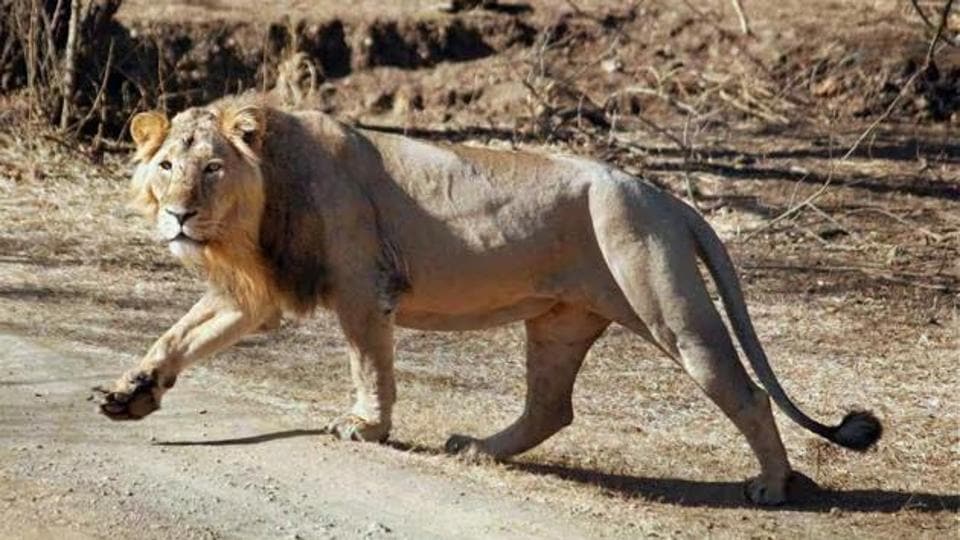
This directive comes as part of a comprehensive review of measures to protect the iconic species from railway-related fatalities.
The court was hearing a public interest litigation concerning the protection of Asiatic lions from railway accidents. Three separate incidents occurred on January 3, January 12, and January 21, 2024, resulting in lion fatalities on railway tracks near the Gir Protected Areas.
In response to these events, a high-level committee was formed under the supervision of the Ministry of Railway and the Forest Department, Gujarat. This committee, comprising senior officials from both the state and Centre, was tasked with developing a Standard Operating Procedure (SoP) to ensure the safe movement of lions while preventing future accidents.
The SoP covering the 90-km stretch of railway lines covering Gir (east) wildlife division, Shetrunji Wildlife Division and Amreli Social Forestry Division in Amreli district, restricts the train speed to less than 40 kmph to avoid accidents.
On July 12, 2024, chief justice Sunita Agarwal and justice Pranav Trivedi reviewed an affidavit submitted by the chief conservator of forest, Wildlife Circle, Junagadh. The affidavit outlined several measures recommended by the high-level committee, including “frequency, imposing speed restrictions in specific time and place, issuing caution orders in emergency situations, construction of under-passes, IT interventions, guidance and training of railway staff and periodical review of various provisions.”
In its order dated July 12, 2024, the court said, “The high-level committee after visiting the spot has noted that there was proper fencing to prevent the lions from coming on the railway track, there is an underpass available just below the dashing site.” However, the committee found that “had the speed been less, the incident could have been avoided,” the order said.
Based on these findings, the court has ordered several measures, including permanent reduction of train speeds during nighttime at identified hotspots, improvement of locomotive headlights, regular vegetation clearing along tracks and in underpasses and retrofitting of existing underpasses and construction of new ones.
A copy of the order was made available online on July 27.
The court has set an August 9, 2024 deadline for authorities to report back on the implementation of these recommendations.
“We post the matter on August 9 to place before us compliance of the recommendations of the committee in the first phase such as the decision of the Railway Board for improvement of the headlights of locomotives to relax the speed restrictions, the periodic vegetation shredding on both the sides of the railway track, cleaning of vegetation from the underpasses by the railways, reduction of speed of trains as per the recommendation of the Committee,” according to the court order.
On Wednesday night, a passenger train running between Mahuva and Surat ran over a male adult lion between Liliya and Pipavav in Amreli district, said a forest department official. In the last one year, at least seven lions have been killed by running trains in Gujarat, he added.
A lion census carried out in 2015 recorded 523 lions. When the exercise was carried out again in 2020, there were 674 lions which means there was a 29% increase in population in five years.
Presently, Asiatic lions are present in Gir National Park and Sanctuary and its surrounding areas including Girnar Sanctuary, Mitiyala Sanctuary, Pania Sanctuary, coastal areas, Savarkundla, Liliya and adjoining areas of Amreli and Bhavnagar districts with satellite populations. The Asiatic lions have moved to forested patches through conducive corridors. They are now distributed in nine districts of Saurashtra including Junagadh, Gir Somnath, Amreli, Bhavnagar, Rajkot, Botad, Porbander, Jamnagar and Surendranagar. They are spread in 30,000 square kilometers, termed the Asiatic Lion Landscape.
Of the total number in the wild today, about 300-325 reside in the Gir sanctuary, spread over 1,412 square kilometers and the others are outside it. The sanctuary area includes 258 sq km of Gir National Park.
The lion population has gone up in the last few years and while their numbers have more or less stabilised in the sanctuary, a greater number of lions are seen outside the protected areas, according to an official.