E-Paper



HT interview: Delhi AQI data fully transparent, can’t be fudged, says Sirsa
Rejecting AAP’s charge, Sirsa said the government’s pollution control measures are showing results, with air quality better than in previous years.

 Prefer HTon Google


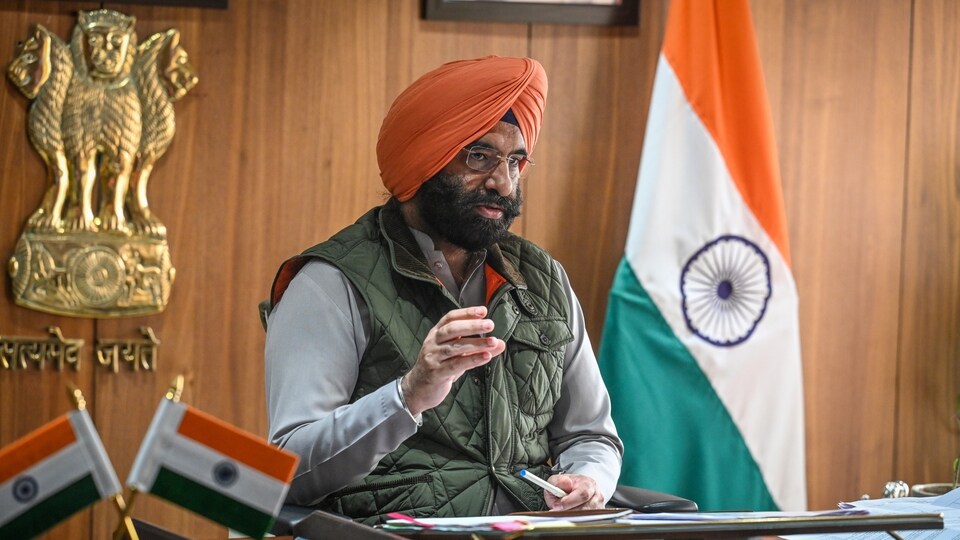
As the Capital’s air quality deteriorated, dipping into the ‘severe’ category for the first time this season, Delhi’s environment and forest minister Manjinder Singh Sirsa spoke to HT’s Jasjeev Gandhiok, highlighting the government’s plans to tackle the air pollution problem.
Q: It has been around eight months since your government took charge and this is the first winter for you as environment minister. What have we learnt about the air pollution problem in Delhi so far?
MS: The air pollution problem in Delhi can be divided into four main parts: vehicular pollution, dust pollution, pollution from industries, and pollution from waste. We first identified the problem and divided it into these four broad verticals. To tackle vehicular emissions from dirty fuels, we are gradually switching to an electric fleet, be it buses or e-rickshaws and e-autos for last mile connectivity. Secondly, we are looking to improve the conditions of roads by doing patchwork and recarpeting to tackle dust pollution. As part of this exercise, the Delhi Police has also identified close to 100 hotspots where either traffic, industries or waste are creating pollution and we are looking to address the issues there by creating a proper plan.
Also Read | Union environment minister takes stock of Delhi-NCR pollution
In addition to recarpeting, around 91 mechanised road sweepers are presently deployed — while we are carrying out greening or paving brown areas in the city. Construction sites are under surveillance and we are also installing anti-smog guns on high-rise buildings. Industrial areas are also a source and we have 27 such areas which are unauthorised. The process to regularise them began under the Sheila Dikshit government but we are now completing it. More than 1,200 industries have been found to be polluting and we have taken action against them too. All construction sites with an area of over 500 sq m will be monitored online by the DPCC (Delhi Pollution Control Committee) and we also have 1,812 enforcement teams on-ground to tackle various sources of pollution. Recently, we have experimented with cloud seeding too.
Q: What is the status of cloud seeding in Delhi right now? We have had a few trials, but with no rain. Will the government hold more trials ahead?
MS: It is not the government, but IIT-Kanpur holding these trials. There is a plan to hold more trials and we are simply waiting for clouds to reappear. Based on that, you will see more attempts made. Cloud seeding is not the only innovation we are looking at the moment and more solutions are being assessed.
Also Read | Delhi AQI stays ‘severe’: GRAP-3 in place, schools go hybrid
Q: What other innovations are being looked at to tackle air pollution? You recently launched an innovation challenge too.
MS: A number of technologies are being looked at. A total of 127 ideas have been submitted as part of the Innovation challenge, pending verification from IIT-Delhi and a full-fledged expert panel. The best solutions will be shortlisted. We are looking at smog-eating surfaces, which are chemicals that naturally combat pollution. We have also looked at roof-mounted pollution absorbing devices which can be retrofitted on vehicles to purify the air by absorbing it and passing it through filters. The PM 2.5 and PM 10 is absorbed so the emissions being released by the vehicle are somewhat offset.
Also Read | Rampant construction leaves Delhi choking on dust
Q: Delhi’s AQI is 430 at 3 pm today. This is the highest it has been since December last year. What emergency-level action is planned by the Delhi government?
MS: Stage-3 of the Graded Response Action Plan (Grap) has already come into force with immediate effect in Delhi. Proper enforcement of measures under Grap is the key. We are working to implement these measures properly.
Q: Not just Delhi but the entire NCR is considered as one large airshed. The BJP is now in power in all NCR states. How important is interstate coordination here in tackling the problem?
MS: We are regularly having meetings with NCR states through Union environment minister Bhupender Yadav. Monthly meetings are held and data for all NCR states is shared with the minister and CAQM. We are looking to identify the same common factors impacting cross-boundary pollution and how they can be tackled together, be it vehicles, industries, waste burning and dust.
Also Read | Grap stage-3: Noida prohibits constructions, demolitions as AQI turns ‘severe’
Q: BJP’s manifesto promised bringing down pollution in Delhi by 50% by 2030. Do we have a long-term plan in place?
MS: There is a long-term plan that we have. The chief minister held a meeting today as well, where she sought details from all agencies on how much greening has been done under their jurisdiction to reduce brown areas in Delhi. There are measures agencies have been asked to implement in the short-term, medium-term and long-term. Under it all, our goal is to reduce dust pollution by 30%. Industries and construction, similarly, we want to monitor better. As far as we are concerned, the four verticals we mentioned earlier roughly contribute the same kind of pollution load in Delhi and need to be tackled simultaneously.
Q: There were protests at India Gate this weekend, where people were demanding clean air. A lot of them were detained too. What are your thoughts on that?
MS: People have all the right to protest and demand clean air. But they have to understand that the previous government has given us 10 years of dirty air, which cannot be cleaned in just seven to eight months. It is impossible. For that, we are working day and night and such protests make us more aware. As far as the detentions were concerned, we had no role in it and the Delhi Police acted on Supreme Court’s directions which say no protests can happen at India Gate. For that, Jantar Mantar is the designated site.
Q: There have been questions raised on the data from air quality monitoring stations. Allegations have also been raised by the opposition that data is being manipulated, going missing and even that stations are being sprinkled with water. What do you have to say about that?
MS: They (the Opposition) feel what they could not do, they have a problem that we are tackling those issues and doing it well. This includes us providing a cleaner Yamuna, celebrating Chhath on the Yamuna floodplains, and acting on air pollution. Through our efforts, the air quality this year is lower than previous years and to justify this, the Opposition is terming it as data manipulation.
How can data be fudged when the entire data is online and available for all to see? When it comes to sprinkling water — the entire goal of these is to settle dust. AAP, themselves, hired water sprinklers during their tenure and if they say this is not a solution to tackle dust, then why did they hire water sprinklers?
Q: You speak of a cleaner Yamuna. During Chhath, we saw more water being released into the river through Haryana’s Hathanikund barrage. Is that a solution being looked at?
MS: No, I don’t think releasing more water is possible in the long-run. The only solution to improve the water quality remains tackling sewage. If sewage continues to flow into the river like it did in the 10 years under AAP, the river will stay like this. We have already started tackling that problem.
Q: Any timelines the government has set to clean the Yamuna or improve air quality?
MS: The government views December 2027 as a realistic deadline to clean the Yamuna, improve air quality to a large extent, and even flatten landfills in Delhi.