
 E-Paper



Khori residents: We are ready for the worst, will die here
On Thursday morning, residents gathered outside their residences around 9.30am in a protest against the demolition drive, even as structures at the village entrance were being razed to pave the way for the upcoming drive. Residents alleged that they have been facing hardships as the supply of drinking water has been stopped for almost a month


Residents of Khori village in Faridabad on Thursday refused to move out of their houses, saying they will resist the demolition drive despite a lack of basic amenities, such as water and electricity.
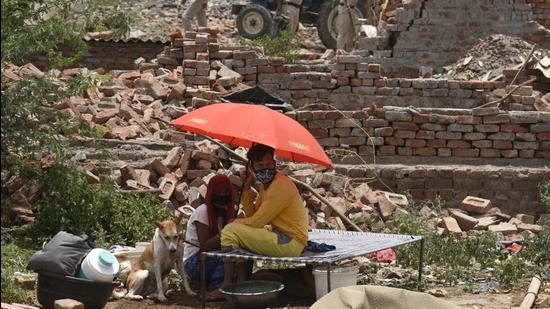
Ramesh Sharma, who constructed his house in 2006 and lives with his wife and two teenage sons, said that he shifted here from Madhya Pradesh and has cut all ties with his village of origin. “The four of us are ready to die here. No one can force us to leave the house. If anyone tries to force us, we will commit suicide. We are ready for the worst,” he said.
On Thursday morning, residents gathered outside their residences around 9.30am in a protest against the demolition drive, even as structures at the village entrance were being razed to pave the way for the upcoming drive. Residents alleged that they have been facing hardships as the supply of drinking water has been stopped for almost a month.
Six-year-old Mohit Kumar, who was born in Khori village and lives with his parents, said he has not had any water to drink in two days. “I requested the police uncle to give me one bottle of water but he scolded me,” he said.
Residents of Khori were dependent on water tankers and water cans, but the supplies have been cut off. A few residents said they are smuggling water bottles through longer routes to evade the police.
Seventy-year-old Shakunta Devi, who recently lost her husband and has two ailing sons, said that she could not take them for treatment as they would not be allowed back into the village. “The small shops in the area also do not have water bottles and the shopkeepers have been directed not to get drinking water so that we are forced leave the village,” she said.
Twenty-five-year-old Priya Sharma, who is pregnant, said, “Officials should at least make some arrangements for pregnant women who are in dire need of medical care, food, and water.”
Another resident said her two-year-old daughter has been sitting under a tree to protect herself from the heat. “We have no place to go to or money to buy food. We will sit inside our house even when they raze the houses,” said 35-year-old Shabnam Khatun, a single parent who has been living here for the past 15 years.
Around 10,000 houses are built illegally on the Aravalli forest land in Khori village. The Supreme Court, on June 7, ordered the demolition of slums encroaching on the Aravalli forest area in Faridabad district, holding that there cannot be a “compromise or concession on forest land.”
The police refuted the allegations and said residents were allowed to move freely, and that there is a regular water supply through tankers. “We have deployed our teams and checkpoints have been set up at all entry points of the village, but only to ensure that outsiders do not spread violence or misinformation in the village,” said OP Singh, the commissioner of police.
Yashpal Yadav, the deputy commissioner of Faridabad, said that water tankers are sent thrice a day and stationed outside the village for residents to get their fill. “Our aim is to get the village vacated and not to harass anyone. We are helping them in every possible way and also providing food to those who are in need. If anyone is facing any kind of water or ration issue, they can approach the district administration,” he said.


