
 E-Paper



Larger criminal nexus suspected behind organised child beggary in U.P.
While some of these children resort to begging after losing their parents or guardians, others are forced into this world by child trafficking rackets or child begging gangs


LUCKNOW Most of us have been in a situation where a child beggar in torn clothes turns up near our vehicle at a red light. If not all the time, at least most of the times, we end up checking our pockets for coins and give them to these kids, thinking it will help them buy some food. However, in the process, we end up promoting a social evil called child beggary.
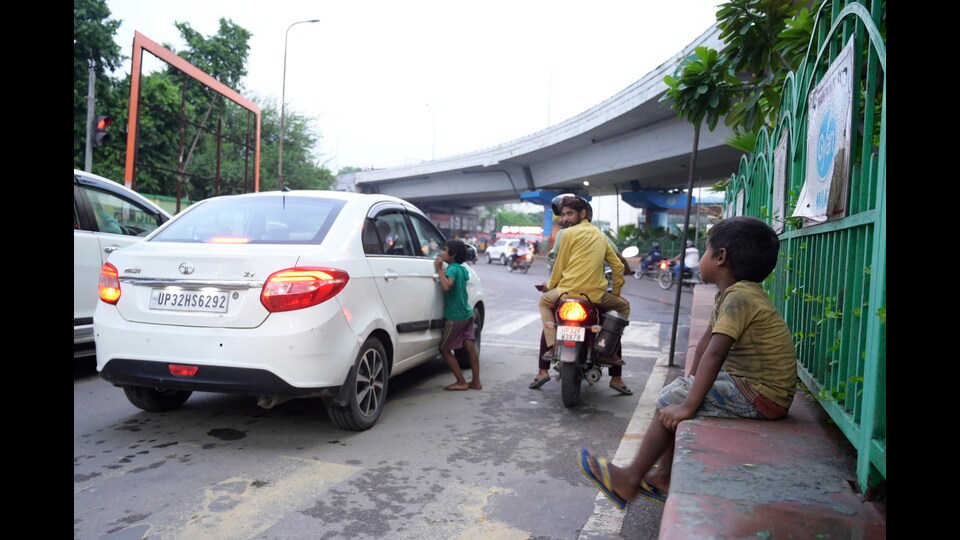
While some of these children resort to begging after losing their parents or guardians, others are forced into this world by child trafficking rackets or child begging gangs. For past several decades, we have been hearing of such gangs that station child beggars at marketplaces to ensure that they make a decent earning but in the past few years, there has been a concerning rise in the population of child beggars across the state, including Lucknow.
Taking cognisance, chief minister Yogi Adityanath on Wednesday pledged to take decisive action against criminal gangs that are forcing children into begging. Against this backdrop, HT tried to dig deep to find out about the nexus behind such gangs active in Lucknow and other big cities.
According to experts, the network of kids seen begging at road crossings might just be the tip of the iceberg of a possible criminal nexus facilitating child beggary. They added that the way these child beggars’ groups operate in an organised manner across the state hints towards the possible involvement of a larger nexus.
Child beggary gangs
Sangeeta Sharma, the director of Childline in Lucknow, said that there are lots of clues pointing towards the existence of such gangs facilitating child beggary but not enough evidence to tie it all together to find the people behind the rackets.
“When our Childline team was carrying out a reconnaissance effort some time back, we actually spotted some children coming in tempos and getting dropped off. They would then spread out and start begging, and then return back to where they came from in the evening,” said Sharma.
“Even when we rescued some children from these groups and brought them back for questioning and counselling, they refused to give us their real names, did not want us to take their pictures, and kept changing their stories every day. It seems like they had been trained to evade questioning,” she added.
Recalling a related incident, she said, “Once, our rescue team spotted a girl begging at the Polytechnic crossing. She was questioned by the team members. Subsequently, she disappeared from the spot. A few days later, she was spotted begging at a different crossing.”
Different communities target different locations
Different communities or families from different places come to operate in different locations of the city, says Balbir Singh Mann, who is associated with the Umeed NGO. He added that child beggars at the Hazratganj crossing and its adjoining areas come from Nagram, which is nearly 40 kilometres from there. Similarly, those operating near Indira Gandhi Pratisthan crossing come from the adjoining Barabanki district. Besides, child beggars near Lohia Park come from the Chinhat area and the child moving around with boot polish in the city come from Unnao, another adjoining district. Interestingly, they keep changing their locations.
Mann further said these children are brought in a vehicle from their respective places in the morning and taken back in the evening. He said these children do overtime on weekends and stay at different crossings as people remain in market areas and at eateries till late evening.
Child beggary prevalent among nomadic communities & tribes
When asked the possible involvement of a nexus behind child beggary, Mann said, “So far, we have not come across any such nexus in Lucknow and the state. The malpractice of kidnapping children and forcing them into beggary often prevails in mega cities like Mumbai and Delhi.”
In a similar vein, Raveendra Singh Jadaun, chairperson of Child Welfare Committee in Lucknow, said, “As far as our investigations are concerned, we have not found the involvement of any gangs when it comes to child beggars. In most cases, once the families are traced, we find that the children were begging with the complete knowledge of the family. However, they largely try to deny the fact and make excuses for why the child was found begging at a certain place.”
He emphasised that the Child Welfare Committee (CWC) has not uncovered the involvement of any gangs or rings peddling child beggars during his two years in the panel. The CWC is responsible for reviewing the investigation and directing the further course of action to be taken for a rescued child beggar.
‘Joint efforts from stakeholders required’
Suggesting ways to put an end to child beggary, Mann said, “Multiple departments have to play their role in eliminating child beggary and rehabilitation of the children who are into it. All stakeholders like social organisations, child activists, child welfare bodies, municipal corporation, police, and district administration, among others, must come together and work in coordination to check child beggary.”
‘Official figures don’t reflect ground reality’
As per experts, the actual number of child beggars is much higher than the estimated government figure. “As per the estimated data, there are at least 3,500 child beggars in Lucknow but they all come from different tribal or nomadic communities that have been into child begging for ages. The rehabilitation of such families is a must to end this traditional trend to push their child into begging,” said Mann.
In contrast, the state-wise information available on the website of the Registrar General of India states that the number of children (age up to 14 years) engaged in begging are the highest in Uttar Pradesh (10,167). U.P. is followed by Rajasthan (7,167), Bihar (3,396), and West Bengal (3,216). This information, based on Census 2011, was also tabled in the Lok Sabha in December 2021.


