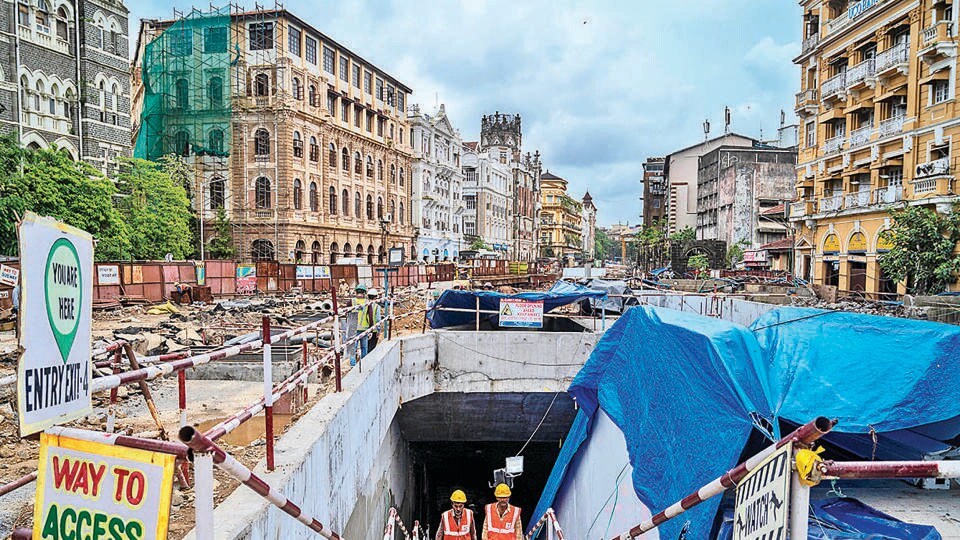
Mumbai: In May this year stakeholders of Mumbai Metro 3 who are developing Package 1 – the stretch between Cuffe Parade and Hutatma Chowk – presented a paper at the World Tunnel Congress, in Athens, Greece, on the innovative practice employed to create a tunnel at Hutatma Chowk metro station in a manner that the delicate heritage precinct in the area remains protected.
Mumbai, India - July 12, 2023: Heritage and old building in South Bombay were preserved during construction of Hutatma Chowk Underground Metro station. Details on how the engineers built a Metro station below heritage and old buildings on DN road near Fountain in Mumbai, India, on Wednesday, July 12, 2023. (Photo by Satish Bate/ Hindustan Times) (Hindustan Times)
Palwinder Singh, project manager, Larsen & Toubro (L&T), who presented the paper, expressed the novelty simply as Indian “jugaad”. “It is a matter of pride for our country that we came up with a unique method of tunnelling to ensure heritage buildings were safe. The world can follow this idea wherever needed,” Singh said. Global experts converge at the annual meet, a knowledge bank of tunnelling.
Eighty two per cent of the work at the Hutatma Chowk station, in the underground metro line between Colaba and Seepz, is complete. But for the engineers, building a station below heritage and other old buildings was a unique challenge. It was proposed to construct a part of the station and platform below the road and another platform tunnel of 253 meters long, 9.7 m height, 11.78 meters wide below heritage buildings.
Normally, engineers use the ‘cut and cover’ method to execute such a project; but in this case, it was only partially possible since the road was narrow and part of the station had to be built below heritage buildings.
“Usually, we use the ‘cut and cover’ method for building stations, which means we cut, go down and build the station from bottom to top. This is not very difficult to achieve when built below the roads or an open space, but here at Hutatma Chowk, this was only partly possible, which means the second side of track and platform had to be built below the heritage buildings,” explained Singh.
So, the team cut and went below from the roadside and horizontally dug through the connecting passage below the heritage buildings to build the platform and track. A gap of around 12.5 meters was given between the heritage buildings and the platform tunnel below. (Refer graphic)
After discussing this with owners of the buildings (some older than 120 years) that the structures would be protected, tenders were floated for tunnelling but no bids were received. Potential bidders were nervous that “if anything happens to these old buildings, it would be a disaster”.
The engineers at L&T then decided to take matters in their own hands and devised a strategy to carry out the task safely. In the normal course for blasting around heritage structures, the peak particle velocity (PPV) is 5 mm/ sec; in this case, the team reduced it to 2.54 mm. Simultaneously, they added support from above and below to all the buildings for safety.
Further, the engineers integrated two methods of excavation – using drum cutter and small blasts with low charge and long delays. “The drum cutters were used to make various holes in the outer border of the rock, following which more were created around the blast sites,” said Singh.
Subodh Gupta, director, projects, Mumbai Metro Rail Corporation, said, “This lane is called ‘heritage mile’, 100% of the buildings at this road are old or have a heritage tag. The rocks at this site were very hard, which made it a very difficult work site which demanded blasting. Extensive controlled blasting had to be carried out.”
Instead of three traditional blasts, the team used 15 micro blasts. This method ensured that buildings above felt no impact. Nearly 10,000 micro blasts were carried out to build this 253-meter platform tunnel. Gupta explained that the buildings were monitored online 24x7. “There are devices on each and every building to monitor the impact, which continues till today.” The team’s objective was to optimise productivity while reducing the ground vibrations to a level which is acceptable. “Had we not come up with this solution, the Tunnel Boring Machine (TBM), coming from Churchgate and moving towards Azad Maidan, would have delayed us by nearly 26 months, which we sought to avoid,” said Singh.
Metro line 3, Package 1, is being built by L&T and STEC (Shanghai Tunnel Engineering Company) in a JV.

 E-Paper




 Prefer HTon Google