E-Paper



Odisha government doubles financial payouts for surrendering Maoists
Under the scheme, higher-ranked cadres classified as Category A, including Central Committee members, Politburo members, and State Committee members, will receive up to ₹5 lakh

 Prefer HTon Google


The Odisha government announced a revised surrender and rehabilitation scheme for Left Wing Extremists, offering higher financial incentives. The new policy, aligned with the Union home ministry’s revised guidelines issued in August 2022, provides a tiered rehabilitation package based on the rank and importance of the surrendering cadre, ranging from ₹2.5 lakh to ₹5 lakh in direct financial assistance.
Under the scheme, higher-ranked cadres classified as Category A, including Central Committee members, Politburo members, and State Committee members, will receive up to ₹5 lakh. Of this amount, ₹50,000 will be given immediately in cash, while the remaining ₹4.5 lakh will be deposited in fixed deposits. The deposited amount will be released in tranches, ₹50,000 after one year and ₹4 lakh after three years, subject to satisfactory conduct certified by district police authorities.
Middle and lower-ranked cadres under Category B, including Divisional Committee members, Local Guerrilla Squad commanders, and party members, will receive ₹2.5 lakh under similar disbursement terms.
Also Read: Chhattisgarh constable injured after stepping on pressure IED in Sukma: Police
The scheme offers additional monetary incentives for surrendering weapons.
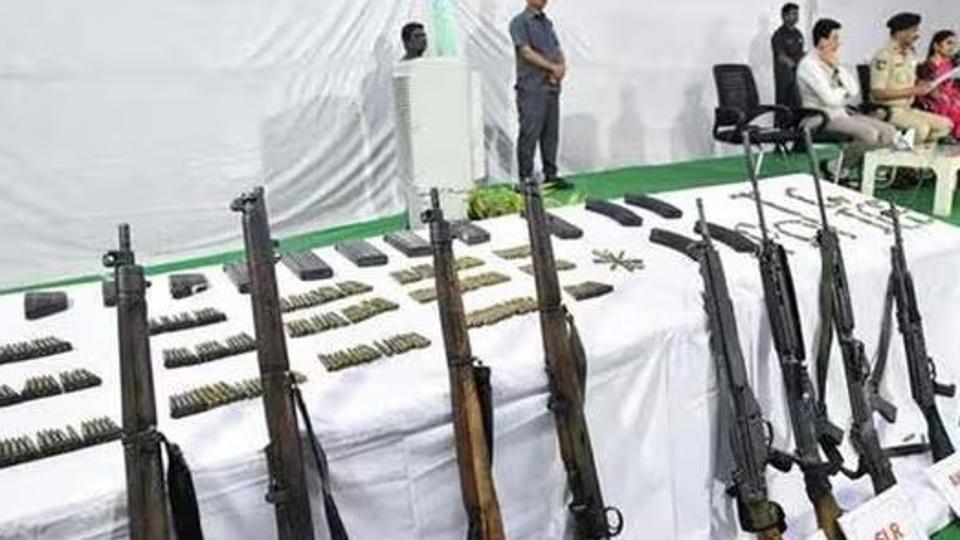
A cadre surrendering with a light machine gun (LMG) in working condition will receive ₹4.95 lakh, while an AK-47 or Trichy Assault Rifle will fetch ₹3.3 lakh. Other weapons attract varying amounts, ₹2.75 lakh for a 2-inch mortar, ₹1.65 lakh for an INSAS rifle, and ₹82,500 for a .303 rifle. Even ammunition and explosives are covered, with each round valued at ₹55 and explosive substances at ₹1,100 per kilogram.
The policy offers additional incentives for those surrendering weapons. Compensation ranges from ₹4.95 lakh for a light machine gun to ₹550 for grenades and gelatin rods. An incentive of ₹25,000 will be provided to all surrenderees, regardless of whether they surrender weapons.
For high-value targets carrying government-declared rewards of ₹5 lakh or more, the policy provides an additional lump sum of ₹10 lakh, deposited as a fixed deposit and released after three years based on satisfactory conduct. Alternatively, such cadres can opt for the declared reward amount if it exceeds the standard financial assistance — with rewards ranging from ₹1.10 crore for Central Committee members to ₹1.65 lakh for party members.
Beyond financial incentives, the rehabilitation package includes provisions for housing under the Antyodaya Gruha Yojana, a one-time marriage incentive of ₹25,000, free or subsidized rations under central food schemes, and priority healthcare through government health cards.
Surrendered cadres will be enrolled free of cost in short-term training programs and may pursue vocational education in ITIs or polytechnics.
A monthly stipend of ₹10,000 will be provided for up to 36 months, discontinued only upon securing government employment or gainful self-employment. To be eligible, surrenderees must fulfill stringent criteria including revealing the identities of associates, disclosing details about financiers and supply chains, confessing to criminal acts, and making a public statement of voluntary surrender through media.
According to state home department officials, currently about 80 to 85 operatives are active in Odisha.