
 E-Paper



RSS’s 100-year journey on display at Magh Mela
The RSS showcases its 100-year journey through an exhibition at Magh Mela 2026, highlighting its history, ideologies, and key contributions.

 Prefer HTon Google


The Rashtriya Swayamsevak Sangh (RSS)—often described as the ideological mentor of the ruling Bharatiya Janata Party (BJP)—is showcasing its 100-year journey through a special exhibition at the ongoing Magh Mela 2026. Founded on September 27, 1925, the RSS celebrated its centenary in 2025.
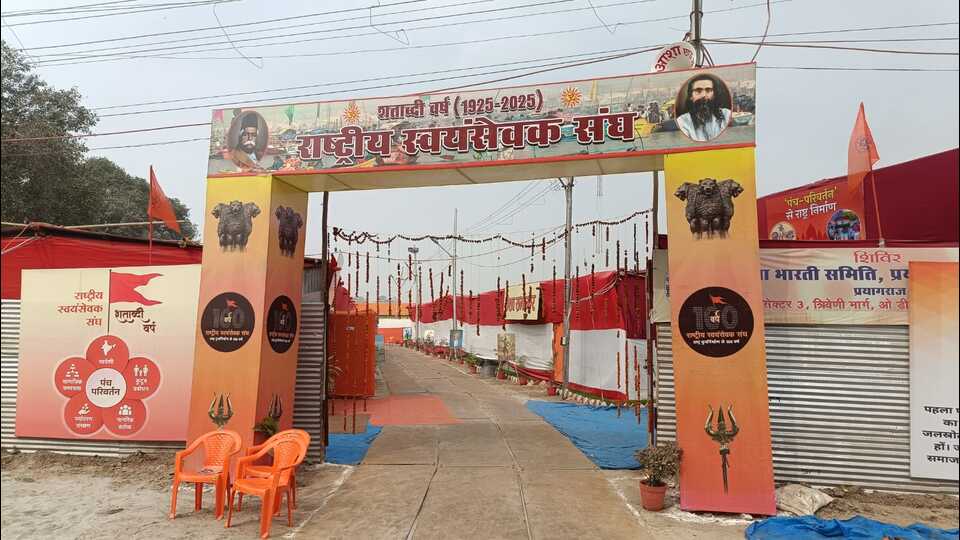
The exhibition, located on the banks of the Sangam, is attracting large numbers of pilgrims and visitors each day, said the organisers.
Spread across separate halls at the Parade Ground, it traces the evolution of the RSS through curated panels and live displays, providing a visually rich and structured account of the organisation’s history, including information about its founder, Dr Keshav Baliram Hedgewar, the physician who established the RSS in Nagpur in 1925, they added.
Visitors are welcomed by a decorated statue of Bharat Mata at the entrance, setting a symbolic tone for the exhibit. Each hall features interactive displays and visual narratives highlighting the RSS’s ideology, organisational growth, and activities over the past century.
In one hall, the exhibition focuses on the Sangh’s service activities during social and national crises, alongside campaigns and movements undertaken over its 100-year journey. A pictorial account of Hedgewar’s life is also showcased, said exhibition in-charge Sachit Tandon.
In another hall the tradition of Sangh pracharaks, the network of Sangh-inspired organisations, the role of volunteers during the country’s partition, and the different phases of the Shri Ram Janmabhoomi movement is highlighted, Tandon explained.
In yet another hall the concept of Akhand Bharat (Undivided India) is emphasised, the Sangh’s contribution to the freedom struggle, and the “Panch Parivartan” (Five Transformations) as the foundation for a progressive society. Standees feature portraits and brief biographies of all six Sar Sanghchalaks to date.
Tandon noted that the Sangh has witnessed many highs and lows over its century-long journey. He emphasised that the RSS is a non-political organisation that has aided society during natural disasters and supported the country during the 1965 and 1971 wars.
The exhibition also depicts the periods when the RSS was banned—in 1948, 1975, and 1992—and subsequent lifting of these bans. Alongside its history and traditions, the exhibit highlights the Sangh’s guiding principles through the framework of the “Five Transformations.”


