
 E-Paper



The Shinde-Fadnavis duopoly: One a grassroots neta, other a master strategist
Though Shinde (58) is CM, his deputy’s firm grip on the steering wheel is evident. This dynamic started when Shinde was minister for public works (public undertakings) in the Bharatiya Janata Party (BJP)-Shiv Sena coalition government of 2014-2019, led by Fadnavis (52)


Mumbai: At first glance, they are comrades in arms, running the state government through a unique diarchy of power. But, when it comes to temperament and style of functioning, they are chalk and cheese. One of them is seen as a “people’s politician”: someone who is more comfortable among the masses than the rarefied confines of Mantralaya. The other, with his near-total command over the affairs of his party in Maharashtra is a drawing-board strategiser, who also handles the nuts-and-bolts of the regime, making him the real power behind the throne.
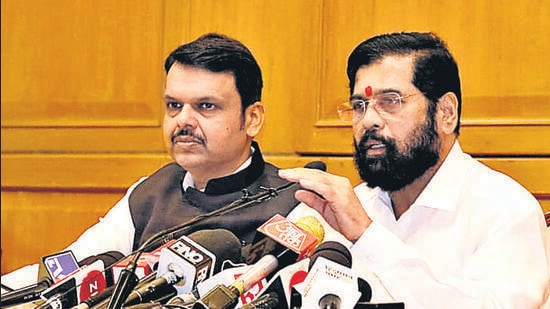
This, in a nutshell, sums up the personalities and styles of chief minister Eknath Shinde and deputy chief minister Devendra Fadnavis, whose government completes 100 days today.
Though Shinde (58) is CM, his deputy’s firm grip on the steering wheel is evident. This dynamic started when Shinde was minister for public works (public undertakings) in the Bharatiya Janata Party (BJP)-Shiv Sena coalition government of 2014-2019, led by Fadnavis (52).
It wasn’t an easy start. In 2017, upset that his ministry was being overrun, Shinde threatened to quit. Once Shinde began work on Fadnavis’s pet project, the Mumbai-Nagpur Samruddhi communication expressway, all prickliness melted. The ₹55,000-crore project of the 701 km-long access-controlled expressway that runs through 14 districts, with industrial hubs along its length, could potentially change the face of Maharashtra and in Shinde, Fadnavis found a minister who was willing to implement his vision.
The working equation between the two remained unchanged even after the BJP and Sena parted ways following the 2019 elections. Even now, despite a reversal in roles, Fadnavis enjoys complete command over the government.
Both Shinde and Fadnavis work long hours: people close to Shinde claim that he sleeps only for three hours a day, working till 3 am on most days. Fadnavis earmarks his time for political, administrative and party work. He spends a sizable amount of time on social media too, officials close to him said.
Shinde is more of a grassroots politician. At present, he’s busy trying to wean leaders away from the Shiv Sena to buttress his claims of representing the “real” Sena and meeting people who throng outside his official residence, obliging many with a selfie. Indeed, the joke in the corridors of power is that Shinde probably meets more people in a day than former CM (and Shinde’s ex-boss) Uddhav Thackeray did in the two-and-half years of his tenure when the Maharashtra Vikas Aghadi (MVA) government was in power.
During the recent Ganeshotsav festivities, Shinde’s priorities were obvious when he went pandal-hopping. Leaders of his faction admitted that he hardly refused any requests to visit a mandal. He also drove strategy when it came to reaching out to Ganesh mandals and Navratri mandals with sponsorships. These groups, which have strong roots in the working class and local communities, perform a crucial role during the elections.
“Eknath Shinde’s priorities may be different because of the uncertainty over the fate of his faction, but he lags in administrative acumen which could damage his image as the leader in the long run. After all, the performance of any CM is judged from his command over the administration, though his performance in elections fought under him is also a parameter of success,” a senior bureaucrat who has worked closely with both politicians, said.
“Fadnavis is more organised, disciplined and commands the administration without compromising on his political commitments. He is also popular and calls the shots in his party which is almost three times bigger than the Shinde camp,” he said.
“(Fadnavis) has left a clear imprint through the decisions made in past three months, be it a reversal of the construction of the Metro carshed, the ex-gratia package to farmers or the massive reshuffle of the IAS officers last week,” he said.
There is a good reason for this, a senior IAS officer said.
“He has deep knowledge of the bureaucracy and the styles of working of IAS and IPS officers. This leads to him being both, respected and feared by them,” the officer said.
“Fadnavis is updated on every front, from political developments to happenings in the administration. The portfolios he holds -- home and finance – help him stay centre-stage in decision-making. Almost every policy decision needs to be cleared by the finance department, while intelligence inputs he gets as home minister gives him pulse of the political scene,” another IAS officer said.
“Fadnavis controls much of these appointments—directly or indirectly--with care being taken to see that those who worked with Congress and NCP ministers are not re-appointed as personal secretaries, personal assistants or officials on special duty (OSD),” a former officer on special duty said.
<Complementary … for now>
This division of labour, as it were, seems to have worked for Shinde and Fadnavis in their new coalition government. But, as leaders from both camps admit, potential flashpoints exist between the allies.
For one, the BJP, which has conceded the CM’s chair to Shinde despite being thrice the size of the Sena faction, controls crucial portfolios like home, finance, water resources and rural development. The Shinde camp which is more of a loose coalition of legislators who have coalesced around Shinde rather than a political party, has several aspirants for ministerial berths with too few positions to go around. Already, there are whispers that some Shiv Sena ministers who jumped ship to Shinde are unhappy at being given a “raw deal” with portfolios of less significance.
Differences have emerged but both leaders have successfully covered them up, for now. “In case differences go haywire, Fadnavis could have an upper hand not only because of his charisma but also owing to our strength in the state,” a BJP leader said requesting anonymity.
“The BJP did not support the coup to topple the Maharashtra Vikas Aghadi (MVA) government to make Shinde chief minister. They did so because they wanted to run us to the ground. When they feel that this purpose is served, they may dispense with Shinde,” a Shiv Sena leader noted.
“Eventually, Shinde may have to merge his group with the BJP and Fadnavis may try his best to undercut and weaken him so that he is not a threat to his prospects. Some leaders from the Shinde camp like former legislators Vilas Tare and Amit Ghoda from Palghar have joined the BJP. Shinde is relentlessly targeted by the Sena with memes on social media [over things like his subservience to the BJP leadership] but it must be noted that the BJP’s troll army has not risen to his defence,” the Sena leader said.


