
 E-Paper



World Owl Awareness Day: 40% of respondents still afraid of owls, says survey
Due to road accidents having drastically reduced during the lockdown period and human exclusion from the environment, owl sightings had become more frequent


Even as “World Owl Awareness Day” was recently celebrated on August 4, an ongoing research paper to be published on how people perceive the owl by Dr Satish Pande, honorary wildlife warden of the Ela Foundation, has found that 40% of people are still afraid of owls and believe that they are a bad omen.
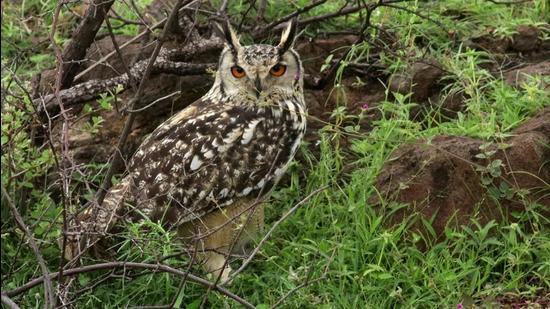
“It is indeed shocking to know that even in this era, people still have mixed perceptions about this bird which is also looked upon as the vehicle of Goddess Laxmi. Some are extremely afraid while some harbour superstitions about the owl, whether they are educated or otherwise. We have surveyed people from all strata: farmers, shepherds, professionals, teachers and students,” Dr Pande said. “It is very important to be more sensitive towards owls and get rid of superstitious beliefs about them. There have been stray incidents of owl trapping that were addressed immediately,” he added.
Dr Pande has spent several years studying the mysterious bird. “Under the Ela Foundation, we conduct studies and long-term surveys of owls in western Maharashtra using the ‘nearest neighbour distance method’ confirmed by G-statistics. There are four species found in western Maharashtra that are often seen in the Purandar area. As per our surveys, the population density of the Indian Eagle Owl is one pair in every 4.5 to 6kilometre of suitable habitat; that of the Motted Wood Owl is one pair for every 5.5 to 8kilometre; and that of the Spotted Owlet is one pair in every 2.5 to 4.5kilometre. The oft-seen species is the Barn Owl; these birds are common in human-occupied urban and rural areas and their population is higher, proportional to the availability of garbage, open drains and litter frequented by rats and bandicoots,” Dr Pande informed. Pune constitutes a suitable habitat for every species of owl that is closer to urban and human-occupied areas, he said. The Indian Eagle Owl is found in open, hilly areas; the Brown Fish Owl near permanent water bodies; the Motted Wood Owl on cropped land; the Spotted Owlet in deciduous forests and fringe areas habituated by humans; while the Brown Wood Owl is found in evergreen forests, he added.
Apart from the species of owl found in the state and their habitat, Dr Pande raised concerns over the increasing number of owls being found morbid or dead due to consumption of rodents that have ingested pesticides and reduction in the owl population due to their territories including fallow lands, croplands and hills being diverted for urbanisation. Several previously occupied owl habitats are now sadly empty, he pointed out. “Owls are nocturnal and are facing serious problems mainly due to human intervention in their habitats, chemicals, electrocutions and road accidents. Due to road accidents having drastically reduced during the lockdown period and human exclusion from the environment, owl sightings had become more frequent,” he said. During the lockdown, the elusive Brown Fish Owl was spotted in Purandar taluka while Brown Wood Owls were seen on several occasions in the western ghats around Pune, he added.


