
 E-Paper



Centre earmarks ₹363 crore for film restoration project under National Film Heritage Mission
PUNE Union minister of information and broadcasting Anurag Thakur during his visit to Pune on Thursday announced that the film restoration project under the National Film Heritage Mission (NFHM) with a budget of ₹363 crore has been cleared by the ministry

 Prefer HTon Google


PUNE Union minister of information and broadcasting Anurag Thakur during his visit to Pune on Thursday announced that the film restoration project under the National Film Heritage Mission (NFHM) with a budget of ₹363 crore has been cleared by the ministry.
The National Film Heritage Mission launched in 2016 is aimed at preserving, restoring and digitising our cinematic heritage. According to Thakur, a decision was taken on Wednesday to the effect that, “Out of the total outlay of ₹597 crore earmarked for this mission, ₹363 crore will be utilised exclusively for restoration purposes, making it one of the world’s largest film restoration projects.”
The NFHM in addition to restoration also involves the ongoing preservation processes of film condition assessment, preventive conservation and digitisation with the total allocated budget of ₹597 crore, which is one of the world’s largest film preservation missions.
“It is Prime Minister’s Narendra Modi’s vision to prioritise preservation, protection and promotion of India’s rich cultural heritage and films constitute an important part of this heritage,” Thakur said during his visit to the National Film Archives of India.
According to the minister, the process of restoring over 5,900 short films, documentaries and features is underway and this exercise carried out by the NFAI “proves to be one of the world’s biggest restoration, conservation, preservation and digitisation processes undertaken.”
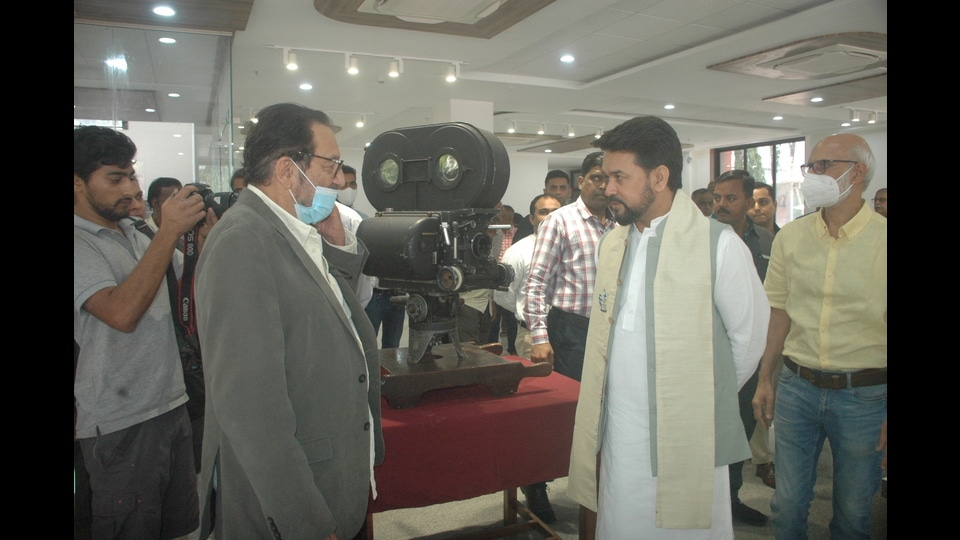
The restoration project now awarded is set to commence at the National Film Archives of India (NFAI), which the minister visited. The process involves frame-to-frame digital and semi-automated manual picture and sound restoration from the best surviving source material. The source negative or print will be scanned at 4K to .dpx files, which will be then digitally restored.
“The damages including scratches, dirt and abrasions in every frame of the picture negative will be cleaned during the restoration process. The sound will also be restored in a process similar to the picture restoration procedure. The numerous pops, hisses, crackles and distortions on the sound negative will be digitally removed. After restoration, the digital picture files will be color graded (DI process) and balanced to achieve the look of the film at the time of the original release,” NFAI said in a press statement.
In the interim, the NFAI undertook restoration of 10 prestigious Satyajit Ray films which will be subsequently showcased at various international film festivals. Of which, Pratidwandi has been selected by Cannes to premiere in the Cannes Classics Section of the 2022 edition. A restored version of G Aravindan’s 1978 Malayali film Thamp will be showcased at Restoration World Premieres in Cannes by the Film Heritage foundation.
Under the NFHM, approximately 2,200 films will undergo restoration. The titles have been shortlisted by forming language-wise committees consisting of filmmakers, documentary filmmakers, film historians, producers etc. Eminent film personalities such as Aparna Sen, Shriram Raghavan, Anjali Menon and Vetrimaaran are part of these committees.
Beyond Satyajit Ray films, feature films as diverse as Neelakuyil (Malayalam) and Do Aakhein Barah Haath (Hindi) will also be covered. Extremely important shorts and documentaries from the collection of NFAI, films division and other rare materials, including pre independence, will also be restored as they capture the growth of India like no other.
Indian cinema, which has been in existence for more than a hundred years now, holds a very unique place in the pantheon of world cinema. The restoration of Indian films will once again give a chance to the current and future generations to relive the glory of these films which have enamoured audiences for decades.


