
 E-Paper



Civic Sanskriti: To live to 80, #love30... kmph, that is
The speed permitted by the Ministry of Road Transport and Highways in urban areas is 70 kmph. However, urban roads in our cities can’t be designed for 70 kmph, like highways.


Need for Speed. Fast cars. The Rat Race. The city that moves. We’ve glorified speed.
Sometimes speed is essential – ambulances can save lives. Rapid response to crises is crucial.
But, speed is known to kill:
-The likelihood that a pedestrian will die if hit by a car travelling at 30 kilometres per hour (kmph), is less than 10%.
-The certainty that a pedestrian will die when hit by a car moving at 50 kmph is more than 80%.
Speeding on roads may be causing more than 67% of the deaths in cases of road accidents in India.
The speed permitted by the Ministry of Road Transport and Highways in urban areas is 70 kmph. However, urban roads in our cities can’t be designed for 70 kmph, like highways. No wonder, globally, India has the worst record on road safety.
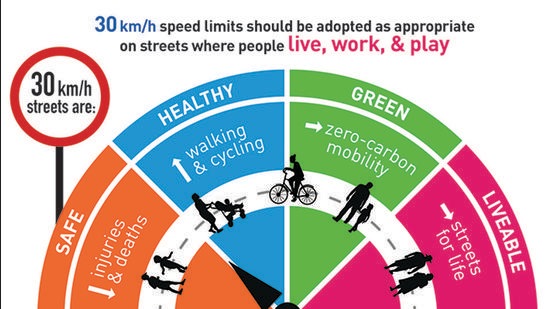
The message of the UN Global Road Safety week, from May 17 to May 22, is “Love 30”, signifying that 30kmph, maximum, should be the default speed in residential areas.
Road safety advocates Pranjali Deshpande, Ranjit Gadgil and Harshad Abhyankar, suggest a few key measures, to be taken up jointly by PMC, PCMC, traffic police and highways authorities.
1) Safe pedestrian paths and crossing facilities, speed control by traffic calming measures like raised pedestrian crossings, change of road texture, rumble strips and use of roundabouts, as recommended by the Transport Research and Injury Prevention Programme (TRIPP) at IIT Delhi.
2) Special safety features and designs based on the road hierarchy for different kinds of roads, and zones which require a higher degree of care, such as schools and hospitals.
3) Review road safety in every ward, with neighbourhood groups, and especially with children, women, people with disabilities, pedestrians and cyclists; and introduce signage and traffic calming measures.
4) In line with the recommendation by the UN and WHO, speed limits on roads in Pune should be 30 kmph or lower.
5) The speed limit on arterial roads may be increased to 40 or 50 kmph, after a road safety audit and implementing safe road design and management systems to prevent fatalities.
6) Widespread publicity of the speed limit.
7) Widespread and effective enforcement by Traffic Police.
It is appreciable that the municipal road department has already initiated construction of pedestrian crossings at certain locations. Such measures must be in place on priority as they help to save lives.
TRIPP suggests that the 30 kmph limit in residential areas may be enforced by the judicious use of speed breakers and roundabouts. Arterial roads may have 40 to 50 kmph limits, enforced by road design and police monitoring. Service lanes along all four-lane highways and expressways should be constructed for use by low-speed and non-motorised traffic.
In some time, when lock-downs are lifted, can the city that emerges be a slightly slower, friendlier, more humane city?
Many of us have faced so much loss already. The lockdowns have also slowed the pace of life. We want to move forward, post-Covid.
Yet, let us not lose the lessons from last year - when lockdowns were lifted, there was a surge in road accidents. Roads with lighter traffic and poor lighting, with speeding vehicles, may be the most dangerous post-lockdown.
This time, if any safety measures can be constructed in advance of the re-opening, that would be best. Otherwise, when lockdowns are lifted, traffic calming measures with barricades can be used as an immediate measure on city roads and highways, to be followed by proper road safety measures.
Our political leaders, the municipal administration and Traffic Police must show us the leadership we need to save lives through a city-level road safety strategy followed by concerted action.
A “safe system” approach to road and traffic management with all relevant authorities acting together to enable mobility without deaths and serious injuries is what Pune urgently needs.
Speedy adoption of this approach will save lives!
Those interested in joining initiatives by local NGOs may get in touch with this writer for taking up and strengthening neighbourhood road safety plans and actions.


