
 E-Paper



Curtain Call: The story of adapting for stage
One thing that I realised involuntarily after adapting this story (“Cycle”) in a play is that the most important thing is to envision and build the world the story is set in. The craft of writing and staging will follow when that choice is made, says Nipun Dharmadhikari, story teller


I have written a few plays some years back, but I know I am not a writer. But at the same time, I would say that if I had some source material at hand, the process becomes relatively easy for me. Though it’s been a few years since I have written a play, I would like to talk about my personal process of adapting a story into a play.
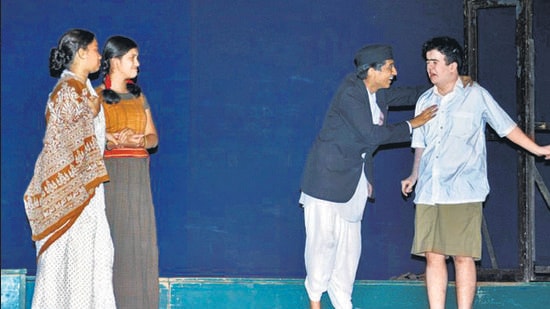
The first play that I adapted and directed was a short story named “Cycle” by a renowned writer in Marathi, Vyankatesh Madgulkar (I am about to narrate the gist of the entire story here, so in case you want to experience the story in its original form first, please refer to his book called “Jaambhlaache Diwas”). “Cycle” is about a school teacher in Pune who has promised a bicycle to his son if he secures the first rank in class. The son keeps securing it for three years and the teacher is still unable to afford it, making him feel extremely guilty.
Finally, he buys a used cycle on a whim making his son extremely happy and reliving himself of the guilt. But the teacher finds out that one of his own students has died in a road accident while riding that same cycle and his happiness turns to fear. When he returns home that evening he finds his son absent and the cycle missing. His wife and two daughters are crying at a corner and he fears the worst! They are too afraid and distraught to tell him anything. But seeing his desperation, his wife finally breaks her silence and tells him the truth – their son has lost the cycle and has gone outside to search for it! The son returns home, unsuccessful in his attempt at retrieving it. He looks at his father, waiting for him to explode. But the teacher seems happy instead, leaving the entire family pleasantly confused!
The descriptions of the teacher’s state of mind at various places were heart-wrenching. It had transported me to the world of the protagonist and I was so engrossed that by the end of it I felt this gush of warmth in my heart.
The minute I heard it, I knew what the scenes were going to be. The overall scene outline wasn’t a challenge. The real challenge was getting the craft of conveying the emotions. During that period of time I was personally not fond of a narrator in a play. I used to find that format of writing extremely escapist. Of course, I do submit that it was my lack of experience back then. The plays which had a narrator who spoke directly with the audience, that I had read or seen by then, did not hold my interest. Since then, I have come across plays that have used that format really well. Anyway, so I had decided not to use this format. Then, the question arose – how to convey the information in the story which is written as the mental turmoil of the teacher? He doesn’t express his emotions to anyone in the story!
So, I introduced new characters and new situations that would make the protagonist speak his mind. To give an example, in the first scene itself, when his son tells him that he has secured the first rank, the teacher gives him a chalk as a prize. Even the son accepts it gracefully and leaves. All this is witnessed by a school peon who notices to his surprise that the teacher doesn’t seem too happy about this. When he asks the teacher about it, he reluctantly confesses what his predicament is. It is the peon that encourages the teacher to just go and buy a bicycle and get done with it. This, I believe, is a catalyst for the next scene where he actually purchases it. He finally expresses it to someone and when that person, one who is economically weaker than him, tells him to go for it, really sets the ball rolling.
When he learns about his deceased student, the teacher goes through a roller coaster of emotions about how fast youngsters ride their bikes and how can they be so careless and not worry about their parents. For these emotions to come out, we had a new situation wherein, when he is thinking about all this at a bus stop, a school-going kid falls from the cycle in front of him. This triggers the teacher and the emotions flow through words aimed at the student in front of him but the subtext really is different.
One thing that I realised involuntarily after adapting this story in a play is that the most important thing is to envision and build the world the story is set in. The craft of writing and staging will follow when that choice is made. This helped me a lot when I adapted two more stories of extremely different genres — “Baapjanma” and “Dalan”. But more about that in the next segment.
Nipun Dharmadhikari is a storyteller and looks forward to telling them on stage, in front of the camera or in person.


