
 E-Paper



Early Punekars hunt & fish… and settle down!
Environment of Pune started to change around 10,000 to 4,000 years ago due to strong monsoon, says Saili K Palande-Datar

 Prefer HTon Google


Dr DD Kosambi was no ordinary man who saw the connections of living communities and long-forgotten cultures in his backyard of his home in Pune. As a polymath well versed in fields of Mathematics, Sciences, Numismatics, and Religion and so on, he is credited with extensive explorations in the vicinity of Pune. As he studied the spaces occupied by humble folk deities in and around Pune, he observed the material aspects of religious worships, their migrations and associated communities.
Kosambi is known for his unique Marxist approach to study of Indian history through critical analysis, changing means of production of various societies. It was no wonder that he took great interest when he stumbled upon the stone tools of prehistoric humans of Pune during his explorations. The ubiquitous stone tools and carved remains found in the vicinity of the primitive cult sites convinced him of the vibrant cultural association of certain communities with these prehistoric places.
Environment of Pune started to change around 10,000 to 4,000 years ago due to strong monsoon, leading to more water flows in the rivers, more black soil deposition and fertile landscapes. The vegetation around the river banks and valleys flourished, birds and animals bred providing better game, in turn to form the conducive atmosphere for man to not just survive, but also to thrive. This period hence saw significant rise in human and animal populations.
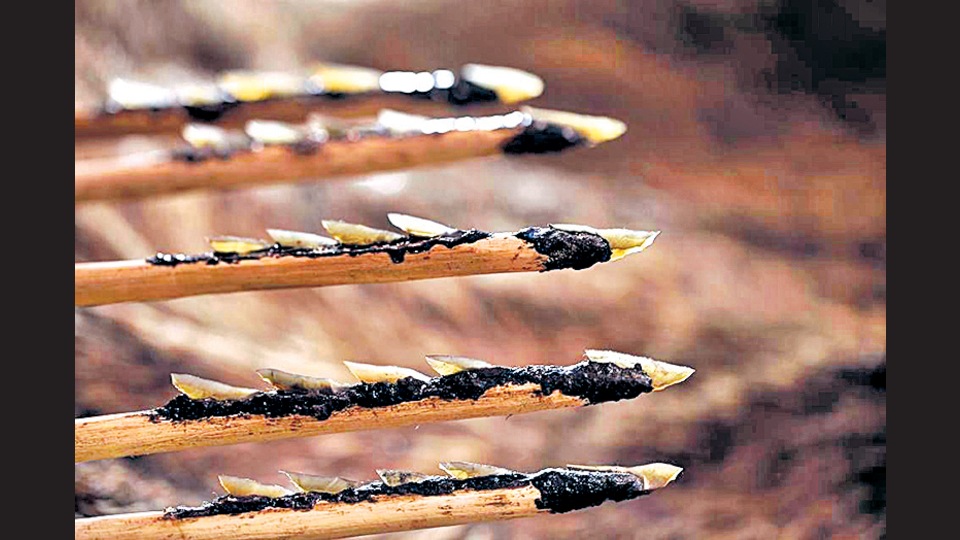
This Mesolithic period is generous in terms of availability of food, water and shelter. The tool technology changed from bigger awkward tools to smaller micro stone tools. In absence of metal objects, it was pertinent to use stones to get sharper, effective edges. The smaller parts were scraped from strong material such as flint, quartz, chalcedony, etc. These tools were sharper and are set in wood, horn or bone with gum adhesive to make a blade for cutting or piercing tool. Sickles, harpoons, javelins, arrows, knives, needles and many such tools were made with this technology. It is however not easy to date these tools accurately unless found in stratified context. But, as we see the environment of Pune in context of changing Deccan environment, it provides us with broad trends.
The prehistoric man is, thus, cutting the grain stalks, hunting fish, scraping the animal hide to make leather, stitching the leather, etc. The stone tools indirectly indicate the activities of cattle rearing undertaken on hills tracks of Pune and fishing done on banks of rivers.
Microlithic tools are reported from both east and west of Pune city, for example, Yavat, Bhosari, Loni, Dapodi, Jejuri, Saswad, Theur, Lohagad, Malavali, etc.
In Pune city, Kosambi reports such microlithic tools from Vetal hill, Law college hill, Pashan hill, near National Chemical Laboratory (NCL), Vaiduwadi in Pune. The continuous stretch of microliths extends towards east to great distance along hill ranges and river valleys. He has tried classifying these two locations in “high-land” and “low-land” cultures based on the crudeness and finesse of the tools found. However, these two varieties of tools may not necessarily represent two different kinds of groups.
As one goes further down the river valleys, the average technique improves; many of the specimens are works of art, some as delicate as fine surgical tools. Excavation and erosion show enough of the underlying soil to prove that there are no occupation layers, nor other artefacts such as pottery. A track normally runs along the bottom of the hill at the margin of the river valley.
These concentrations of microliths may indicate the seasonal fishing camps along the river pools. One such camp was seen near Poona Mental hospital.
Fishing would certainly provide supplement to the primitive diet, but human groups would have to look at main food source in hills of Pune near streams. Such areas around Vetal hill, Prabhat studio and NCL yield sizable microliths indicating human occupation. It would be temporary or seasonal as we do not find significant deposits of settlements representing more permanent occupation.
These moving communities are the proverbial ancestors of nomadic Dhangars we see today, moving along the same tracks. Agriculture is not in picture yet, but one sees a prominent shift towards cattle rearing, harvesting the wild grasses, fishing and hunting.
As we move further down the Pune’s timeline, we see human cultures in Deccan finally settling down owing to the best environmental conditions. This period is part of proto-historic period of India. Proto history is sandwiched between pre-history and history where some cultures have developed literacy, but is not known to other cultures.
This advent of literacy provides a whole new meaning to existence of humans as a civilised society. Between the evolution of script and first historians writing, proto-historic period marks the further development from Stone Age.
In northern India, proto-historic period marked by development of first civilisation, the Harappan civilisation. Through presence of the internationally used Harappan script which is yet convincingly deciphered, we get an idea about zenith of urban development they had achieved.
This is also the time when Copper is discovered and harnessed by human cultures, thus, leading to combined use of Copper and stone underlining the Chalcolithic culture (2450 BCE – 900 BCE). Contemporary to and slightly later than Harappan culture, numerous Chalcolithic sites in Deccan practised irrigated agriculture through improved tool technologies. In Pune district alone, archaeologists have extensively studied Chalcolithic sites at Inamgaon, Walki, Chandoli, Theur, Koregaon Bhima, Songaon, through excavations. Padmashri Dr M K Dhavalikar is internationally applauded for his landmark study into the social aspects and early farming cultures of Deccan at the site of Inamgaon in Pune district.
However, till recently, Pune city had not reported any significant Chalcolithic remains in or around the city which did raise important questions about continuity of human habitation in Pune.
But, to our collective delight, archaeologists Varada Kahaladkar and Manjiri Bhalerao during their yet unpublished survey have documented 3,000-year-old chalcolithic pottery from Sangvi in western Pune. This surely is exciting news and we hope that their work would unravel many more secrets pertaining to Pune’s settlements and chalcolithic culture.
Thus, so far from large tools wielding Paleolithic humans wandering around banks of rivers, we come to proto-historic man gaining firm footing on the grounds of Pune, gently spreading the wings to settle down permanently.


