
 E-Paper



Global Village Idiot: Sojourn to Goa and the reputation that Pune enjoys...
Pune has a historical aura of its own and much of it can be traced back to its development as the Maratha capital in the 18th century.


Pune: Every time I step out of Pune, I realise what a great reputation the city has in the eyes of the world. The moment people learn that I am from Pune, a positive vibe fills the air, their tones get hushed in respect, and without doing anything to earn it, I get to bask in the admiration that is bestowed on the city.
Cities, like nations and people, have an identity of their own. In fact, in millennia gone by, cities were the fulcrum around which states and empires were built. Ayodhya, Baranasi, Kaushambi, Athens, Sparta and Rome from the first millennia before the modern Christian Era; Delhi, Beijing, Istanbul, Venice in the medieval ages and Singapore in current age, are some good examples of powerful city-states.
In the 21st century, many cities are famous urban personalities and often lend their own characteristics and attributes to their inhabitants. New York is The Big Apple. My educated guess is that it is named so because it is the ultimate in opportunities, also therefore in material gains, and thus it probably rears tough, professional people who are focused on their goals. Which is similar to the City of Dreams, Mumbai. And so on.
Pune has a historical aura of its own and much of it can be traced back to its development as the Maratha capital in the 18th century. Across India (and many parts of the world) the mention of Pune inspires a warm, competent and sociable aura. And that was the exact vibe we picked up from everyone we met these past 10 days as we travelled across parts of Maharashtra and Karnataka to Goa and back. I had heard a lot about Sawantwadi and driving through it was an eye opener. It’s an idyllic well-developed little town with an old-warm charm and beautiful green landscape. It is a former capital of a Maratha princely state and has a palace and a lake. I wondered why I had never visited Sawantwadi so far.
Travelling through Maharashtra and Karnataka, I was struck by a common factor that I can probably generalise: away from the big cities, culture in India is an intimate integration of social, economic and religious life. You will see a temple at almost every kilometre.
On the Goa sojourn, I met lots of people from Delhi, Mumbai, Bengaluru, Kolkata, Amritsar, Goa, Jaipur, Jodhpur, Ranchi, Karwar, Sawantwadi, Asansol, Guwahati, among other places. People from many different cultural, religious and social backgrounds. All of them were curious about Pune, its educational institutions, opportunities for growth and its nurturing approach to all comers.
We had a similarly fabulous impression of the people we met from Goa. It’s an incredibly welcoming state, people are non-intrusive but very warm and agreeable. The manner in which the state has been developed is fascinating. The development model seems like a combination of government, private, community and individual initiatives. It has preserved its rural heritage and planned development around the natural ecological consciousness of the people. Goa has also preserved its religious diversity and related history of the region.
We made only four touristy stops. The first was the Goa Chitra Museum in Benaulim, which showcases three separate historical artefacts collections of Victor Hugo Gomes, an ardent restorer. We met Victor at the museum and learned about a fishing community preservation project that he has recently unveiled. The second was a pilgrimage to the Mahadev Temple at Tambdi Surla. Dedicated to Lord Shiva, it was built in the 12th century deep in the forests at the foothills of the Western ghats.
The third was a visit to the famous Fort Aguada, from where we made a hasty exit since there were tourists by the hundreds and very little by way of order.
The fourth was to the Basilica of Bom Jesus in Goa Velha (Old Goa), an incredible part of India’s contribution to the global Roman Catholic heritage. The Basilica has a great collection of relics, paintings, artefacts, the pride of which is the silver casket preserving the mortal remains of St Francis Xavier. Goa Velha is idyllic with knolls and hills and dotted with chapels and churches (like much of Goa). In fact, I would say Goa Velha was the fulcrum city around which the Roman Catholic Portuguese empire built its Asian dominions.
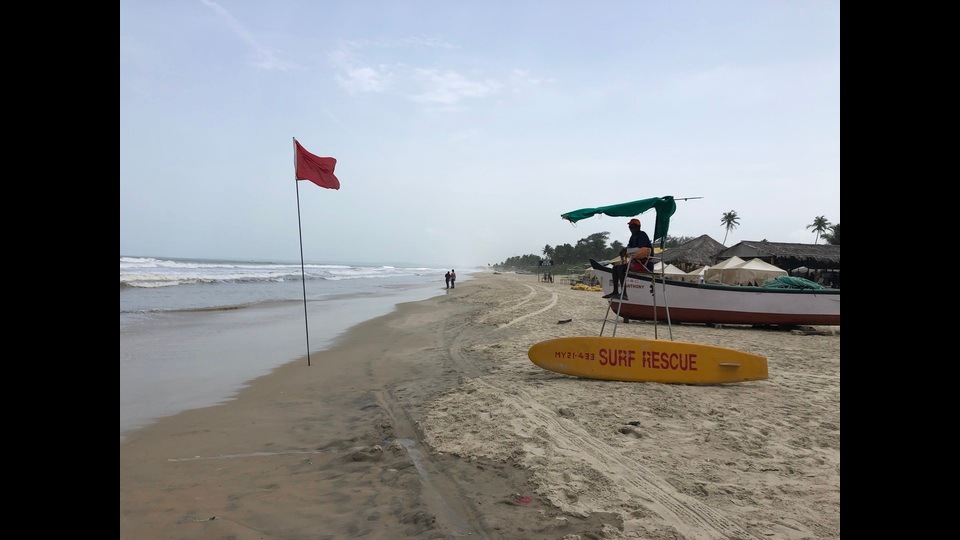
Beyond the history and heritage, Goa has a well-developed tourism industry built around its impressive array of beaches. The state also has a beach safety ecosystem and employs the dedicated and knowledgeable private agency, Drishti Lifesaving, to patrol and take care of lifeguard duties across all beaches.
We stayed in Benaulim and walked the beach at least a couple of hours every day. Apart from the fact that it is a pristine and untouristy stretch of the coastline in Goa, our confidence came from the alert lifeguards one could see every few hundred meters. The prominent red flags planted firmly on the dry sand, signalled to everyone the safety line.
I spoke to several of the lifeguards across the 3-kilometre stretch on various days. There are apparently more than 700 of them across Goa and they hail from Maharashtra, Goa and Karnataka. Most of the ones I spoke to were from Karwar and Goa. They are fit, well trained (I observed one of their extended training sessions and it was pretty intense) and vigilant. One of the senior lifeguard trainers was originally from Dakhineshwar near Kolkata. Overseeing the entire exercise was Colonel Austin Collaco, a retired Indian army officer.
Apart from all that I have already described, there are two reasons for which I am likely to consider the 10-odd hours drive to Goa again. First is the Goan fish thali and prawns fry at Jia’s Roochik restaurant in Pulvaddo, Benaulim (very close to Goa Chitra Museum). The husband-wife team of Jia and Praveen Naik started this quaint eatery during the pandemic and it is an absolute delight of local flavour. The second and really pressing reason would be to eat the Coconut Soufflé at Martin’s Corner in Binwaddo, Betalbatim. I can honestly say if there is heaven in any culinary dish, it is in the Coconut Soufflé at Martin’s Corner.
Mukherjee, author, learning-tech designer and management consultant, is founder of Mountain Walker and chief strategy advisor, Peak Pacific. He can be reached at thebengali@icloud.com


