
 E-Paper



Indian medical students in Ukraine stare at a bleak future
PUNE Two years ago, Anup Devtale had to face the daunting task of convincing his parents when he decided to go to Ukraine to study medicine


PUNE Two years ago, Anup Devtale had to face the daunting task of convincing his parents when he decided to go to Ukraine to study medicine. The main concern for the family was the expense of his medical education which they sorted out working on multiple options. While Devtale returned to India during the pandemic, he recently went back to Ukraine as offline classes resumed. Never did he imagine that he would have to return to India so soon, that too with no clarity about his medical course or future.
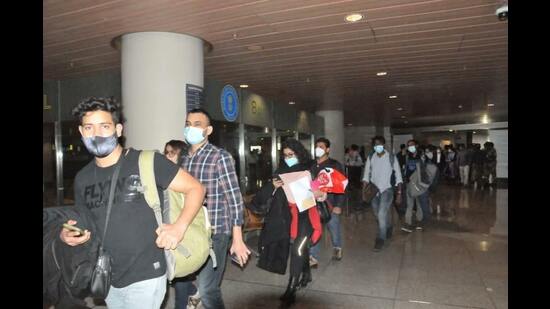
“When I came back to India last week, I was not much afraid but looking at the war situation now has forced me to rethink going back to Ukraine. Our university has stopped online classes till March 11 and given foreign students time to evacuate the country. We hope that online classes will start after March 11, but there is uncertainty about going back to Ukraine which depends upon the war situation,” said Devtale who hails from Kolhapur in western Maharashtra and is presently in his second year MBBS at the Bukovinian State Medical University (BSMU) located in Chernivtsi city in western Ukraine.
“We have not yet taken any decision and we as a family will discuss my studies as it will shape my future career. If everything goes back to normal, certainly I will go back to Ukraine but if not, we will have to look for other countries to transfer my admission,” said Devtale.
For many students like Devtale, it has been a difficult decision to go back to Ukraine to continue their studies only to now return to India due to the Russian invasion of Ukraine. Students who have returned over the past few days after war broke out are facing a huge dilemma: whether to resume online studies or look for alternatives in terms of countries to take admission for the next academic year. Similarly, Ukraine and Russia are now off limits for students looking to take fresh admissions in medical courses abroad.
Another student from Pune, Maharashtra, Roshan Gunjal, 20, said, “When I returned to India two days ago, my family and parents were relieved and they are not willing to send me back. But it is very difficult to change the university and go to another country for studies; many students like me have taken education loans and there are several government formalities to be completed before we can get admissions. There is a lot of confusion and at the same time, fear amongst students. If the offline classes resume, who will take responsibility for our safety and what if war breaks out again.”
India has already issued multiple advisories asking students to leave Ukraine. The Indian embassy in Kviv on Monday issued an advisory asking Indians “to make their way to the railway station for their onward journey to the western parts. The Ukraine railway is deploying special trains for evacuation.” The advisory asked all Indian nationals to remain “patient, composed and especially not exhibit aggressive behaviours at railway stations.” To make matters worse, the death of an Indian student in the eastern Ukrainian city of Kharkiv which has been hit by intense shelling, has further spread fear among students stuck in Ukraine as well as those who have returned to India this week.
The parents of these students are a worried lot. Ramesh Jalse, whose daughter is studying in a medical college in Ukraine, said, “We are ready to pay double the fees here in India but not willing to send our daughter back to war-prone countries. People are dying out there in Ukraine; students are running from pillar to post to save their lives and even if the situation gets better, there is always fear of war. Risking our children’s lives for the sake of their careers is not worth it and so, we have decided not to send her back.”
There are around 20,000 students stranded in Ukraine with 2,000 to 4,000 in Kharkiv alone, which is one of the worst-affected cities. Indians and other foreign nationals have been unable to leave most of the cities in eastern Ukraine, including Kharkiv and Sumy, as the country’s airspace has been closed since February 24. Rail and public transport services have also been disrupted in the eastern Ukrainian region.


