
 E-Paper



Maha foils 6,428 child marriages in 7 yrs; cases rise by 800% since 2018
Maharashtra has prevented 6,428 child marriages in seven years, but incidents rose 800% recently, indicating socio-economic pressures persist.


PUNE: Maharashtra has prevented 6,428 child marriages over the past seven years, even as the state continues to witness a sharp rise in such incidents. According to data from the Women and Child Development (WCD) department, the number of attempted child marriages detected in the state has increased by over 800 per cent—from 187 cases in 2018-19 to 945 this year between April 2025 and November 2025.
WCD officials said the steady surge reflects improved reporting along with persistent socio-economic pressures that push families, particularly in rural and tribal pockets, to marry off minors. The trend shows a year-on-year rise, with the pandemic years aggravating vulnerabilities that forced many families toward early marriage.
The cumulative figure of more than 6,428 prevented marriages and 516 FIRs highlights the scale of interventions during this period. According to data, WCD prevented 187 child marriages in 2018-19, 240 in 2019-20, 519 in 2020-21, 831 in 2021-22, and 930 in 2022-23. From here, there is a sharp jump in 2023-24 and 2024-25, when the state prevented 1,243 and 1,533 child marriages, respectively. Between April 2025 and November 2025, the state witnessed 945 cases.
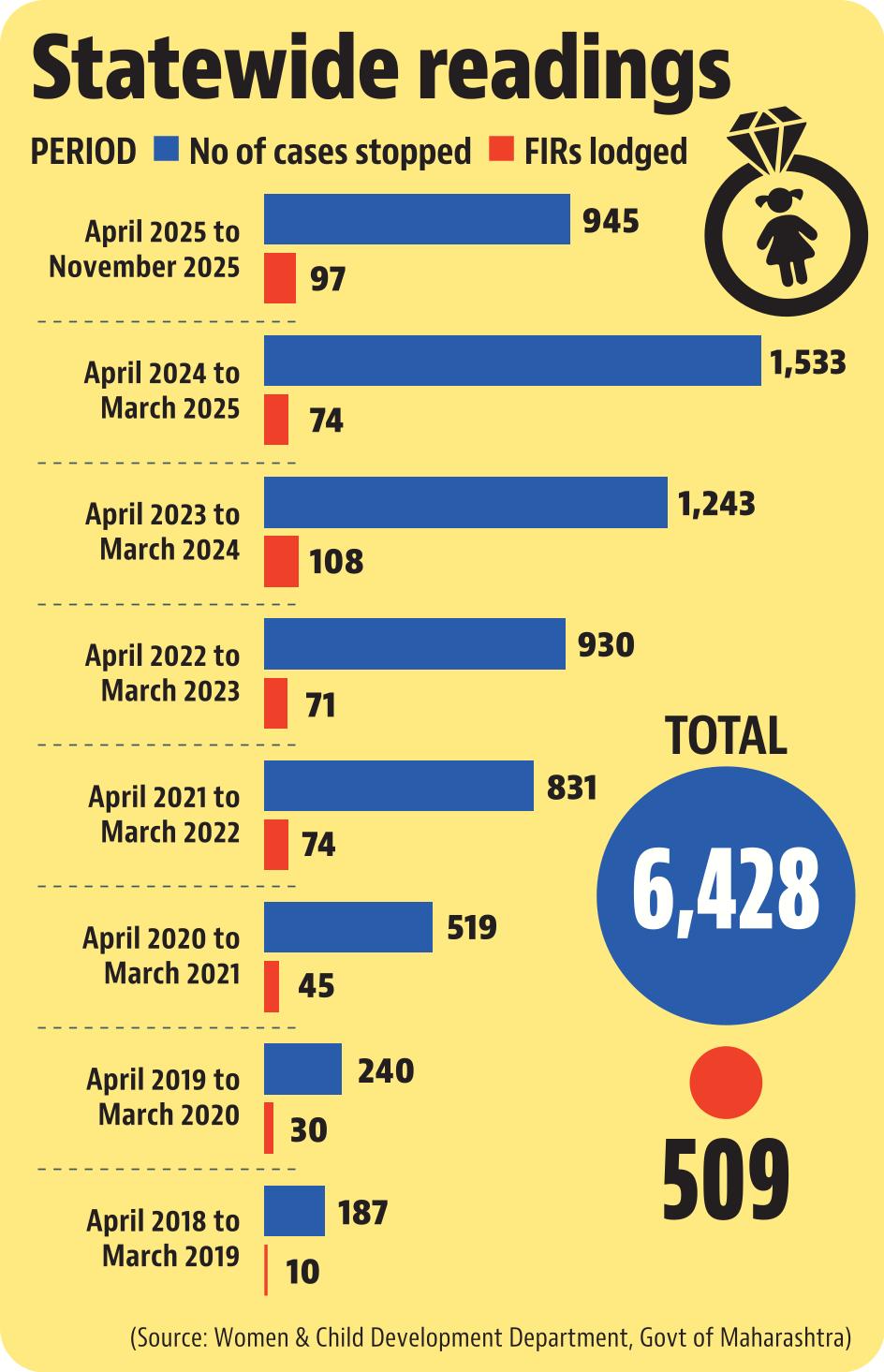
During the same period, 10, 30, 45, 74, 71, 108, 74, and 97 FIRs were filed, respectively, preventing child marriages. Between April 2025 and November, as many as 97 FIRs were registered across the state.
Women and Child Development (WCD) commissioner Nayana Gunde attributed school dropouts and poverty to the rise in child marriages. “Yes, in the last few years, we have successfully prevented over 6,599 child marriages and filed around 500 FIRs related to this. Apart from this, as per the Bal Vivah Mukt Abhiyan, we have appointed 25,562 Child Marriage Prohibition Officers (CMPOs) in rural and urban areas across the state.”
Gunde further said the WCD, in collaboration with UNICEF, has prepared a joint action plan. For its effective implementation, district-level task forces have been established in 12 districts, including Solapur, Chhatrapati Sambhajinagar, Hingoli, Jalna, Nanded, Dharashiv, Beed, Latur, Parbhani, Nashik, Dhule and Jalgaon. The task force functions under the chairmanship of the District Collector and includes the District Programme Officer of the WCD department (member secretary), the District Women and Child Development Officer, and others.
Yogesh Jawade, Assistant Commissioner, WCD Maharashtra, said the surge in prevention numbers reflects improved reporting and quicker intervention by CWC teams, particularly in rural and tribal regions. “This has helped check child marriages,” he said.
According to Jawade, gram sevaks in every Gram Panchayat have been appointed as child marriage prohibition officers for their respective areas. Anganwadi sevikas appointed in the Gram Panchayat area have also been designated to assist CMPOs.
Jawade said that at the district level, the district WCD office, District Child Protection Unit, Childline 1098, the Child Development Project Officer and other CMPOs work together to stop child marriages. Action is carried out through the District Child Protection Unit, voluntary organisations, and Childline.
Additionally, for the effective implementation of the Act, coordination is being maintained with various government and semi-government departments.
Although the numbers indicate a troubling rise, WCD officials said they also point to strengthened vigilance and greater community participation. Expanded field monitoring, village-level child protection committees and faster response systems have contributed to more cases being detected. Districts from Marathwada, Vidarbha and parts of North Maharashtra continue to record some of the highest numbers due to poverty, school dropouts and entrenched social norms. Some of the vulnerable districts are Beed, Parbhani, Jalna, Dharashiv, Nandurbar, Solapur and Nanded.
Child activist Ashok Tangde, who has been working for over a decade to prevent child marriages in Beed district, observed that in many instances, even after raids by WCD and police teams, parents continued the marriage by shifting the venue. As the head of the child welfare committee in Beed, Tangde introduced a system to address this.
“Based on our experience, during such raids, we now take the girl child into our custody and keep her at the Child Protection and Care Centre for a few days. During this period, we provide counselling. When the child spends these crucial days in the care centre, the parents are unable to mobilise their resources, and in most cases, the marriage gets cancelled,” Tangde said.
According to him, this issue is not restricted to rural areas; it is also seen in city areas where families from rural regions relocate. “There are several social and economic reasons behind child marriage. The patriarchal system, control over women’s sexuality, restrictions on decision-making, economic hardships, lack of alternatives, lack of awareness about harmful health consequences, ignorance of the law, and political apathy. Apart from these, many family, personal, religious or other reasons also lead to child marriages.”
For example, due to pressure from grandparents, some parents end up getting their daughters married early. In some cases, families fear a good marriage proposal might be lost. Sometimes, parents believe that if the girl is married young, she will adjust better in her marital home. There are also instances where parents feel the girl is not active, not performing well in studies or staying at home most of the time, and therefore decide to marry her off early, Tangde said.
Nandita Ambike, Child Welfare Committee Pune-2, said the 10th standard plays a major role in this behaviour. According to her, parents start thinking of marriage for the girl as soon as she clears Class 10. She said the 16-17 age group is very vulnerable for child marriages because parents are not aware of the law, particularly in lower economic strata where education plays a major role. According to her, to prevent child marriages, the government should involve various NGOs and private institutes.
Child rights activists, however, believe enforcement alone is not enough and stress the need for sustained efforts to improve girls’ education, vocational opportunities, and social support systems. They warn that without long-term solutions, families may attempt to conduct the marriage again once immediate surveillance ends.
The latest data presents a complex picture for Maharashtra. The state has successfully prevented thousands of child marriages, safeguarding minors from social and health consequences. Yet the sharp escalation in cases over the years underscores the need for deeper social interventions and targeted support for the most vulnerable communities.
Hindustan Times contacted one of the parents whose child marriage was foiled by authorities in Beed district. The parent, a sugarcane cutter, said that for most months of the year, they live in the fields of western Maharashtra, nearly 200-300 km away from their native village, leaving their children alone at home.
“We were worried about our children, especially our 17-year-old daughter, who had to stay alone,” the parent said. “To reduce our anxiety, we decided to marry her to the son of one of our relatives, who also works as a cane cutter. This would not only ease our worry but also ensure that she gets hired by the same contractor along with her husband. Contractors prefer hiring couples, so she would start earning and help support the family.”
The parent added that they did not want to lose what they considered a suitable match: “The boy was good, and we were not sure if she would get such a good life partner again in the future. So we didn’t want to miss the opportunity.”


