
 E-Paper



Making diagnostics easier for newborns
Amrita Sukrity discovered a need gap whilst shadowing doctors at a program organised by Ventre Center. Following that, she developed a solution to make testing easier for newborn children


Soon after graduating from IIT Kharagpur, Amrita participated in Pune Venture Center’s program that allowed young engineers to work closely with doctors and observe healthcare delivery in rural settings. It was here that she encountered a problem that stayed with her. “Diagnostics are very critical to healthcare. If diagnostics don’t work well, everything else can go awry. In small towns and villages, access was limited and turnaround times were slow. I kept asking myself why we couldn’t build something that narrowed this gap,” she says.
Where to begin?
Diagnostics is a very wide canvas, and where exactly could she start?
“I was particularly affected by the condition of neonates who are generally born small, weighing around 6-800 g. And doctors needed to draw 1.5 ml of blood to do most tests that are important for diagnosis and treatment. Every time a doctor needed to know the baby’s status, the pathologist had to draw 1.5 ml of blood. I felt that there should be an easy way of testing a neonate for say sepsis, which is a life-threatening situation,” she said. So, sepsis diagnostics it was.
Amrita had witnessed the tedious process of testing for sepsis while she was shadowing doctors at the Venture Center project. “It was quite painful for the neonate, so I wanted to find out what else could be painless and equally efficient at indicating the presence of sepsis? If not blood, then what else could be a reliable indicator of the sepsis levels in a neonate? Amrita got the opportunity to work on a research project with Dr Sandeep Kadam, a neonatologist at KEM Hospital, Pune.
“They were doing an exploratory research on the kind of tests that could be done on saliva to understand sepsis in neonates,” she said.
Amrita worked on that project for eight months with some direction toward her goal of making diagnostic tests less difficult for neonates. “While we could use saliva, we had to figure out what kind of markers could diagnose it? Which marker would help the clinician understand the immune status of the baby? We identified 4-5 markers. But there was another challenge. “Even to collect 10 ml of saliva from a neonate was difficult since their mouths are usually dry.”
This was in 2017. Amrita did further research with CMC Vellore with Dr Santhanam. She says, “We started evaluating 4 markers in blood and saliva to see how they worked. We found that they worked well in saliva and blood. But then Covid hit, so our work stopped abruptly.”
While the pandemic disrupted ongoing studies, it also led to a broader realisation. “Diagnostics weren’t just broken in extreme settings like NICUs. They were broken for everyone. Issues around access, dependence on central labs, turnaround time, and lack of meaningful interpretation became visible almost overnight,” Amrita says.
This period marked a turning point for SpotSense. Instead of focusing only on individual tests, the team began thinking in terms of diagnostic systems—tools, protocols, and software that could work across hospitals, clinics, and eventually homes. During this time, SpotSense continued working with Fernandes Hospital in Hyderabad, using saliva as a testing medium.
SpotSense’s technology consists of two key components: the assay and the device. Traditional lateral flow assays are typically optimised for a single sample type and a single marker, often producing qualitative or semi-quantitative results. SpotSense redesigned the lateral flow architecture so it could function across multiple sample types, maintain consistent flow despite variations in viscosity and composition, and support accurate quantitative measurements.
The team also re-engineered reporter molecules, not just at the chemical level but in how they behave physically on the test strip, to improve signal stability, reduce background noise, and enable reliable quantification rather than simple binary outcomes.
On the device side, SpotSense moved away from conventional photodiode-based readers, which are often sensitive to alignment issues, ambient light, and operator handling. Instead, the company developed an analyser that uses image-based signal capture combined with image-processing algorithms. This approach allows the system to correct for spatial non-uniformity on the strip, detect subtle signal gradients, and function reliably in real-world conditions where environments are rarely controlled. Fernandes Hospital later published a paper validating this technique.
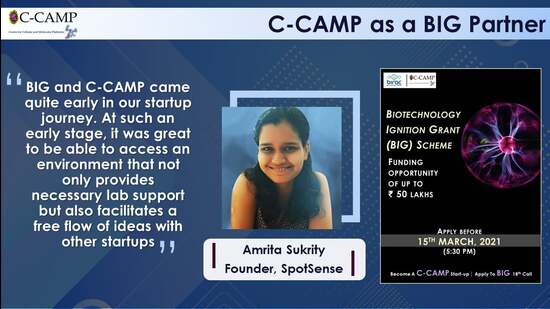
Amrita initially invested ₹15 lakh of her own funds to get the company off the ground. This was followed by a ₹5 lakh grant from Venture Center and a ₹50 lakh grant from BIRAC. SpotSense later raised ₹1.3 crore from a strategic investor who also became a customer, and subsequently raised ₹1.5 crore from India Accelerator. The company has generated revenues of around ₹3 crore so far, though it remains loss-making. Manufacturing of test kits is currently outsourced to a contract manufacturer. Amrita now plans to raise ₹5 crore in the next funding round, which will largely be used for research and development, clinical studies, and infrastructure to begin in-house production.
SpotSense currently targets two key customer segments. The primary market consists of clinics and small hospitals where laboratory access is limited, but clinical decisions need to be made daily, particularly for chronic conditions that require repeated quantitative measurements. The secondary market is at-home users managing chronic illnesses, preventive health, and follow-up testing between doctor visits.
Competition comes from established diagnostic companies such as Roche, Abbott, and Siemens, which offer robust lab-grade instruments but depend on controlled environments and are not designed for decentralised or point-of-care use. At the other end are single-test point-of-care devices that are affordable and simple but limited in scope and often lack clinical depth. SpotSense positions itself differently, offering multi-parameter, quantitative diagnostics designed for real-world settings. In the specific area of saliva-based diagnostics for newborns, the company currently faces no direct competition.
Looking ahead, SpotSense is preparing to launch an at-home self-testing device capable of measuring over 30 parameters. “The goal isn’t to replace doctors or labs,” Amrita says. “It’s to give clinicians and individuals earlier, more usable information for screening, monitoring, and follow-up.”


